
Can a spiral stairlift be installed on a staircase with no available load-bearing wall for support?
Yes, a spiral stairlift can often be installed without a load-bearing wall, because its bespoke rail is normally secured to the staircase structure rather than relying on the wall. An assessment is essential to confirm that the treads, landings and surrounding structure can safely support the rail, with alternative mounting supports considered where necessary.
Yes. A spiral stairlift can often be installed on a staircase without an available load-bearing wall because the rail is usually designed to follow and attach to the staircase itself, rather than being supported by a wall. The feasibility depends on the strength and condition of the treads, landings, central structure and any suitable fixing points.
Unlike a conventional straight stairlift, a spiral stairlift normally uses a bespoke rail shaped to the exact curve, gradient and changing width of the staircase. The rail may be fixed to the stair treads, structural landing areas or purpose-designed support posts. This allows the stairlift to remain stable through tight turns without requiring a wall alongside the stairs.
The absence of a wall does not mean that the balustrade, handrail or decorative surrounding structure can automatically support the installation. These parts may not have been designed to carry the combined forces created by the rail, carriage and passenger. An installer will therefore identify the actual load-bearing elements and select fixing points that transfer the load safely into the stair structure.
Depending on the staircase, possible arrangements may include:
- directly securing the rail to suitably strong stair treads;
- using brackets or plates designed for the particular staircase construction;
- installing support posts at the lower or upper landing where there is a suitable structural base;
- combining stair and landing fixings to provide a stable continuous rail; or
- adapting the rail design to work around the central column, balustrade and available walking space.
Every spiral staircase is different. Timber, metal, stone and composite stairs have different fixing requirements, while older stairs may need particular care if there is movement, deterioration or limited access beneath the treads. A central column can also affect the available route and may limit where brackets or supports can be positioned. The installer must check that the proposed fixings will not weaken the staircase or interfere with its normal use.
A proper survey should assess the full route rather than just the wall area. This normally includes the condition and construction of each relevant tread, the strength of the landings, the central support, the available headroom and the clearance between the stairlift, balustrade and surrounding walls. The survey should also consider where the user will get on and off, whether doors or passageways remain accessible, and whether the lift can be parked without obstructing the staircase.
Where direct fixing to the steps is unsuitable, a bespoke support arrangement may be possible, but it must be designed around the structure of the home. Extra posts, strengthened fixing points or changes to the rail route may be required. These options should only be confirmed after an in-person assessment; a photograph or general stair measurement cannot establish whether the structure can safely accept the proposed loads.
There may be cases where installation is not advisable. Examples include treads that are too weak or damaged, insufficient landing space, an unstable central structure, unsafe clearances or a route that cannot provide reliable support without substantial building work. In those circumstances, the surveyor should explain the limitation and identify whether structural alterations or an alternative accessibility solution would be more appropriate.
For this reason, a spiral stairlift should not be selected solely on the basis that it does not need a supporting wall. The important question is whether the staircase and surrounding structure can provide a secure load path for the complete system. Independent Stairlifts can assess the individual staircase, explain the available mounting approach and confirm whether a safe bespoke installation is practical before any fitting work is agreed.
A load-bearing wall is not always required for a spiral stairlift. Its bespoke rail can often be secured to structurally sound stair treads, landings or purpose-designed support posts, allowing the lift to follow the staircase without relying on the surrounding wall.
The fixing method must be chosen after an in-person survey. The installer will check the construction and condition of the stairs, central column, landings, clearances and available fixing points to confirm that the complete system can be supported safely. A balustrade or decorative handrail should not be assumed to provide adequate support.
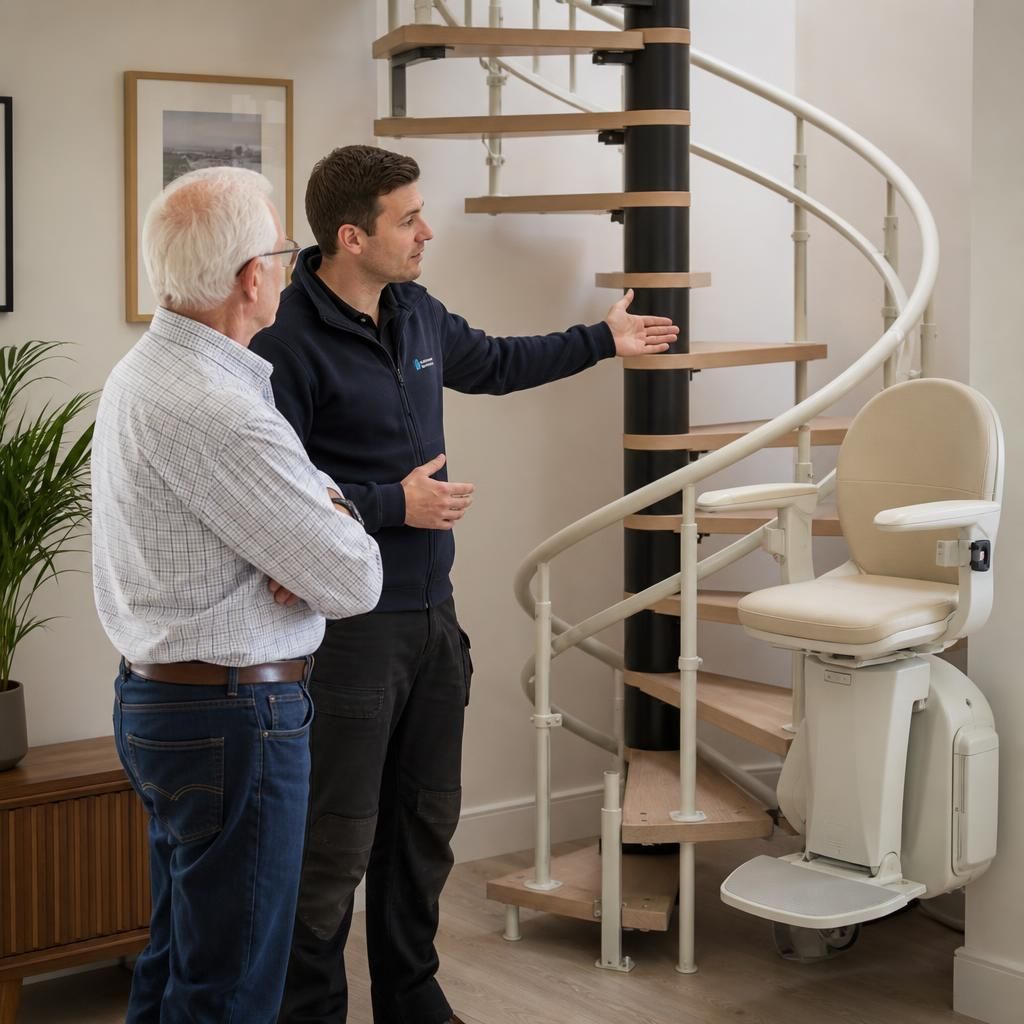
Arrange a bespoke spiral stairlift assessment
Arrange a bespoke spiral stairlift assessment with Independent Stairlifts to confirm whether your staircase can support a secure installation without a load-bearing wall. Our surveyor will assess the stairs, landings and available fixing points, then explain the most suitable options.