
What should I expect during a spiral stairlift installation at my home?
A spiral stairlift installation usually begins with a detailed home survey to assess the staircase, access points and your mobility needs. The bespoke rail is then fitted to the stair layout, followed by thorough safety checks, a demonstration of the controls and practical guidance on using and caring for your stairlift.
A spiral stairlift installation is a planned, bespoke fitting process rather than a standard rail installation. It normally starts with a detailed survey of your spiral or helical staircase, continues with manufacture or preparation of a rail shaped to the stairwell, and finishes with installation, safety testing and user instruction in your home.
The initial home survey
An assessor will examine the complete staircase and the surrounding areas, not just the stair treads. Spiral staircases can vary considerably in width, radius, tread depth, gradient and headroom, so accurate measurements are needed to determine the most suitable rail route and seat position.
The survey will usually consider:
- the direction and tightness of the staircase curve;
- the available stair width and clearance around the lift;
- headroom at bends, landings and entrances;
- the position of doors, hallways, radiators, furniture and other potential obstructions;
- where you will get on and off the stairlift;
- the most practical locations for charging points or parking positions; and
- your height, mobility, transfer ability and preferred method of using the controls.
The assessor should also discuss whether you will use the stairlift independently, whether somebody may need to assist you, and whether you need features such as a powered swivel seat, folding or powered footrest, harness, adjustable armrests or a different control arrangement. If the staircase is shared, rented or subject to building restrictions, any relevant permissions should be considered before work is arranged.
Agreeing the design and preparation
Following the survey, the proposed rail route and stairlift configuration should be explained to you. On a spiral staircase, the rail may need to follow the inner or outer edge, or a carefully calculated path through the curve, depending on the stair design and the clearances required. The aim is to provide a stable, comfortable journey while retaining as much usable staircase space as the property allows.
Some spiral stairlift rails are made or configured specifically for the surveyed staircase. This means the final design may not be confirmed until the measurements and access requirements have been assessed. You should receive clear information about the proposed equipment, where it will park, how you will transfer on and off the seat, and any preparation needed before the fitting team arrives.
Before installation, remove fragile items and unnecessary belongings from the staircase, landings and access route. Make sure the installers can reach the electrical supply and the areas where components need to be positioned. You may also be asked to arrange for pets, children or other household members to remain away from the work area while fitting is taking place.
What happens on installation day
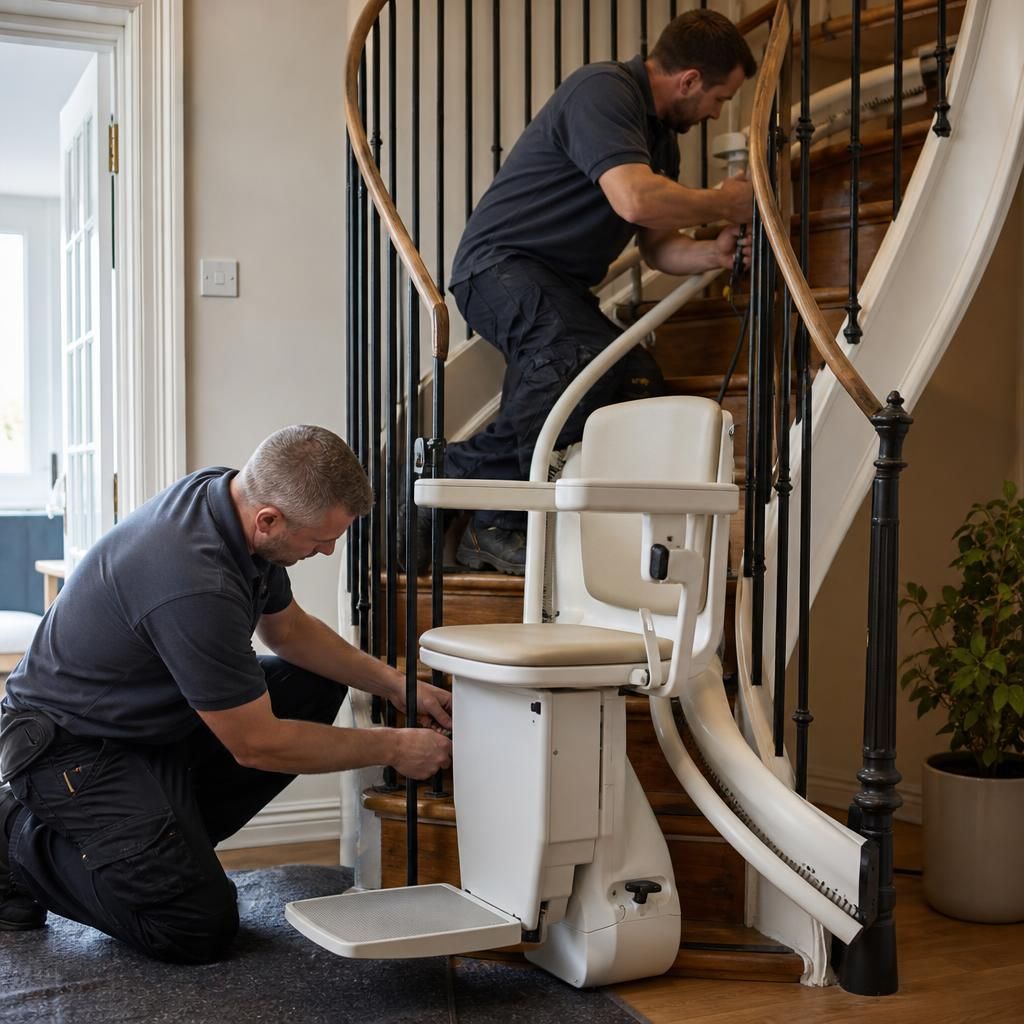
The installation team will first review the agreed layout and check the staircase and access route. They may protect nearby flooring, walls or furniture while components are brought into the property. The rail is then positioned and secured to the staircase or supporting structure in accordance with the equipment design. On a spiral stairlift, particular care is needed around the curve, because the rail must maintain the correct alignment and clearance throughout the journey.
The lift carriage, seat, footrest, controls and safety equipment are fitted to the rail. Charging equipment is connected at the agreed parking position or positions, where applicable. Installers will also check that the seat can swivel or fold as intended, that the footrest does not obstruct the staircase unnecessarily and that doors, handrails and access areas remain usable.
There may be some drilling and normal installation noise. The duration and level of disruption depend on the staircase, the rail design, access within the property and whether any electrical work or additional adjustments are needed. A competent fitting team should keep disruption controlled, explain any unexpected issue before making a change, and leave the working area clean and safe.
Safety checks and commissioning
The stairlift should not be considered ready for normal use until it has been commissioned and tested. The installer will check the rail fixings, carriage movement, stopping positions and clearances along the full route. They should also test the controls and relevant safety systems, which may include:
- the seat belt or harness, where fitted;
- seat swivel and locking mechanisms;
- the footrest and obstruction sensors;
- the on-board and remote controls;
- the emergency stop control;
- charging and battery operation; and
- any additional safety features provided with your particular model.
Testing should take place with the stairlift travelling through the whole spiral section, including its approach to the boarding and exit points. The installer should confirm that the lift stops correctly, that the seat is secure before travel, and that the controls respond as expected. If your installation has more than one user or remote control, each relevant control should be checked.
Demonstration and handover
After the technical checks, the installer should demonstrate the complete journey at a practical pace. You should be shown how to sit down safely, fasten the belt or harness, operate the controls, swivel the seat where applicable, stop the lift and leave the seat at the top or bottom of the staircase. You should also be shown how to use the remote control and what to do if the stairlift stops away from a charging point.
Ask questions while the installer is present, particularly if you are unsure about transferring on and off the seat, using the controls with limited hand strength, or positioning the footrest. If a family member or carer helps you, they should receive the same guidance. You should be given the user instructions, warranty or service information and the appropriate contact details for support and faults.
After installation
Keep the stairlift’s travel path clear and use it only as instructed. Do not carry more weight than the equipment is designed to support, allow other people to sit on the lift during travel, or use the stairs as a storage area. Keep the charging points accessible and follow the instructions for leaving the lift at its designated parking position.
Contact the support team if you notice unusual noise, jerky movement, repeated stopping, a warning light, reduced battery performance or difficulty with the seat, belt or controls. Do not attempt to adjust the rail, bypass a safety sensor or carry out electrical repairs yourself. Routine servicing and prompt reporting of faults help maintain safe operation and identify wear before it affects reliability.
A well-managed installation should leave you with a stairlift that fits the particular spiral staircase, has been tested throughout its route and can be used with confidence. If the completed installation differs from what was agreed, or if any part of the handover is unclear, raise it with the fitting team before relying on the stairlift independently.
During a spiral stairlift installation, the fitting team secures a rail designed for the staircase, installs the lift carriage and seat, and tests the complete route before handover. The curved section requires careful alignment so the stairlift maintains suitable clearance from the steps, handrails, walls and nearby fittings.
Before work begins, the installers should confirm the agreed rail route and protect the surrounding flooring or furniture. Once the lift is fitted, they will check:
- the rail fixings and carriage movement;
- stopping positions at the top and bottom of the stairs;
- seat swivel, locking and folding functions;
- the footrest, belt or harness and obstruction sensors;
- the controls, emergency stop and charging system; and
- clearance around bends, doors and access points.
You should then receive a practical demonstration, including how to transfer safely, fasten the restraint, operate the controls and respond if the lift stops away from its charging point. Ask the installer to repeat any part of the demonstration that is unclear, and make sure family members or carers who may assist you receive the same guidance.
Arrange your spiral stairlift installation assessment
Arrange a home assessment for your spiral stairlift installation so we can measure the staircase, discuss your access needs and confirm the most suitable rail and seat configuration.