
What safety features are included in spiral stairlifts to ensure user security?
Spiral stairlifts are designed with safety features such as a secure seat belt, swivel seat, obstruction sensors, controlled start and stop, and reliable braking systems. Depending on the model and staircase, they may also include powered footrests, safety edges, remote controls and battery backup to support secure travel during a power cut.
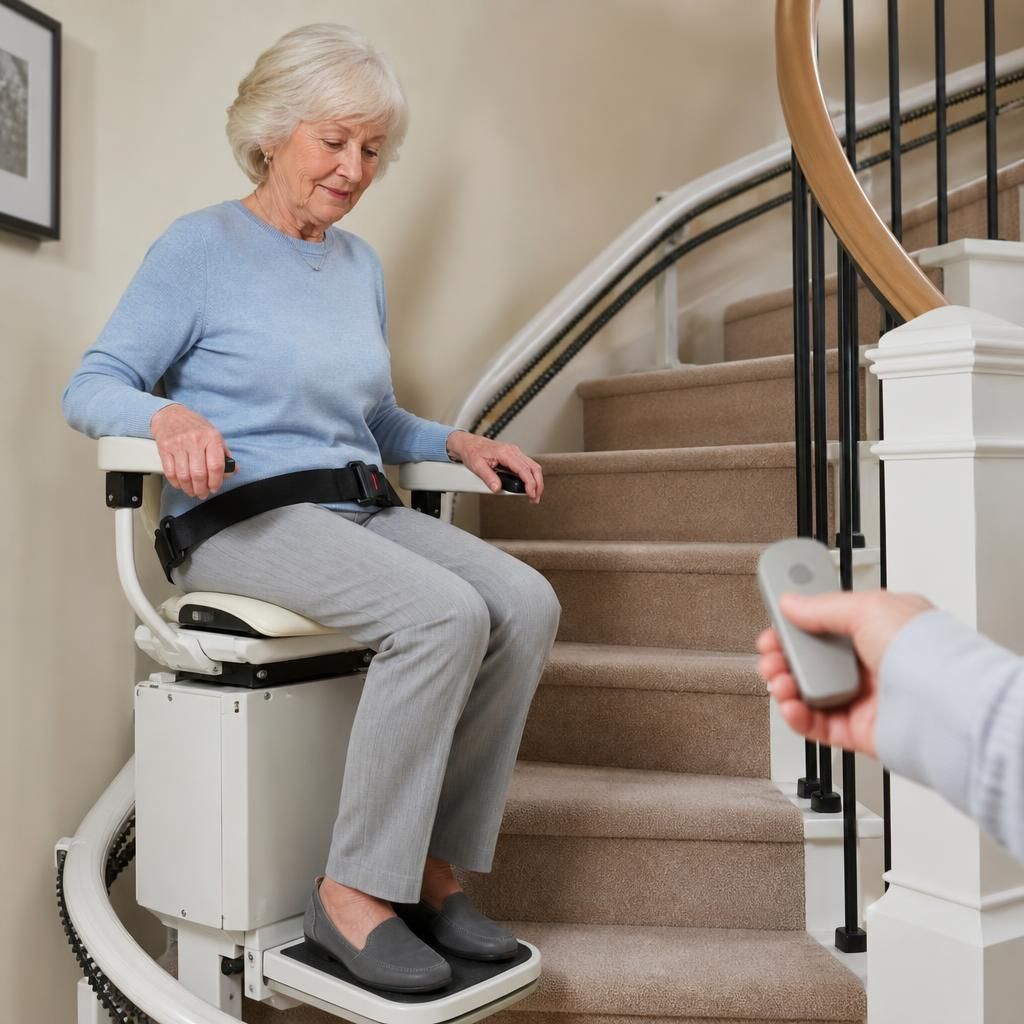
Spiral stairlifts include several features designed to keep the user secure while travelling around a tight, curved staircase. These commonly include a supportive seat, adjustable seat belt, powered swivel seat, safety sensors, controlled acceleration and braking, secure foot support, intuitive controls and battery backup. The exact combination depends on the stairlift model, the staircase layout and the user’s needs, so each feature should be confirmed during the assessment and fitting process.
Secure seating and restraint
A properly shaped seat helps the user remain stable while the lift follows the curve of the staircase. Armrests provide additional support, while a seat belt helps prevent the user from leaning or sliding forwards during movement. Depending on the model, the belt may be fitted with a buckle or other fastening designed for straightforward use. The belt should be fastened before travel and checked regularly for damage or wear.
Many spiral stairlifts have a swivel seat. At the top or bottom of the staircase, the seat can turn towards the landing, allowing the user to get on or off facing away from the stairs. This reduces the need to twist or step sideways at the most exposed part of the journey. A locking mechanism holds the seat in the correct position for travel and should be fully engaged before the lift moves.
Controls that reduce the risk of accidental movement
The armrest control is usually positioned so the user can operate the stairlift without reaching awkwardly. Controls are commonly designed for simple forward and reverse operation, with pressure needing to be maintained while the lift is moving. Releasing the control stops the stairlift. This gives the user direct control and allows them to stop promptly if they feel uncomfortable or notice an obstruction.
Remote controls may also be supplied, allowing the stairlift to be called to a different level when it is not parked nearby. They should only be used when the staircase is clear and the stairlift is being operated from a safe position. Some models include key switches or other controls to prevent unauthorised use.
Obstruction sensors and safety edges
Spiral staircases can contain narrow sections, changes in direction and features such as newel posts or radiators. Obstruction sensors help detect an object in the stairlift’s path. Safety edges or pressure-sensitive sensors may stop the lift if the footrest, carriage or another protected part makes contact with an obstruction. The stairlift should not be used to move furniture, household items or people standing on the stairs, and sensors should never be covered or bypassed.
Before every journey, check that the route is clear, particularly around the bends and at both landings. If the stairlift stops because a sensor has detected something, remove the obstruction only when it is safe to do so and follow the instructions supplied with the equipment. Do not force the lift to continue.
Smooth starting, stopping and braking
A spiral stairlift is programmed to start and stop in a controlled way rather than moving suddenly. Its drive and braking systems regulate speed as the carriage travels along the rail, including through curved sections. When the control is released or the lift reaches its destination, the brake holds the carriage securely. The rail, carriage and drive system must be installed and adjusted correctly for these safeguards to work as intended.
Powered footrests are available on some models. They can make it easier to fold the footrest into position without bending down and provide a stable platform for the feet during travel. Fold-away seats, armrests and footrests can also help leave more usable space on the staircase when the lift is parked, although the remaining clearance should always be assessed during installation.
Battery backup and fault protection
Most domestic stairlifts use rechargeable batteries and continue to operate for a limited period if the mains power fails. This can allow the user to complete a journey or reach a suitable landing rather than being left part-way up the stairs. The charging points should remain connected whenever the lift is parked as instructed, so the batteries are ready for use.
Many systems also include diagnostic indicators or audible alerts for conditions such as a low battery, an incorrectly positioned seat, a charging problem or a detected obstruction. These warnings should not be ignored. If the stairlift behaves unusually, makes a new noise, moves unevenly or fails to charge, stop using it and contact the service team for advice. Do not attempt to repair electrical, braking or drive components yourself.
Correct fitting is part of the safety system
Safety features are effective only when the stairlift is suitable for the staircase, correctly secured and adjusted to the user. During an assessment, the installer should consider the spiral staircase’s width, curvature, landings, clearances and fixing points, as well as the user’s height, mobility and ability to operate the controls. After installation, the user should receive a demonstration covering the belt, swivel seat, controls, parking position, charging and emergency procedures.
Keep the rail and steps clear, use the seat belt, travel facing the correct direction and follow the supplied operating instructions. Regular servicing helps confirm that sensors, belts, batteries, brakes and fixings remain in safe working order. If a user’s mobility changes, request a review rather than continuing with a set-up that has become difficult to operate safely.
Obstruction sensors are a key safety feature on spiral stairlifts. They detect objects in the carriage’s path and stop the lift if the footrest or another protected part meets an obstruction, helping prevent damage and unsafe movement around bends or narrow sections.
Keep the steps, landings and rail clear before every journey, and never cover or bypass a sensor. If the stairlift stops unexpectedly, follow the operating instructions and contact the service team if the route is clear but the problem continues.
Arrange your spiral stairlift safety assessment
Arrange a spiral stairlift safety assessment with Independent Stairlifts to confirm the most suitable features, fit and controls for your staircase and mobility needs.