
What makes a spiral stairlift safer than other types of stairlifts on the market?
A spiral stairlift may be safer than other types when its curved rail is individually designed to follow the staircase, providing a controlled, stable route around bends and landings. Safety also depends on correct assessment, professional installation and features such as a secure seat, seat belt, sensors and reliable braking, so the safest option is the model properly matched to your home and mobility needs.
A spiral stairlift may be safer than other types because its curved rail is designed to follow the exact route of a winding staircase, keeping the lift controlled through bends, changes of direction and landings. Unlike a standard straight stairlift, it does not require the user to transfer between separate sections of rail. However, safety is not determined by the stairlift shape alone. A properly assessed, correctly installed and well-maintained lift is the safest option for the individual staircase and user.
Why the design can improve safety
Spiral and other curved staircases can create risks for anyone who has difficulty with balance, strength or depth perception. The steps may narrow towards the centre, the handrail may change position, and the staircase may include tight turns or intermediate landings. Walking these sections can require repeated changes of direction and careful foot placement.
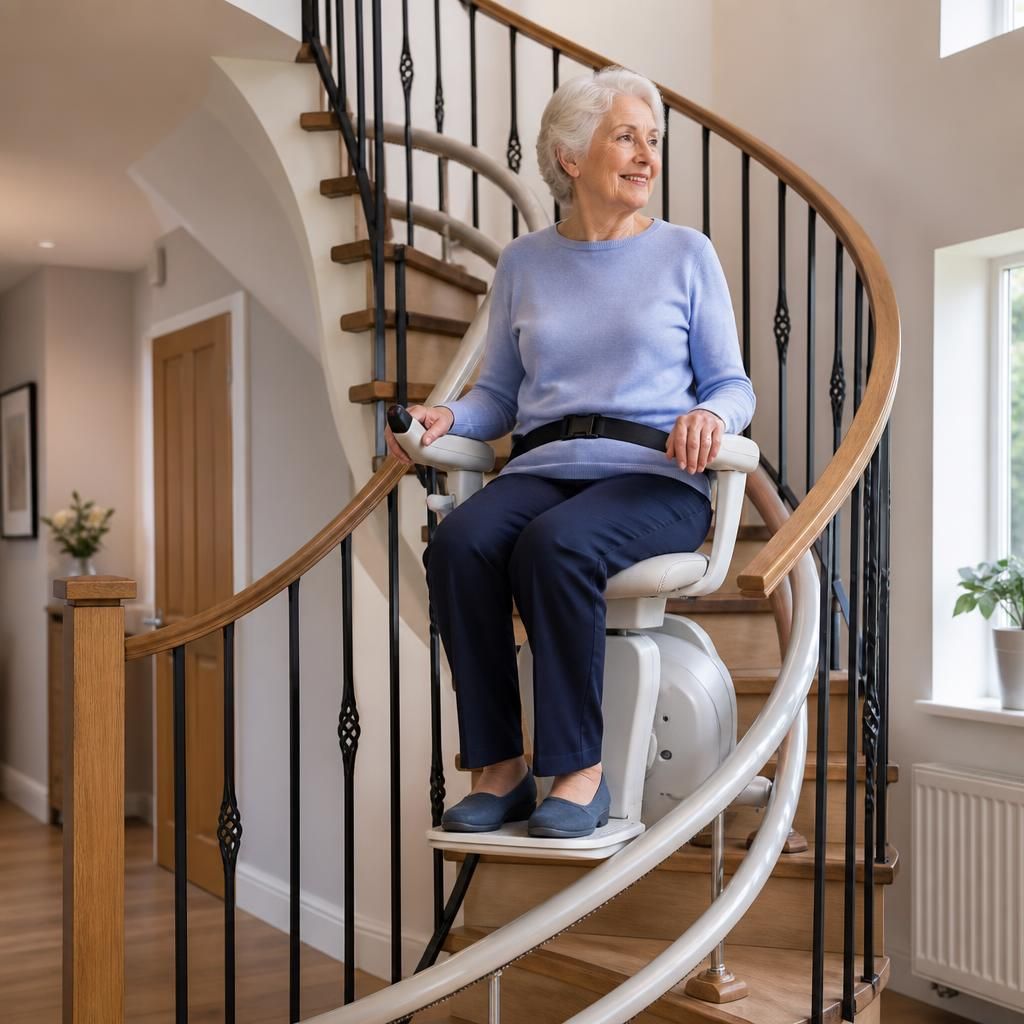
A spiral stairlift uses a continuous, bespoke rail to guide the carriage along the staircase. This can provide:
- A consistent route: the carriage follows the programmed line of the rail rather than requiring the user to negotiate each bend on foot.
- Controlled movement around curves: the lift is designed to travel at a suitable speed through changes in direction, reducing the need for sudden stops or manual repositioning.
- Reduced transfers: a single lift can often serve the full staircase, avoiding a transfer from one stairlift or landing position to another.
- Better use of available space: the rail can be planned around the staircase, helping to preserve access to steps, doorways and landings where the layout allows.
- A more stable seated journey: the user remains seated and supported instead of relying on the staircase while turning or climbing.
These advantages are particularly relevant where the staircase is too complex for a straight model. A straight stairlift can be highly suitable on a single flight, but it cannot independently follow a spiral or curved route. A curved installation may therefore remove hazards associated with walking the staircase or changing lifts at a landing.
Safety features that support secure travel
The exact specification depends on the model and assessment, but a spiral stairlift will normally be selected with features that help the user remain secure and allow the lift to stop safely when necessary. Important features may include:
- A supportive seat and armrests: these help maintain a stable sitting position while the carriage changes direction.
- A seat belt: this helps prevent the user from sliding or rising from the seat during travel. It should be fastened before the journey begins.
- A swivel seat: at the top or bottom of the stairs, swivelling the seat can help the user turn towards the landing before standing. This is useful where the final step is close to a wall, balustrade or doorway.
- Sensors and safety edges: these can detect an obstruction on the rail or staircase and bring the lift to a controlled stop.
- Braking and speed control: the drive system is designed to keep movement steady and stop the carriage when the controls are released or a fault condition is detected.
- Controls suited to the user: simple, accessible controls can reduce the risk of confusion, particularly where hand strength or dexterity is limited.
- Battery backup: rechargeable batteries allow many stairlifts to complete a journey during a temporary power cut, provided the unit has been charged and maintained correctly.
Safety features are only effective when they are used correctly. The user should remain seated, keep hands and clothing inside the carriage, use the belt and follow the operating guidance provided at installation. Children, pets and objects should be kept clear of the staircase while the lift is moving.
Why the assessment is central to safety
A spiral stairlift is made safer by matching its design to the property and the person using it. During an assessment, the installer should consider the staircase geometry, available clearance, landing space, door positions, lighting, electrical supply and any obstructions. The assessment should also cover the user’s height, weight, posture, balance, transfer ability and likely changes in mobility.
This information affects decisions such as the seat style, travel controls, rail position, parking point and whether a powered swivel or folding component would be useful. A person who finds it difficult to turn while standing may need a different arrangement from someone who can transfer easily. Similarly, a narrow landing may require careful positioning so that the user can leave the seat without being placed too close to a wall or obstruction.
Professional fitting is essential because a curved rail must be measured and installed accurately. The carriage should travel smoothly without striking walls, bannisters or other fixtures, and the fixings must be suitable for the staircase structure. After installation, the installer should test the full route, safety devices, charging points, controls and stopping positions, then explain normal operation and emergency procedures.
How it compares with other stairlift types
The safest type depends on the staircase and the user’s needs:
- A straight stairlift may be the simplest option on a single, unobstructed flight. It is not intended to travel around spiral sections or complex bends without additional arrangements.
- A curved or spiral stairlift can provide one continuous route on a staircase with bends, landings or changing angles. This can reduce the need to walk difficult sections or transfer between lifts.
- A standing or perch stairlift may suit some narrow staircases or users who have difficulty bending their knees, but it requires sufficient standing balance and is not appropriate for everyone.
- An outdoor stairlift needs weather-resistant components and a suitable installation environment. Outdoor conditions introduce additional considerations, including surface condition, drainage and protection from moisture.
A spiral stairlift is not automatically safer for every user. Someone who cannot sit safely, maintain trunk control or transfer at the top and bottom may need a different mobility solution or additional support. A professional assessment is the right way to establish whether the design is suitable.
What you can do to preserve safety
Keep the rail and steps clear, park the carriage in its recommended position and leave the stairlift connected to its charger when it is not in use. Do not allow items to hang from the seat or armrests, and report unusual noises, jerky movement, repeated stops or a warning signal rather than continuing to use the lift without advice.
Routine servicing helps confirm that the rail, drive system, batteries, seat, belt, sensors and braking functions remain in good working order. The stairlift should also be checked after changes to the staircase, nearby building work or any incident that may have affected the rail or fixings. With an accurate assessment, suitable safety features, professional installation and regular maintenance, a spiral stairlift can offer a safer and more reliable way to use a complex staircase than attempting the route on foot or relying on an unsuitable straight model.
A spiral stairlift may be safer on a winding staircase because its bespoke curved rail provides one continuous route around bends and landings. The user can remain seated throughout the journey, rather than walking difficult sections or transferring between separate stairlifts at a landing.
Safety still depends on accurate measurement, suitable seating and professional installation. The rail must maintain safe clearance from walls, bannisters and doorways, while features such as a seat belt, swivel seat, sensors and controlled braking help support secure travel and safe stopping.
Arrange a spiral stairlift assessment
Arrange a professional spiral stairlift assessment to confirm the safest design, seating and rail position for your staircase and mobility needs. Contact Independent Stairlifts to discuss your requirements.