
How does the installation process for a spiral stairlift differ from that of a standard stairlift?
Installing a spiral stairlift is more complex than fitting a standard straight stairlift because the rail must be individually designed and accurately shaped to follow the staircase’s curves, landings and changing angles. It requires detailed surveying, bespoke manufacture and specialist fitting, rather than installing a largely standard rail on a straight flight.
A spiral stairlift installation is a bespoke design and fitting process, whereas a standard straight stairlift usually uses a largely pre-configured rail installed along a single, consistent flight. On a spiral or complex staircase, the rail must be measured, designed and manufactured to follow changing angles, curves, gradients and landings accurately. This makes the initial survey, preparation and specialist fitting more involved.
The assessment is more detailed. A straight stairlift can often be assessed by checking the length and width of the stairs, the position of the top and bottom landings, and suitable locations for the charging points. A spiral staircase requires a much closer examination of the whole route. The surveyor will assess the radius of the curve, the width and depth of individual treads, headroom, transitions between sections, landing space and any obstructions such as doors, radiators, bannisters or adjacent walls.
Measurements are taken at multiple points rather than treating the staircase as one uniform flight. The survey also considers how the user will approach the lift, transfer on to the seat, travel around the bend and leave safely at the top or bottom. Where the staircase is particularly tight or includes unusual changes of direction, the proposed rail design may need to account for very small clearances and the position of the user’s knees, feet and shoulders during travel.
The rail is individually designed. A standard straight stairlift normally has a straight rail that can be cut or adjusted to suit the staircase. A spiral stairlift needs a curved or multi-section rail shaped to the surveyed staircase. Depending on the design, it may include different gradients, radiused bends, transitions between straight and curved sections, and carefully positioned entry or exit points.
This design work is important because the rail must provide a smooth, controlled journey without reducing usable access on the stairs more than necessary. The design must also leave appropriate clearance from walls, ceilings, bannisters and other parts of the staircase. A suitable solution may use a compact seat, a folding or retractable element, or a particular parking position to help preserve access for other people in the home.
Manufacture usually takes place after the survey. With a standard stairlift, the installer may be able to use an available rail system and complete the installation relatively quickly once the measurements have been confirmed. A spiral installation generally involves producing a rail specifically for the property. The fitting date therefore depends on finalising the design, checking the measurements and completing the bespoke manufacturing process.
In some homes, the staircase may be too narrow or irregular for a conventional approach. The assessment may then identify an alternative arrangement, such as a different parking position, a split or modular rail design, or another mobility solution for part of the route. These options should be considered before manufacture, as changing the design after production can affect both the installation and the overall suitability of the lift.
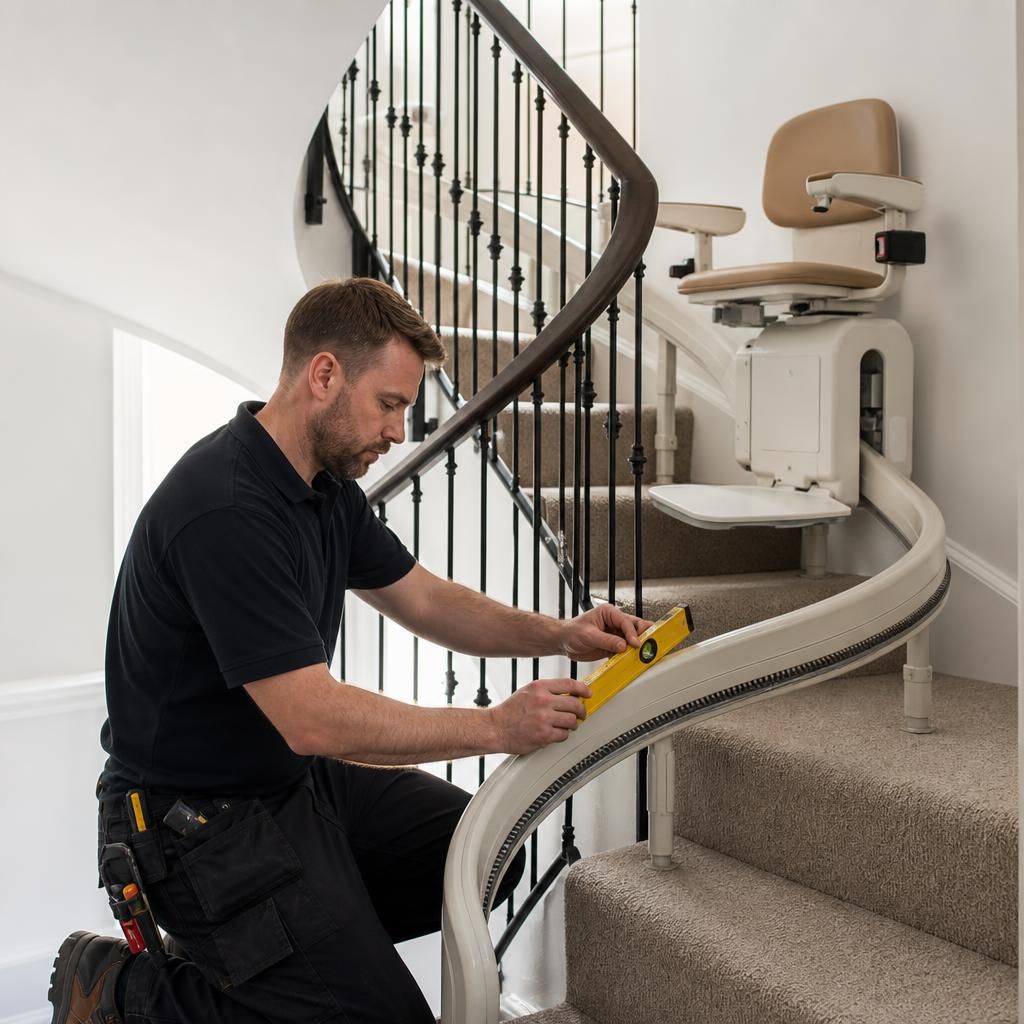
The installation itself requires more careful positioning. A straight stairlift rail is generally fixed to the stair treads or another suitable supporting structure in a consistent line. On a spiral staircase, the fixing points may vary as the rail follows the curve. The installer must position each section accurately, secure the rail to the staircase without compromising its structure, and check that the lift remains stable through every change in direction.
The installer will also fit and test the drive system, seat, armrests, footrest, controls, sensors and charging equipment. Particular attention is paid to the transitions between rail sections and to the points where the stairlift starts, stops or changes direction. The lift should travel smoothly, maintain safe clearances and stop reliably if a sensor detects an obstruction.
Testing is more extensive on a complex staircase. Before the installation is handed over, the stairlift is run repeatedly along the complete route. Checks include the movement around bends, the operation of the controls, the position of the seat at the top and bottom, the folding components, the safety sensors, the emergency stop function and the charging system. The installer will also confirm that the user can board and leave the lift safely at the intended points.
For a standard stairlift, testing is still essential, but the route is more predictable because it follows a single straight gradient. A spiral lift has more points at which alignment, clearance and positioning need to be checked. If the user has particular mobility needs, the final set-up should also take account of how they sit, transfer, use the controls and manage the footrest or seat belt.
The installation may have a greater effect on how the staircase is used. Spiral staircases often have limited width and restricted landing space. The survey and design should therefore address how other household members will pass the lift when it is parked, whether the seat or footrest folds away sufficiently, and whether doors or hallways remain usable. In some cases, a parking position away from the narrowest part of the staircase can make a meaningful difference to everyday access.
Fixing a stairlift to a spiral staircase does not normally require major structural alteration when the staircase is suitable and the rail can be supported correctly. However, the installer may need to work around unusual construction, curved walls, delicate finishes or restricted access. Any necessary preparation should be explained before work begins, including whether furniture or nearby fittings need to be moved temporarily.
The handover should cover the equipment and the route. After fitting, you should be shown how to operate the controls, use the seat belt, fold the seat and footrest, call the stairlift from either end where applicable, and respond to an obstruction or power interruption. You should also understand the recommended parking position and the charging requirements. With a bespoke installation, these practical details are particularly important because the lift’s controls and entry points have been selected for the specific staircase.
In summary, the main differences are the level of surveying, the bespoke rail design, the manufacturing stage, the precision required when fixing the rail, and the additional testing needed around curves and changes in gradient. A standard stairlift installation is usually more straightforward because the rail follows one consistent line. A spiral stairlift must be treated as a tailored installation, with the design based on the staircase, the available space and the needs of the person using it.
A professional assessment is the reliable way to confirm whether a spiral stairlift can be installed safely and which configuration is appropriate. It should establish the route, identify any practical restrictions and explain the expected process before a design is approved or manufactured.
Spiral stairlift installation differs from standard stairlift fitting because the rail must be designed and shaped specifically for the staircase. Rather than following one straight, consistent flight, it needs to accommodate curves, changing angles, narrow treads and any landings along the route.
A detailed survey is therefore essential. The installer checks clearances from walls, bannisters and ceilings, as well as boarding and exit positions, parking space and access for other people in the home. These measurements are used to create the bespoke rail before fitting begins.
During installation, each fixing point and rail section is aligned carefully, then the lift is tested repeatedly around the complete route. This includes checking smooth movement, safety sensors, stopping points, charging and safe transfers at the top and bottom. The result should be a stairlift that fits the staircase and the user’s practical needs, rather than a standard rail adapted after installation.
Arrange Your Spiral Stairlift Assessment
Arrange a professional assessment with Independent Stairlifts to confirm whether a bespoke spiral stairlift is suitable for your staircase and discuss the most practical installation options.