
How do I determine if a spiral stairlift is suitable for my staircase?
A spiral stairlift may be suitable if the staircase has enough usable width, clearance and secure fixing points for a rail, with adequate space at the top and bottom for safe access. Suitability depends on the staircase’s exact shape and the user’s mobility needs, so an in-home assessment is needed to confirm whether a bespoke installation is appropriate.
A spiral stairlift is suitable only when the staircase can accommodate a safely designed rail, the user can transfer on and off the seat securely, and there is enough clearance at every point of travel. Because spiral stairs vary considerably in diameter, gradient, tread shape and surrounding space, suitability cannot be confirmed from the number of steps alone. A detailed in-home assessment is needed to establish whether a bespoke installation is appropriate.
The main points considered during an assessment are:
- The shape and dimensions of the staircase: The assessor will examine the staircase’s width, radius, turning direction, gradient and the changing depth of the treads. A spiral staircase may become narrower towards the inner edge, which can affect the position of the rail and the user’s available foot space.
- The proposed rail route: The rail must follow the staircase without creating an unsafe obstruction or reducing usable space more than necessary. On a spiral staircase, this usually requires a rail designed and manufactured around the individual curve rather than a standard straight section.
- Clearance around the stairlift: There must be sufficient room for the seat, footrest and user to travel safely around the staircase. The assessment also considers nearby walls, balustrades, radiators, doorways, furniture, beams and other projections that could interfere with movement.
- Space at the top and bottom: Safe access is just as important as the journey itself. The assessor will check whether the user can approach the stairlift, sit down or stand up safely, and move away from the staircase when the seat reaches its parking position. A swivel seat, powered swivel or adjusted parking position may be considered where the layout is restricted.
- Suitable fixing points: The rail needs to be secured to a structure capable of supporting it and the loads created during use. The survey may include the condition and construction of the treads, floor, walls and landings. Where direct fixing to the stairs is unsuitable, alternative fixing arrangements may need to be explored.
- Electrical requirements: The installation needs a suitable power supply and a practical location for charging equipment. The position of the charging point should allow the stairlift to be left in its correct parking position without blocking access.
The user’s needs also determine suitability. A stairlift may fit physically but still be unsuitable if the user cannot sit securely, operate the controls, maintain a stable posture or transfer safely at the top and bottom. The assessment should consider the user’s height, weight, leg and hip movement, balance, grip, vision and whether another person regularly assists them. Controls, armrests, footrest design, seat position and the direction in which the seat swivels can all affect safe and comfortable use.
Where more than one person uses the staircase, the assessor will also consider how much space remains for someone to pass the parked stairlift, if passing is necessary. In some homes, the best solution is for the stairlift to park clear of a landing or doorway. In others, the staircase may be too confined for shared use, making the arrangement of the lift and its parking points particularly important.
A stairlift is less likely to be suitable without modification where:
- the spiral is extremely tight or the inner edge leaves very little usable tread;
- the staircase has unstable, damaged or unsuitable fixing surfaces;
- there is no safe landing space at the top or bottom;
- doors, low ceilings or other obstructions cannot be cleared by the proposed rail and seat;
- the user cannot transfer safely to or from the seat; or
- the installed lift would leave an unacceptable obstruction for other occupants.
These limitations do not automatically rule out every solution. A bespoke rail, different parking arrangement, compact seating configuration or changes to the surrounding space may resolve some restrictions. However, any alteration must be assessed for its effect on safety, access and the structure of the staircase. A professional installer should explain clearly which elements are feasible and which are not, rather than treating a standard stairlift as suitable simply because it can be made to travel around the curve.
During the survey, it is useful to explain how the staircase is used throughout the day, where the user normally sits or stands, whether they use a walking aid, and whether assistance is available. Bring up any concerns about knees, hips, balance, transfers or difficulty using controls. These details help determine whether a stairlift is the right type of aid and what configuration would be safest.
The final decision should be based on an assessment of the actual staircase and the intended user, not on photographs or general measurements. Independent Stairlifts can assess the full route, identify potential obstructions and discuss whether a bespoke spiral stairlift, another stairlift arrangement or an alternative mobility solution is most suitable for the property. If the layout is workable, the survey should also confirm the rail route, parking positions, access requirements and any preparation needed before installation.
The suitability of a spiral stairlift can only be confirmed through an assessment of the actual staircase and the person who will use it. The survey checks whether a bespoke rail can follow the curve safely while leaving enough clearance for the seat, footrest and surrounding access.
The assessor will examine the staircase’s width, radius, gradient, tread shape, fixing surfaces and available space at the top and bottom. Walls, doors, ceilings, balustrades and other obstructions are also considered, along with where the stairlift can park without creating an unsafe obstruction.
Physical fit is only part of the decision. The user must be able to sit securely, operate the controls and transfer on and off the seat safely. Balance, joint movement, posture, grip and the need for assistance may affect the most suitable seat, swivel arrangement and rail position. An in-home assessment therefore provides a more reliable answer than photographs or general measurements.
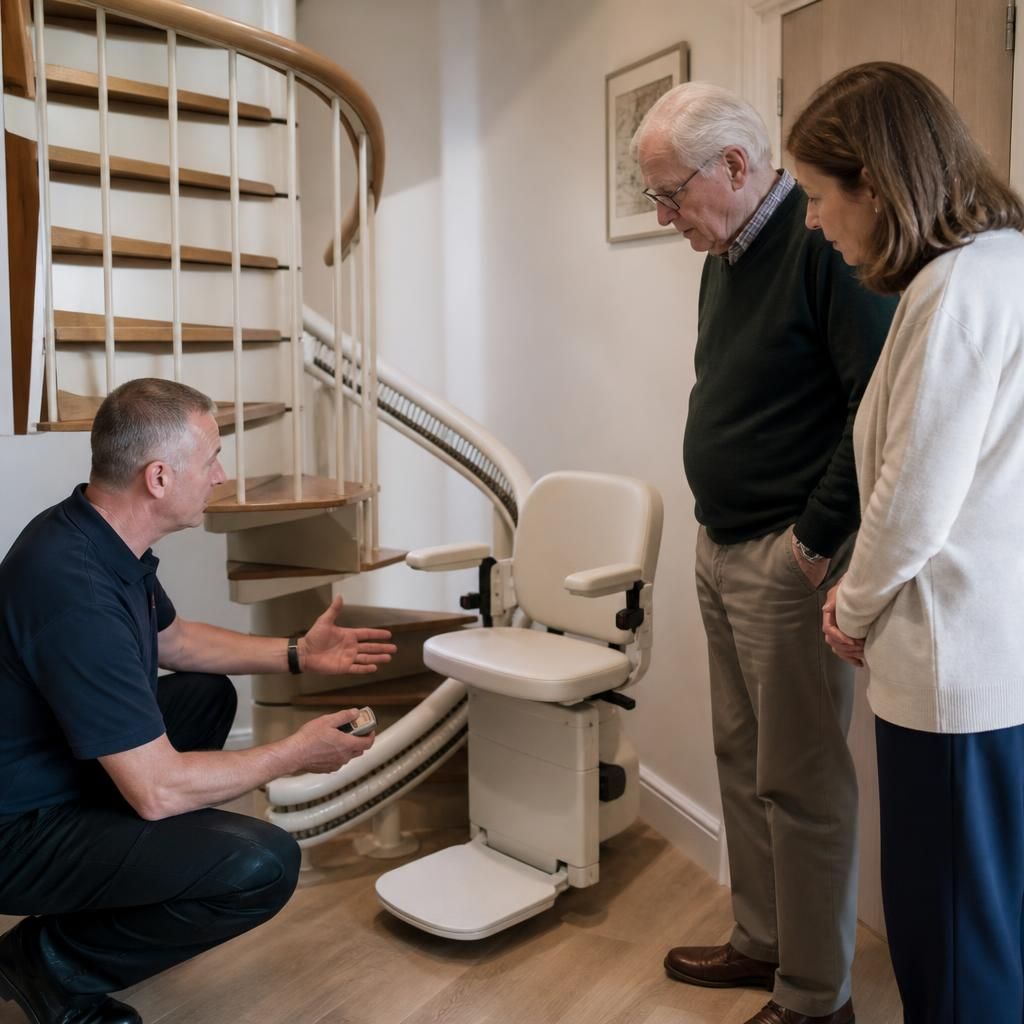
Arrange a Spiral Staircase Suitability Assessment
Arrange an in-home suitability assessment to confirm whether a bespoke spiral stairlift can be fitted safely to your staircase and meet the user’s access needs.