
What should I consider when choosing a stairlift for curved stairs?
When choosing a stairlift for curved stairs, consider the bespoke rail design, available space, seat and safety features, user needs, installation requirements and overall cost. A professional home assessment is essential to confirm the most suitable configuration and ensure the stairlift fits your staircase and can be used safely and comfortably.
Choosing a stairlift for curved stairs involves assessing the staircase layout, the user’s mobility needs, the available seating and safety features, and the practical requirements for installation and ongoing use. Unlike a straight stairlift, a curved model is made with a rail shaped to follow the bends, landings and changes in direction of the individual staircase, so a professional assessment is essential before selecting a suitable configuration.
Consider how the rail will fit the staircase. The rail should follow the route accurately without obstructing doors, hallways or access to the stairs. The assessment will consider bends, intermediate landings, narrow sections, changes in gradient, the position of the top and bottom steps, and whether the lift needs to stop on more than one floor. In some homes, the rail can be installed close to the stairs; in others, its position may need to allow for handrails, skirting boards or nearby furniture.
Ask where the stairlift will park when it is not in use. A parking position at the top or bottom may help keep a hallway clear, while a shortened or folded rail can be useful where space is limited. The available room at the top landing is particularly important because the user needs to get off the lift safely without being left too close to a doorway, landing edge or obstruction.
Match the seat to the user. The seat should provide suitable support and be comfortable for the full journey. Consider the seat height, width, cushioning, armrest position and footrest design, as well as how easily the user can sit down and stand up. A powered swivel seat may help someone who finds turning difficult, whereas a manual swivel mechanism may be sufficient for a user with good upper-body control.
The seat should also suit the person’s posture, balance and leg movement. If the user has stiff hips, restricted knees or difficulty bending, the footrest and seat height need particular attention. If more than one person will use the stairlift, discuss whether the proposed settings and controls are appropriate for everyone. A home assessment can identify whether additional options, such as a powered footrest or a seat that swivels at the top landing, would make transfers easier.
Check the essential safety features. A suitable curved stairlift should include features that support controlled travel, secure seating and safe transfers. Depending on the model and configuration, these may include:
- A seat belt that can be fastened and released without unnecessary difficulty.
- Armrests and a stable seat to help the user remain secure while travelling.
- Sensors that stop the lift if it detects an obstruction on the stairs or rail.
- A swivel seat or powered swivel mechanism to help the user face the landing before getting off.
- A safety edge or footrest sensor to reduce the risk of contact with objects or steps.
- Controls that are clear, reachable and easy to operate.
- A battery system that allows the lift to complete a journey during a temporary power interruption, provided it has been charged correctly.
- Manual lowering or other suitable procedures for situations in which the lift cannot be used normally.
Safety features should be selected for the individual rather than treated as a standard checklist. For example, a user with reduced dexterity may need larger, simpler controls, while someone who is unsteady when standing may benefit from a powered swivel seat and a carefully positioned parking point. Make sure the installer explains how to use the belt, controls, swivel mechanism, charging points and emergency procedure before the stairlift is handed over.
Think about the staircase and the wider home. The survey should cover more than the steps themselves. Check whether the lift will affect access to rooms, fire escape routes, doors, radiators, handrails or storage areas. If the staircase is narrow, ask about the folded width of the seat, arms and footrest when the lift is parked. Where other household members use the stairs, the design should leave as much usable space as possible and avoid creating unnecessary trip hazards.
It is also important to consider the user’s likely needs over time. A stairlift that feels suitable now may need to remain practical if strength, balance, vision or confidence changes. Discuss whether the controls can be operated from either side, whether the seat can be adjusted, and whether the design allows for future support needs without requiring a complete replacement.
Compare the total cost, not only the initial price. Curved stairlifts generally require a bespoke rail and more detailed installation than straight models, so the cost is influenced by the staircase design, the number and sharpness of bends, the number of floors served, the chosen seat and optional features. Ask for a clear quotation that explains what is included, such as the survey, manufacture, installation, removal of packaging, demonstration, warranty and aftercare.
If you are considering a reconditioned stairlift or a rental arrangement, check whether the available equipment can be adapted safely to the staircase and whether the agreement covers servicing, repairs, removal or changes to the installation. A lower initial cost is not necessarily the best value if the seat, rail arrangement or aftercare does not meet the user’s needs.
Assess the installation requirements. Curved rails are normally made to measure, so the process may involve a detailed survey followed by manufacture before installation. Ask what preparation is needed in the home, whether furniture or wall-mounted items must be moved, and how the installer will protect flooring and surrounding areas. Confirm how long the installation is expected to take and whether the staircase will be unavailable during the work.
Before the installation, keep the stairs and landings clear, identify the preferred charging and parking positions, and tell the surveyor about any access difficulties or other mobility equipment in use. After fitting, allow time for a full demonstration. The user should practise starting and stopping, using the seat belt and swivel seat, parking the lift, charging it and responding to an obstruction or power interruption.
Use the assessment to make the final decision. Measurements alone do not determine the best stairlift. The installer should observe how the user approaches the stairs, sits down, controls the lift and transfers at the landing. Take the opportunity to discuss concerns about balance, memory, dexterity, pain, fatigue or changes in mobility. These details can affect the recommended seat, controls, rail position and safety options.
A suitable choice is therefore the one that fits the staircase accurately, supports safe and comfortable transfers, leaves the home practical to use, and comes with understandable installation and aftercare arrangements. If there is any uncertainty between configurations, a home assessment and demonstration will provide more useful guidance than comparing specifications alone.
A professional home assessment is the most reliable way to choose a curved stairlift because the correct model depends on both the staircase and the user’s ability to transfer safely. The survey should consider the rail route, available landing space, seat height, controls and the position in which the user will get on and off.
Explain any difficulty with balance, bending, standing, grip or memory. These details may affect whether a powered swivel seat, powered footrest, adjustable controls or a particular parking position is appropriate. The surveyor should also check that the folded stairlift leaves practical access for other people in the home and does not obstruct doors, handrails or escape routes.
Use the assessment to ask for a clear explanation of the recommended configuration, installation requirements, warranty and aftercare. Trying the seat and controls, where possible, can reveal comfort or transfer issues that are not apparent from measurements alone.
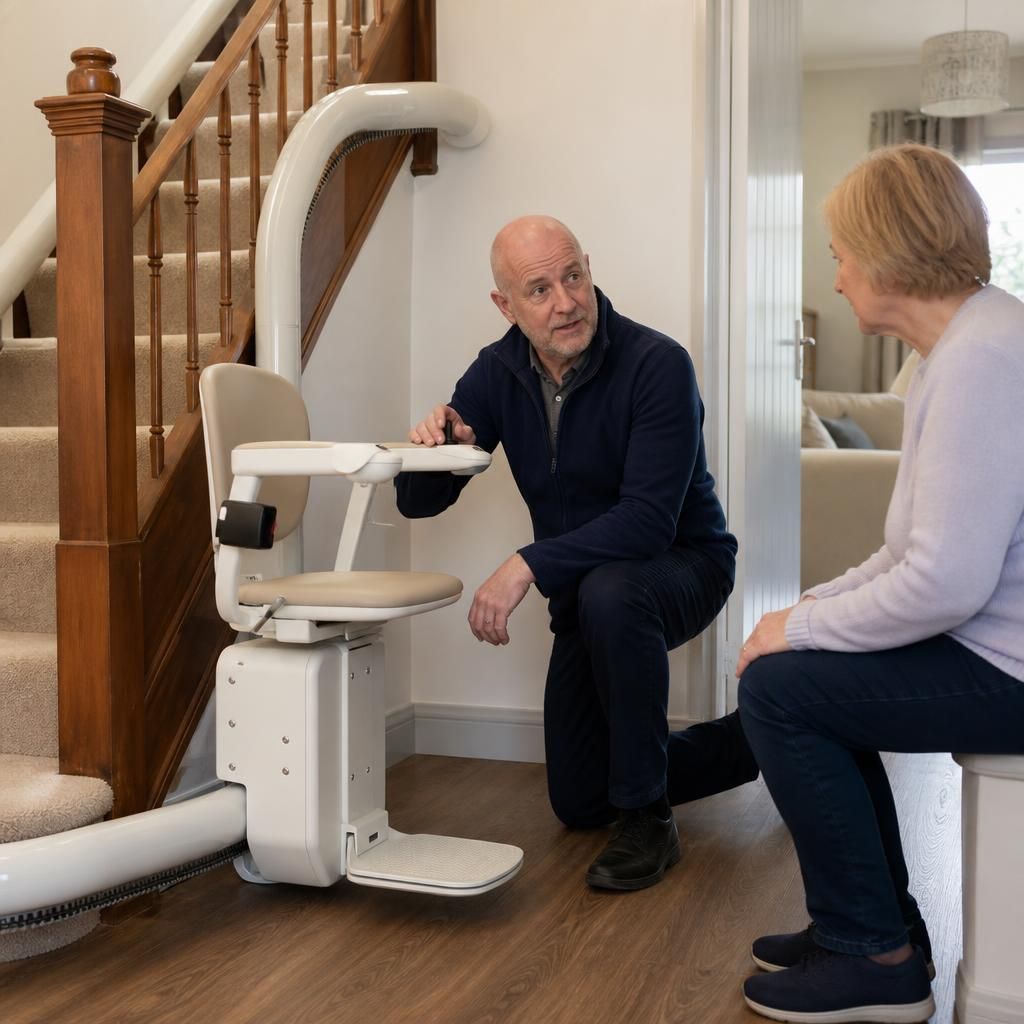
Arrange your curved stairlift assessment
Arrange a professional curved stairlift assessment to review your staircase, transfer requirements, preferred features and installation needs. Independent Stairlifts can then recommend a suitable configuration and provide clear advice on fitting and aftercare.