
What maintenance requirements should I expect for a curved stairlift to ensure its long-term functionality?
A curved stairlift typically needs regular professional servicing, battery and charging checks, and inspection of its track, drive system, seat, sensors and safety controls to maintain reliable long-term operation. Keep the lift and track free from dust and obstructions, follow the manufacturer’s charging guidance, and report unusual noises, movement or fault alerts promptly rather than attempting repairs yourself.
A curved stairlift generally requires routine professional servicing, regular charging and battery checks, and prompt attention to any change in performance. Because its track is made to follow the exact shape of your staircase, maintenance should cover the rail, drive system, seat, sensors, safety controls and charging points, as well as the lift’s batteries. Following the manufacturer’s servicing recommendations and reporting faults early will help preserve safe, dependable operation.
Professional servicing
Arrange servicing at the interval specified for your particular stairlift. The recommended frequency can vary according to the model, age, usage and manufacturer’s instructions. During a service, a qualified technician will typically inspect and test:
- the curved track, joints, fixings and end sections;
- the motor, gearbox, drive mechanism and drive components;
- the batteries, charging contacts and charger;
- the seat, swivel mechanism, armrests, footrest and seat belt;
- the sensors that detect obstacles on the stairs;
- the controls, remote controls, diagnostic indicators and emergency stop functions; and
- the lift’s stopping, starting and movement along the complete track.
They may clean, adjust or replace worn components where necessary. A curved stairlift has more track geometry to check than a straight model, so the technician should test the full route rather than concentrating only on the top and bottom landings.
Battery and charging care
Most indoor stairlifts use rechargeable batteries and are designed to charge when parked at a designated charging point, often at the top or bottom of the stairs. Leave the lift at its charging point whenever it is not in use, unless your model’s instructions state otherwise. Avoid switching off the stairlift or its charger at the wall, as this can prevent the batteries from maintaining their charge.
Battery performance can gradually reduce with age. Signs that the batteries may need checking include slower travel, difficulty completing the full route, repeated low-battery warnings, the lift stopping away from a charging point or a charger that does not appear to be operating. Do not continue using a lift that repeatedly loses power or fails to charge; contact us or the appointed service provider so the batteries and charging system can be tested safely.
Keeping the track and lift clear
Dust and loose debris can collect on the rail, footrest or around the drive components. Wipe accessible surfaces with a soft, dry or slightly damp cloth, following the manufacturer’s cleaning instructions. Keep the stairs and landings clear so the sensors can detect obstacles and the seat can swivel and park without obstruction.
Do not apply oil, grease or household cleaning products to the track unless the manufacturer specifically instructs you to do so. Incorrect lubrication can attract dust, affect the drive system or interfere with sensors and other components. Never remove covers or try to adjust the track yourself.
Checks you can carry out safely
Before using the stairlift, check that the route is clear and that the seat is locked in the correct travelling position. Make sure the seat belt fastens properly, the armrests and footrest move as expected, and the swivel seat returns securely to its travel position. Check that the key switch, joystick or control buttons respond normally and that remote controls are kept where they can be reached from either landing.
Pay attention to changes such as unusual noises, juddering, hesitation, uneven movement, unexpected stops, difficulty swivelling the seat or repeated warning lights. These are not normal signs of wear to ignore. Stop using the lift if it behaves unpredictably, and report the issue with a clear description of what happened and where on the track it occurred.
Safety and fault reporting
Do not attempt to repair electrical parts, replace batteries, alter the track or bypass a safety sensor. A curved stairlift is a bespoke installation, and adjustments that appear minor can affect alignment, braking, clearances or the safe operation of the sensors. Use the manufacturer’s emergency procedure if the lift stops, and ask for assistance rather than trying to move it manually unless the instructions specifically permit this.
Keep the user manual, service information and emergency contact details available. After a service or repair, retain the record and note any parts replaced or recommendations made. This provides a useful history for future technicians and can help identify recurring faults.
When maintenance may be needed sooner
Arrange an earlier inspection if the stairlift is used heavily, has been unused for a prolonged period, has been exposed to damp or unusual temperatures, or has experienced an impact. A lift that has remained unused still needs checking before regular use, particularly its batteries, charging system and safety controls. Outdoor curved stairlifts require additional attention to weather seals, corrosion, drainage and the condition of exposed electrical components; follow the outdoor model’s cleaning and protection instructions closely.
In practical terms, long-term care consists of keeping the lift charged, keeping the track and travel route clear, carrying out simple visual checks and booking professional servicing at the recommended interval. Prompt reporting is important: dealing with a minor battery, sensor or movement issue early is usually safer and more straightforward than continuing until the lift stops operating.
Regular professional servicing is the most important maintenance requirement for a curved stairlift. A qualified technician should inspect the complete track, drive system, batteries, charging contacts, seat, sensors and safety controls, then test the lift across its full route. This is particularly important because a curved rail is individually shaped to the staircase and must remain correctly aligned.
Between services, leave the stairlift at its designated charging point when it is not in use, keep the track and travel path clear, and report warning lights, unusual noises, hesitation or repeated low-battery alerts promptly. Do not lubricate the rail, remove covers or adjust components yourself, as this could affect the lift’s sensors, alignment or braking system.
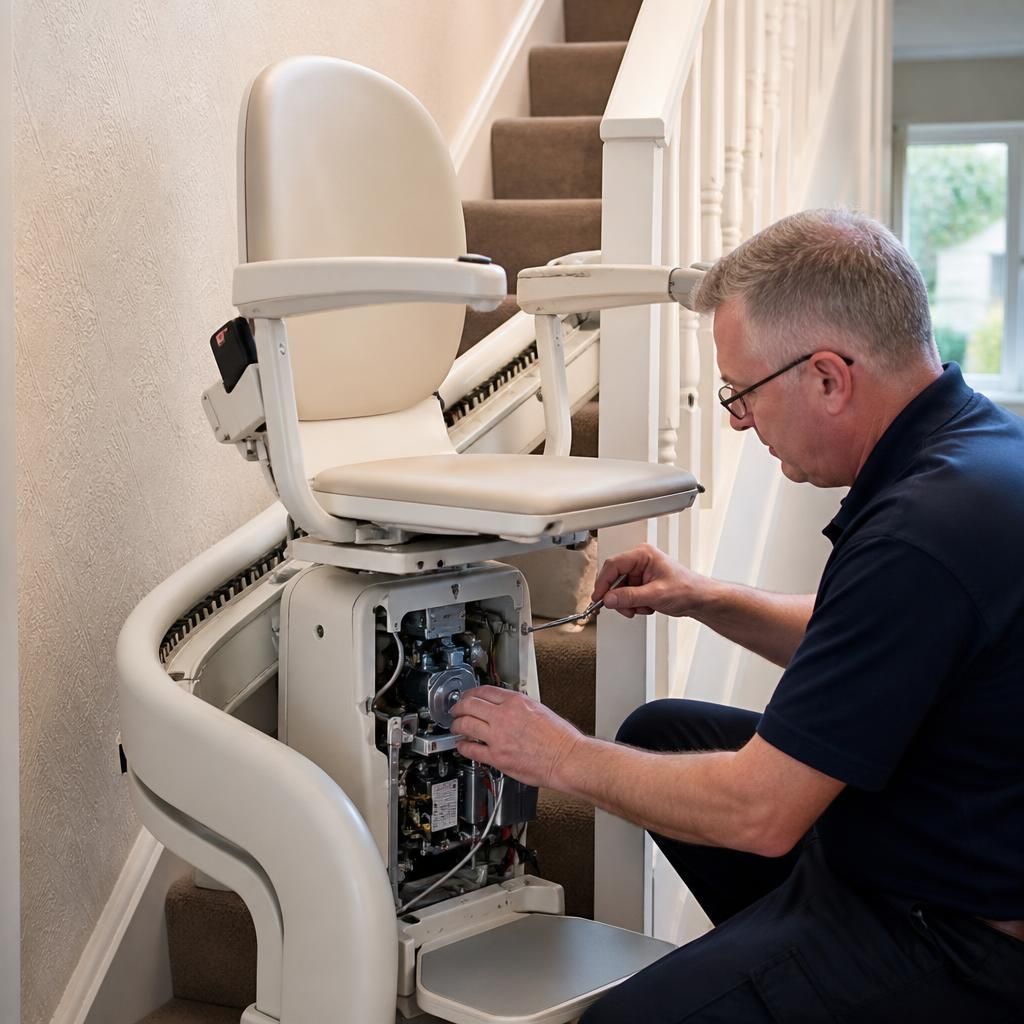
Book your curved stairlift service or maintenance check
If your curved stairlift is due for a service, or you have noticed unusual noise, hesitation or battery warnings, contact Independent Stairlifts to arrange a professional maintenance check. Our team can assess the lift, track and safety systems and advise on any required work.