
What maintenance does a curved stairlift require?
A curved stairlift requires regular professional servicing, together with simple everyday care such as keeping the rail and seat clean and checking for visible damage. Routine maintenance helps identify wear, maintain safe operation and keep the lift running reliably.
A curved stairlift requires routine professional servicing, supported by simple checks and careful everyday use. Maintenance is needed to keep the bespoke rail, drive system, seat, batteries and safety sensors working correctly, while also identifying wear before it affects reliability or safe operation.
Professional servicing
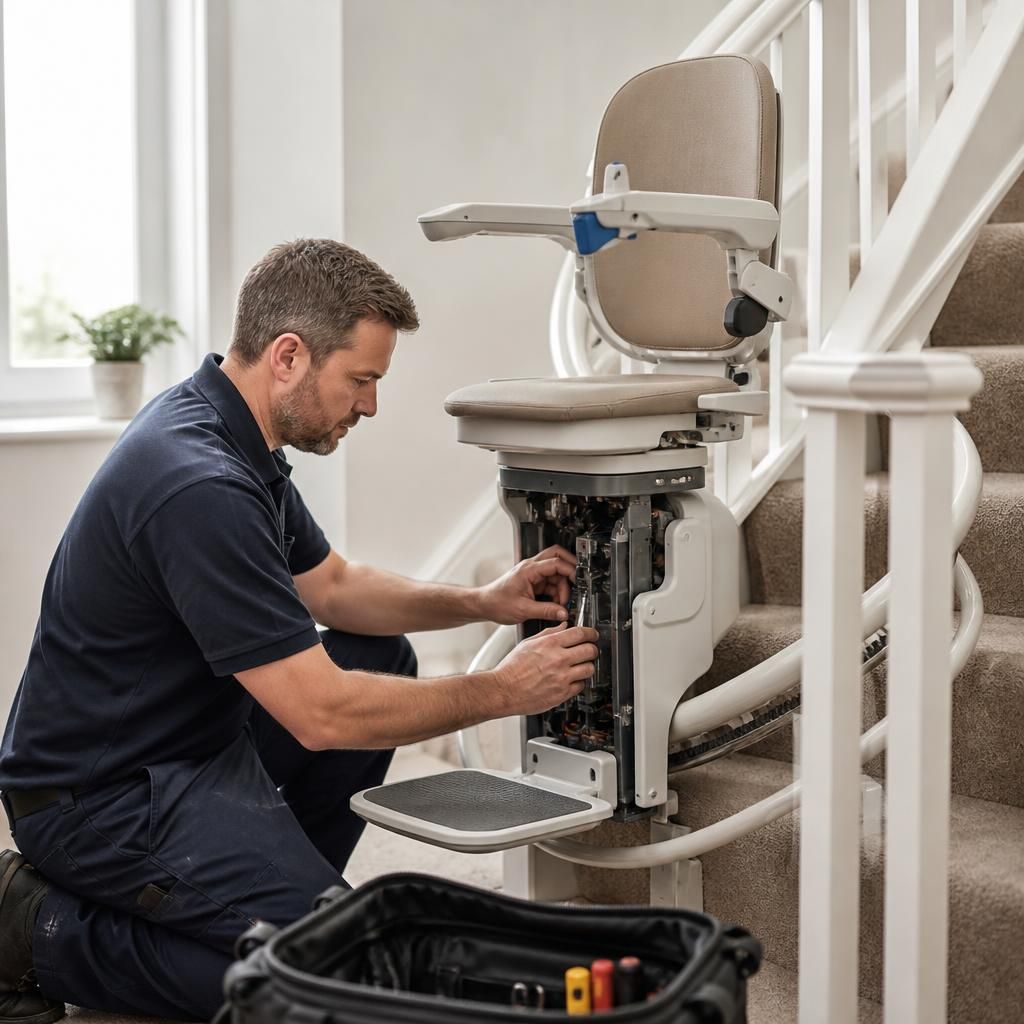
Your stairlift should be serviced in line with the manufacturer’s guidance and the terms of your service agreement or warranty. During a service, a qualified engineer will typically inspect the complete lift rather than focusing only on the visible rail. This may include:
- Checking the curved rail, its fixings and joints for movement, damage or signs of wear.
- Inspecting the drive mechanism, rollers, gears and other moving parts.
- Testing the seat, swivel mechanism, armrests, footrest and seat belt.
- Checking safety sensors, obstruction sensors, controls and stop functions.
- Testing the batteries, charger and charging contacts.
- Checking that the lift starts, stops and travels smoothly throughout the full route.
- Cleaning, adjusting or lubricating components where the manufacturer permits it.
Curved stairlifts need particular attention because their rails are made to follow the individual shape of the staircase. The lift may travel through bends, changes in gradient and tighter sections, so correct alignment and secure fixings are important. An engineer can also check that the carriage is tracking the rail correctly and that the lift remains stable at each part of the journey.
Everyday cleaning and checks
Keep the rail and surrounding area free from dust, pet hair, loose items and other debris. Wipe accessible surfaces with a soft, slightly damp cloth and use only cleaning products recommended for the equipment. Do not pour liquid onto the controls, motor, charger or electrical connections, and avoid abrasive products that could damage the finish.
Before using the stairlift, look for obvious changes such as a loose fixing, damaged cover, unusual obstruction or anything on the stairs that could interfere with the footrest or carriage. Check that the seat is fully in its normal travelling position, the seat belt operates correctly and the controls respond as expected. These checks should be visual and straightforward; do not remove covers or attempt to adjust mechanical or electrical parts yourself.
Batteries and charging
Most stairlifts use rechargeable batteries and are designed to charge when parked at a designated charging point. If your lift is not being used regularly, run it often enough to allow the batteries to recharge, following the manufacturer’s instructions. Keep the charging point clear and check that the lift is reaching it properly at the end of its journey.
A lift that moves slowly, stops before completing the route, gives a low-battery warning or fails to hold charge may need attention. Battery performance naturally reduces over time, but similar symptoms can also result from a charging fault or another issue. Arrange an inspection rather than repeatedly restarting the lift or continuing to use it when it is not operating normally.
Outdoor curved stairlift care
An outdoor stairlift is exposed to rain, moisture, dirt and changing temperatures, so its maintenance needs can be greater than those of an indoor model. Keep the rail, seat and charging area as clean and dry as the design allows, and use any supplied cover correctly. Do not use the lift during conditions or in a way that conflicts with the manufacturer’s instructions. Report corrosion, water ingress, damaged covers or deterioration of outdoor components promptly.
When to stop using the lift
Stop using the stairlift and contact the service team if you notice grinding, repeated jolting, unusual noises, burning smells, visible damage, a loose seat or rail, unreliable controls, a fault warning or a safety feature that does not work. Do not try to bypass a sensor or safety switch. If someone is left on the stairs because the lift has stopped, follow the supplied emergency guidance and seek assistance rather than attempting to move or repair the lift without advice.
Routine maintenance does not usually require the owner to dismantle any part of the stairlift. Keeping the equipment clean, using it as intended, parking it correctly and reporting changes early will help reduce avoidable faults. Professional servicing remains essential because many important components are enclosed and cannot be assessed safely through visual checks alone.
Keep the installation and service information available, including details of the model and any previous repairs. When arranging assistance, describe when the problem occurs, where on the staircase it happens and any warning shown by the lift. This can help an engineer prepare the appropriate parts and assess whether the issue is related to the rail, carriage, controls, batteries or charging system.
Professional servicing is essential for a curved stairlift because important parts are enclosed and the bespoke rail must be checked along its entire route. A qualified engineer can inspect the rail fixings, carriage, drive components, swivel seat, safety sensors, controls, batteries and charging points.
Regular servicing also confirms that the lift travels smoothly through every bend and change of gradient. Keep the rail and seat clean between visits, but do not remove covers, adjust components or bypass safety devices yourself. Report unusual noises, jolting, slow movement, warning lights or charging problems promptly so they can be assessed before they affect safe operation.
Book your curved stairlift service
If your curved stairlift is due for a service or is showing signs of a fault, contact Independent Stairlifts to arrange an inspection with a qualified engineer.