
What is the installation process like for a curved stairlift?
A curved stairlift installation begins with a home assessment to measure your staircase, check access and discuss your mobility needs. The stairlift is then made to suit your stairs, fitted securely by trained installers and thoroughly tested before you are shown how to use it safely.
A curved stairlift installation is a planned, measured process in which the rail is designed to follow the exact shape of your staircase. It usually begins with an in-home assessment, followed by bespoke manufacture of the rail, professional fitting, safety testing and a practical demonstration. The aim is to provide a secure, comfortable route between floors while keeping the staircase as accessible as possible for other household members.
Initial home assessment
An assessor visits your home to examine the staircase and discuss how you intend to use the stairlift. Curved staircases vary considerably, so the assessment considers more than the number of steps. The survey may include:
- the width, length and direction of each flight;
- landings, bends, half-landings and changes in gradient;
- available space at the top and bottom of the stairs;
- doorways, radiators, furniture and other possible obstructions;
- the position of nearby electrical sockets and suitable charging locations;
- your ability to transfer on and off the seat safely; and
- whether other people will need to use the stairs while the stairlift is parked or moving.
This is also the opportunity to discuss features such as a powered swivel seat, powered folding footrest, adjustable seat height, hinged rail or alternative controls. If more than one person will use the stairlift, their different heights, mobility needs and transfer abilities should be considered before the design is agreed.
Measuring and designing the rail
The rail must follow the staircase accurately so that the stairlift can travel smoothly around corners and arrive in a safe position at each end. Measurements may be taken using specialist surveying equipment, templates or digital methods, depending on the staircase and the system being installed. The surveyor uses this information to establish the rail profile, seating position, clearances and fixing points.
Curved stairlift rails are normally secured to the stair treads or the structure of the staircase rather than relying on the wall. This can make installation possible where the wall is not suitable for supporting equipment, although the condition and construction of the stairs still need to be checked. The proposed layout should be reviewed with you before manufacture, particularly where the stairlift will finish close to a doorway, landing or narrow passage.
Agreeing the specification
Before the stairlift is made, you should have a clear understanding of the proposed route, seat arrangement, controls, finish and any additional options. The specification should reflect how you approach the stairs and how you get off at the top and bottom. For example, a swivel seat can help you turn towards the landing before standing, while a powered swivel function may be useful if you cannot operate a manual lever reliably.
Where space is limited, the design may include a rail that extends beyond the bottom step, a hinged section to keep a doorway clear, or a parking position that reduces obstruction. These choices need to balance ease of transfer, safe clearance and convenient access for everyone in the home.
Manufacture and preparation
Once the measurements and specification have been confirmed, the curved rail is manufactured to suit the surveyed staircase. Unlike a standard straight rail, it cannot usually be selected from a universal length and installed without adaptation. The manufacturing stage is therefore an important part of achieving a close fit.
Before the fitting appointment, make the route to the stairs as clear as reasonably possible. Remove loose rugs, ornaments and small items from the stairs and nearby landings, and ensure that installers can reach any relevant electrical supply. You do not normally need to remove fixed flooring or alter the staircase, but any concerns about carpets, flooring, decoration or access should be discussed in advance.
Fitting the stairlift
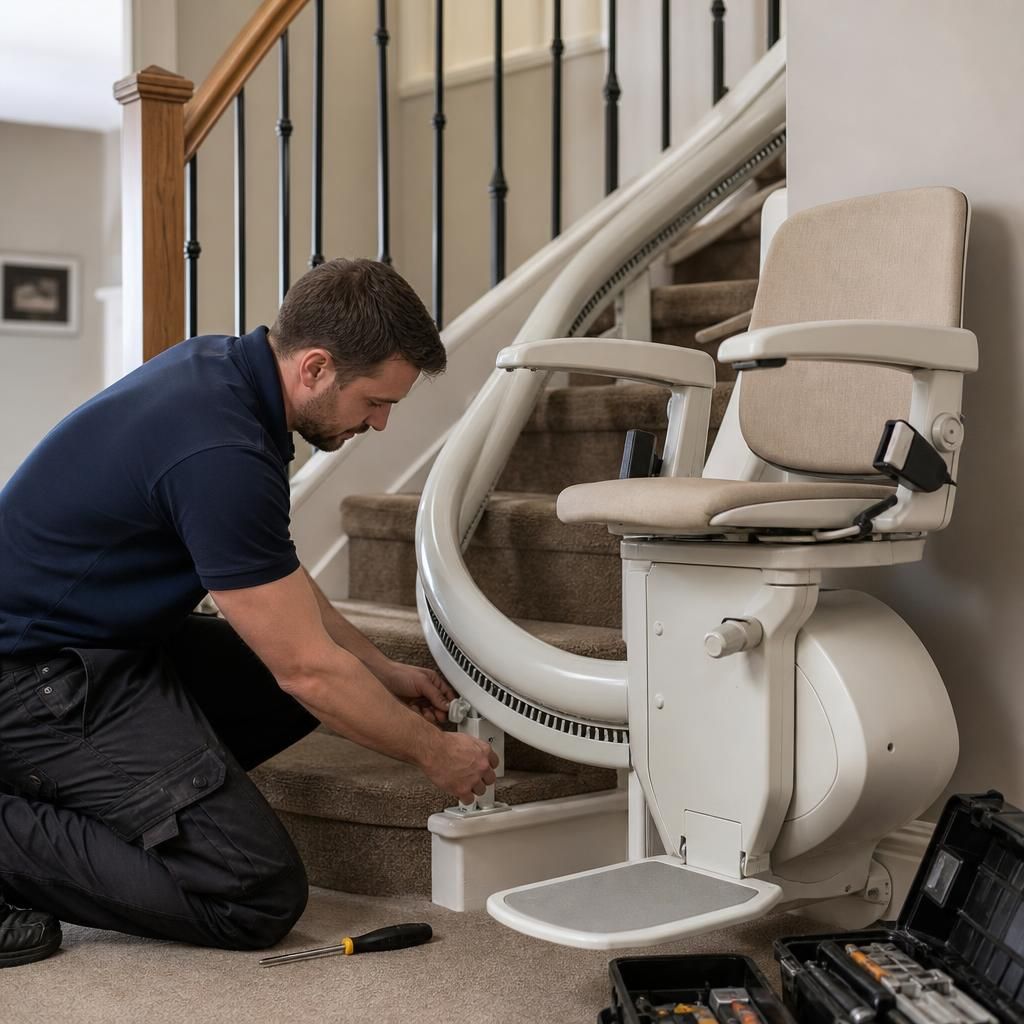
On installation day, the trained fitting team checks the staircase and confirms the agreed layout. The rail sections are positioned and secured to the steps or other approved structural points. The carriage, seat, footrest, controls, batteries and charging equipment are then fitted and connected.
The work is carried out on the staircase itself, so some temporary restriction of access is expected. Installers should keep the working area controlled and explain when the stairs can be used safely. The duration depends on the complexity of the staircase, the rail design, access conditions and any additional options. A particularly intricate route or a stairlift requiring a hinged or extended rail may take longer than a straightforward curved installation.
Testing and commissioning
After fitting, the stairlift is tested throughout its complete route rather than only at the top and bottom. Checks include smooth travel around bends, stopping positions, charging, seat rotation, footrest operation, restraint systems, controls and safety sensors. The installer also checks that the stairlift stops if it encounters an obstruction and that it parks without creating an unnecessary hazard on the stairs or landing.
Any adjustment needed to improve the approach, transfer position or clearance should be addressed before the installation is signed off. The stairlift should not be treated as ready for regular use until the required safety checks have been completed.
Demonstration and handover
You will be shown how to operate the stairlift safely and how to use its essential controls. This normally includes starting and stopping, using the seat belt or restraint, swivelling the seat, folding the seat and footrest, positioning the stairlift for charging and using the remote controls. The installer should also explain what to do if the stairlift stops unexpectedly and how to contact the service team.
Take time to practise getting on and off at both ends of the staircase. Keep your feet positioned on the footrest while travelling, remain seated with the restraint secured and avoid carrying bulky items that could affect your balance or catch on the staircase. If you have difficulty reaching a control or operating a manual feature, tell the installer before the handover is complete so the most suitable adjustment or option can be considered.
After installation
Keep the user information and service details somewhere accessible. The stairlift should be kept charged according to the manufacturer’s instructions, and the rail and charging contacts should be kept reasonably clean and free from obstructions. Do not attempt to alter the rail, bypass a safety feature or carry out electrical repairs yourself. Contact the service team if you notice unusual noise, uneven movement, repeated stopping, a fault warning or difficulty with the seat or controls.
A curved stairlift is designed around the staircase surveyed at the time of installation. If you later alter the stairs, move doors or install furniture close to the route, check that the changes will not affect safe operation. With an accurate assessment, careful fitting and proper instruction, the installation should provide a tailored and dependable way to use a curved staircase.
A curved stairlift installation involves fitting a bespoke rail that follows the exact shape of your staircase, rather than installing a standard straight section. The installer secures the rail to suitable structural points, fits the carriage, seat, controls and charging equipment, then checks the complete route.
Once fitting is complete, the stairlift is tested around every bend and landing. The installer checks stopping positions, safety sensors, the swivel seat, footrest, restraint and charging system before showing you how to use the stairlift safely. You should also practise transferring on and off at both ends and raise any difficulty with the controls before the handover is finished.
Arrange Your Curved Stairlift Assessment
Arrange your curved stairlift assessment with Independent Stairlifts to discuss your staircase, mobility needs and the most suitable installation options.