
What factors should I consider when comparing the different brands of curved stairlifts on the market?
When comparing curved stairlift brands, assess how accurately each rail can be customised to your staircase, along with seat comfort, safety features, reliability, ease of use, installation standards, warranty cover and ongoing servicing. Compare like-for-like quotations carefully, as the most suitable option depends on your home’s layout, mobility needs and the quality of support available after installation.
The most important factors when comparing curved stairlift brands are the quality of the bespoke rail design, suitability for the user, safety equipment, reliability, installation standard and aftercare. A curved stairlift is not simply selected by brand name: each system must be measured and configured for the individual staircase. Compare the complete solution, including the survey, seat and controls, installation, warranty and servicing, rather than comparing the headline price alone.
Rail design and level of customisation
Curved stairlifts use a made-to-measure rail, so the accuracy of the survey and the manufacturer’s ability to accommodate your staircase are central to the comparison. Ask whether the rail can be designed around landings, bends, narrow sections, intermediate floors, changes in gradient and the available space at the top and bottom. A well-planned rail should provide a practical travel path without unnecessarily obstructing the stairs or reducing access for other people in the home.
Check whether the quotation includes a fully bespoke rail or a more limited modular system. Modular sections can be suitable for some layouts, but they may not provide the same flexibility where the staircase has tight turns or unusual geometry. It is also useful to ask where the stairlift will park when it is not in use. A parking position that keeps the seat and carriage clear of a doorway, hallway or landing can make a significant difference to everyday access.
The survey should consider more than the staircase itself. Doorways, radiators, bannisters, light switches and other fixed features may affect the rail position or the user’s ability to get on and off safely. A home assessment should identify these points before the order is confirmed.
Seat comfort and user fit
Compare the seat dimensions, cushioning, back support and footrest rather than assuming that all curved stairlift seats feel alike. The user should be able to sit upright with suitable support and reach the controls without stretching or twisting. If more than one person may use the stairlift, consider whether the seat and control arrangement are appropriate for everyone.
Look at the seat height and the position of the armrests. These affect how easily the user can transfer from standing to sitting and back again. A powered or manual swivel seat can help the user turn towards the landing before standing, but the best option depends on strength, balance, joint movement and the layout at the top or bottom of the stairs. Ask how the swivel operates and whether it can be used reliably by the intended user.
Other options may include a powered footrest, a fold-up seat, adjustable seat components or a different seat style. These features should be recommended because they solve a specific access or comfort issue, not simply because they are available. If the user has limited knee or hip movement, ask for the likely seating position to be demonstrated before the final specification is agreed.
Safety features and ease of use
Most reputable stairlift systems include several safety functions, but the exact specification can vary between models. Compare the presence and operation of seat-belt arrangements, obstruction sensors, braking systems, swivel-seat interlocks and controls that prevent travel when the lift is not correctly positioned. Ask what happens if the carriage encounters an obstruction and whether the lift stops smoothly.
Controls should be simple to identify and operate. Consider the handset positions on the stairs and landings, the control on the armrest, the size and clarity of buttons, and whether the user can operate the lift with limited hand strength or dexterity. A remote control is useful for calling the stairlift to another floor, but it should not be regarded as a substitute for accessible controls on the lift itself.
Ask how the stairlift behaves if the seat is not fully swivelled back into the travel position, if the footrest is not correctly placed or if the belt is not fastened. These interlocks are intended to prevent unsafe movement. The installer should explain each relevant function in practical terms and show the user how to respond to warning sounds or indicator lights.
Power supply and battery performance
Curved stairlifts generally use rechargeable batteries so that the lift can continue to operate for a period during a mains power failure. However, battery capacity, charging arrangements and warning systems can differ. Confirm where the charging points are located, whether the lift charges along the full length of the rail or only at designated parking points, and how the user will know when the batteries need attention.
Ask what happens if the stairlift is left away from its charging position and whether it can be returned safely when the battery is low. You should also be told which items are considered routine battery replacement and whether they are covered by the warranty or service agreement. A clear explanation of charging habits can help prevent avoidable loss of use.
Build quality, reliability and noise
Look for evidence that the carriage, rail, seat mechanism and electrical components are designed for regular domestic use. Smooth starting and stopping, controlled movement around bends and reasonable operating noise are practical indicators of a well-specified installation, although a demonstration in your own home is more useful than relying on a brochure description.
Ask how the proposed system has been assessed for the conditions in your staircase, particularly if it has tight bends, long travel, more than one floor or limited clearance. The rail should be securely fixed without causing unnecessary damage to the stairs or surrounding finishes. The installer should also explain what level of noise is normal and how faults are diagnosed if the lift’s movement changes over time.
Compliance and installation standards
Do not compare a brand only on its advertised features. Ask for confirmation that the stairlift and installation meet the applicable UK safety and electrical requirements, and that the installer will provide the relevant operating information and documentation. The equipment should be supplied with clear instructions, safety information and details of its limitations.
The quality of the installation is just as important as the equipment. Check who will carry out the survey, manufacture or order the rail, install the lift and complete the handover. The installer should check the fixings, charging points, sensors, controls and seat functions before leaving. They should also demonstrate the lift with the user, explain safe boarding and dismounting, and make sure that family members understand the basic operating procedure.
Warranty and what it covers
Warranty terms should be compared in detail rather than by duration alone. Check which parts are covered, whether labour and call-out costs are included, and whether batteries, upholstery, handset controls and damage caused by misuse are treated differently. Ask when the warranty begins and whether it remains valid if the stairlift is moved, serviced by another company or used by more than one person.
Read the exclusions carefully. A longer warranty may provide less practical protection if important components or labour charges are excluded. It is also worth confirming the process for reporting a fault, the hours during which support is available and whether an engineer visit is included when remote assistance cannot resolve the issue.
Servicing, repairs and parts availability
A curved stairlift should be kept clean and used in accordance with the manufacturer’s instructions, but it also needs appropriate professional support. Ask whether servicing is recommended at particular intervals, what is checked during a service and how replacement parts are sourced. Proprietary parts may mean that repairs need to be carried out by an approved engineer, so establish who will support the system after installation.
Find out whether the provider offers support in your area and how faults are handled outside normal working hours. National coverage does not automatically mean that every service is carried out locally, so ask about the arrangements for your address. You should also confirm what happens if a part is discontinued and whether the company can continue to support older equipment.
Quotation and total cost
Request written quotations that describe the same scope of work. Each quote should identify the rail design, seat type, controls, safety features, charging points, removal of any existing equipment, installation, user training, warranty and aftercare. Check for charges that may be listed separately, such as additional parking positions, electrical work, alterations to flooring or removal of packaging.
The lowest initial price may not represent the lowest overall cost if it excludes servicing, batteries, call-outs or important comfort and safety options. Conversely, a higher quotation is not automatically better. Assess whether each additional feature is relevant to the user and whether it solves a genuine issue in the home. If a quotation changes after the survey, ask for the reason and request an updated written specification before proceeding.
Demonstration and independent comparison
Whenever possible, test the proposed seat and controls in person, either in your own home or on a suitable demonstration unit. Pay attention to boarding, swivelling, fastening the belt, operating the controls, travelling around bends and getting off at the landing. If a family member will provide assistance, they should understand how to use the handset and what to do if the lift stops.
It is sensible to compare the written specifications, not just the brand names. Two curved stairlifts from different manufacturers may offer similar core functions but differ considerably in seat dimensions, rail positioning, control design, charging method and aftercare. The best choice is the system that fits the staircase accurately, supports the user safely and can be maintained properly throughout its expected working life.
Before making a decision, confirm the final rail route, seat and swivel arrangement, safety functions, power and charging details, installation date, warranty conditions and servicing arrangements. A detailed home assessment and a clear handover should give you enough information to judge whether the proposed stairlift is suitable for both the property and the person who will use it.
When comparing curved stairlift brands, compare the complete installation rather than the carriage alone. The rail must be accurately measured and made to suit the bends, landings, clearances and parking space in your home.
Ask each provider to confirm what is included in writing, including the seat and swivel arrangement, safety controls, charging points, installation, user demonstration, warranty and future servicing. A lower quotation may exclude important features or aftercare, while a higher price is only worthwhile if it provides a genuine benefit for the user or the staircase.
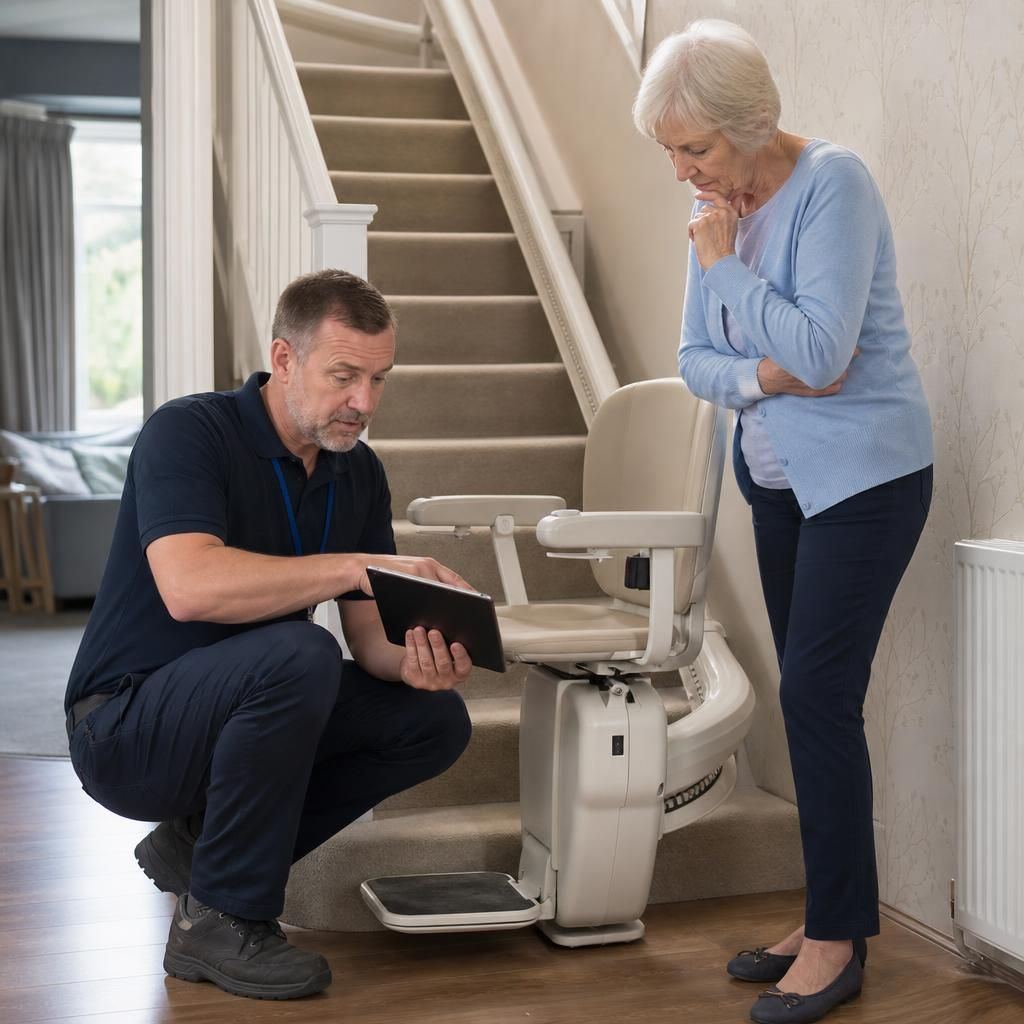
Compare your curved stairlift options with a home assessment
Arrange a home assessment to compare curved stairlift options against your staircase, mobility needs and preferred seat features. We can provide a clear specification covering the rail design, installation, warranty and ongoing support.