
What are the most important safety features to look for in a curved stairlift?
The most important curved stairlift safety features include obstruction sensors, a secure seatbelt, a powered swivel seat, reliable braking and battery backup. Look for easy-to-use controls, footrest and armrest safety features, and a correctly fitted rail and seat so the lift remains stable throughout every bend and landing.
The most important curved stairlift safety features are obstruction sensors, a secure restraint, a powered swivel seat, dependable braking, battery backup and controls that are simple to use. Because a curved stairlift travels around bends, landings and changes in gradient, the rail, seat and safety systems must also be accurately designed and fitted for the individual staircase.
Obstruction sensors
Sensors around the footrest and lower part of the carriage should detect objects in the stairlift’s path. If the lift encounters something such as a toy, shoe or dropped item, it should stop rather than continue over the obstruction. This is particularly important on curved staircases, where parts of the route may not be visible from the starting or landing position.
Ask how the sensors operate, where they are positioned and whether the stairlift can move again only after the obstruction has been removed. The sensors should be tested during the handover, along with any visual or audible warning they provide.
Secure seating and a suitable restraint
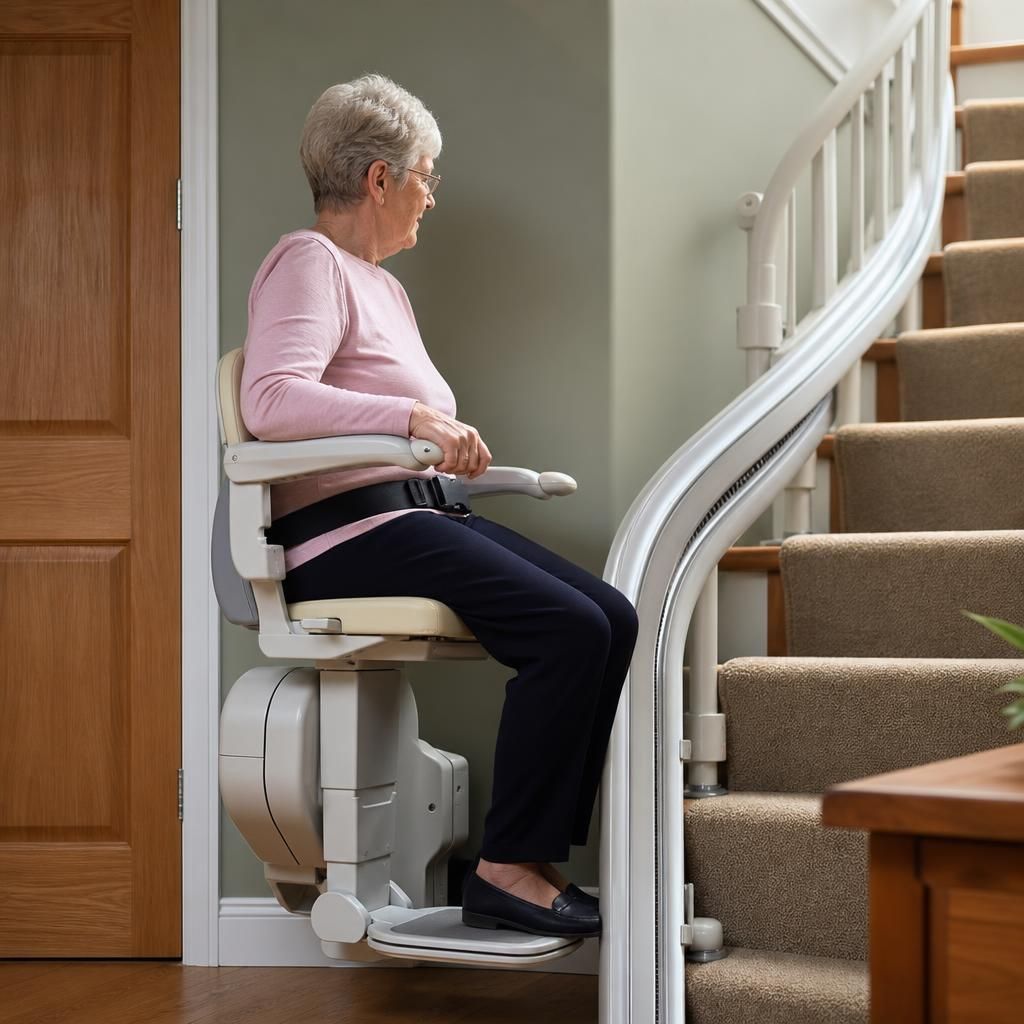
A seatbelt or harness should hold the user securely without being difficult to fasten. It must be used every time the stairlift travels, including on short journeys. The belt should be compatible with the seat design and allow the user to sit upright and comfortably throughout the journey.
For some users, a standard lap belt may be suitable. Others may need a different restraint arrangement because of balance, posture or limited movement. Discuss this during the assessment rather than assuming that one seatbelt design suits everyone.
Powered swivel seat
A powered swivel seat turns the user away from the staircase at the top or bottom, helping them get on and off while facing a safer landing position. The seat should lock securely in both the travelling and swivel positions, and the lift should not travel unless it is correctly aligned.
A swivel seat is especially useful where the staircase finishes close to a doorway, wall or narrow landing. Check that the chosen seat provides enough clearance for the user to turn and stand safely. Depending on the layout, a powered or automatic swivel may be preferable to a manually operated mechanism.
Reliable braking and controlled movement
The stairlift should start and stop smoothly, maintain a controlled speed around bends and stop safely when the controls are released. Its braking system must prevent unintended movement when the lift is stationary, including when it is parked on a slope or curved section of rail.
During a demonstration, listen for unusual sounds and note whether the movement feels steady rather than abrupt. Smooth acceleration and braking are not only more comfortable; they also reduce the risk of the user losing balance when getting on or off.
Battery backup and clear charging
Most modern stairlifts use rechargeable batteries so they can continue operating during a mains power cut. The lift should provide a clear indication when the battery is low and should charge reliably at its designated charging points.
Make sure you know where the charging points are located and whether the stairlift needs to be parked in a particular position. A lift that is regularly left away from its charging point may not be ready when needed. Battery condition should also be checked as part of routine servicing, as batteries gradually lose capacity with age.
Easy-to-use controls
Controls should be reachable and understandable for the person using the stairlift. A directional control on the armrest or a remote control can allow the lift to be called to the required level, while a clearly marked stop control should be available if the user feels unsafe or notices a problem.
Controls should not require excessive grip strength or complicated sequences. If more than one person uses the lift, each person should know how to operate the controls, stop the lift and contact the appropriate support service.
Safe armrests and footrest
Armrests should provide stable support and remain locked in position during travel. They should not fold or move unexpectedly when the user is sitting down or standing up. A correctly sized footrest supports both feet and helps prevent them from moving towards the stairs or the edge of the carriage.
Look for a footrest with obstruction detection and a surface that helps prevent slipping. The footrest should be positioned so that the user can sit back fully without their knees or feet being forced into an uncomfortable position. Some designs also include a foldable or powered footrest, which can be useful where space is limited.
Secure rail, carriage and seat locking
The rail must be measured and manufactured for the specific staircase, with secure fixings at suitable points. On a curved installation, accurate alignment is essential so the carriage remains stable through every turn, transition and landing. The seat, carriage and rail should all be checked for movement or looseness during installation and servicing.
The seat should lock into its travelling position, and any swivel, folding or height-adjustment mechanism should have a positive locking action. A safety switch or interlock should prevent travel if the seat, armrests or footrest are not in the required position.
Protection at landings and exit points
The lift should be positioned so that the user can get on and off without standing on the stairs or reaching around an obstacle. Where the top or bottom landing is tight, a longer rail, hinged rail or alternative parking position may improve access, provided it does not create a trip hazard or obstruct a doorway.
Consider other people who use the stairs as well as the stairlift user. The parked lift should leave a practical passage where possible, and a hinged or folding section should be secured when raised. The installer should also check that doors, walkways and emergency escape routes are not adversely affected.
Warning indicators and emergency features
Useful warning features include audible alerts, battery and charging indicators, fault codes and a clearly identified emergency stop. The user should receive straightforward instructions explaining what each warning means and what to do if the lift stops unexpectedly.
A manual lowering or emergency procedure may be available on some systems, but it should only be used as described in the manufacturer’s instructions. Do not attempt to bypass safety switches or move the stairlift manually unless specifically instructed by a qualified technician.
Correct assessment, installation and servicing
Even well-designed safety features depend on correct installation. The assessment should consider the user’s height, weight, mobility, posture, transfer ability and likely footwear, as well as the staircase’s width, bends, landings and nearby doors. A demonstration should confirm that the user can operate the lift, fasten the restraint and transfer safely at both ends.
After installation, keep the operating instructions and support contact details accessible. Arrange servicing at the recommended intervals and report changes such as unusual noise, jerky movement, a loose seat, worn belt, repeated sensor stops or reduced battery performance. Do not continue using the stairlift if a safety feature appears to be faulty.
Questions to ask before choosing
- Which obstruction sensors are fitted, and what happens when they detect an object?
- Does the seat swivel automatically, and does it lock securely before travel?
- What type of restraint is provided, and can it be adapted to the user’s needs?
- How does the lift behave during a power cut, and where are the charging points?
- Can the user operate the controls and emergency stop without assistance?
- Will the parked lift and rail leave safe access to doors, landings and the rest of the staircase?
- What checks are included during installation, handover and future servicing?
No single feature makes a curved stairlift safe on its own. The best result comes from combining appropriate seating and restraint, responsive sensors, controlled movement, dependable power and a rail that has been accurately tailored to the staircase. A practical assessment and hands-on demonstration will confirm whether the proposed configuration is suitable for the person using it and the way the home is arranged.
A powered swivel seat is an important curved stairlift safety feature because it helps the user turn towards the landing before getting off. The seat should lock securely in the travelling position and only allow the lift to move when it is correctly aligned.
During the assessment, check that the swivel provides enough clearance from nearby walls, doors and bannisters. The user should be able to sit down and stand up without reaching across the stairs or twisting. Ask the installer to demonstrate the controls and confirm that the seat, armrests and restraint are easy for the user to operate safely.
Arrange your curved stairlift safety assessment
Arrange a curved stairlift safety assessment with Independent Stairlifts to review the staircase, seating position, controls and safety features suited to the user and home.