
What are the installation time frames typically involved with fitting a curved stairlift, and how can I best prepare my home for the process?
A curved stairlift is usually fitted in a day once the bespoke rail has been designed and manufactured, although the full timescale depends on the survey, stair layout, chosen specification and any required adaptations. Before installation, clear the stairs and nearby landings, remove fragile or obstructive items, arrange access to power points, and ensure an adult is available to discuss final positioning and receive the handover.
A curved stairlift is commonly installed in a single day once the bespoke rail has been designed and manufactured, but the complete timescale starts earlier with the home assessment and may extend if the staircase is unusually complex, adaptations are needed or the required equipment is not immediately available. The surveyor should confirm the expected schedule after measuring the stairs and discussing the specification with you.
What affects the overall installation time frame?
- Initial assessment: A surveyor examines the staircase, landings, access points, seating position and available power supply. They also consider who will use the lift, whether transfers are difficult and how the stairlift can stop safely at the top and bottom.
- Design and manufacture: Unlike a standard straight rail, a curved rail is made to follow the individual shape of your stairs. The design may include bends, intermediate landings, changes in gradient and parking positions. Manufacturing begins after the measurements and specification have been checked.
- Additional work: The schedule may be longer if the installation requires electrical work, changes to a handrail, alterations to a doorway or other preparation. Listed buildings, restricted access or the need to coordinate with another tradesperson can also affect the date.
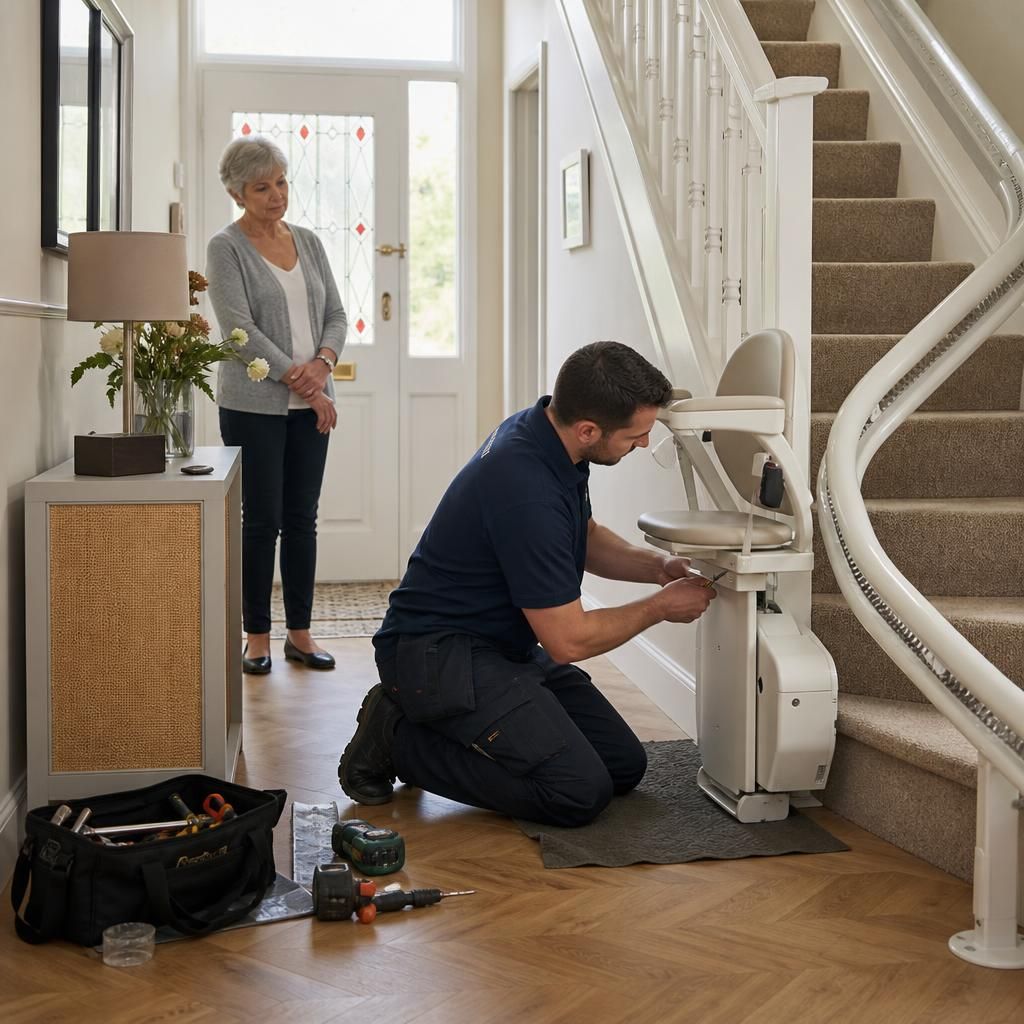
- Installation itself: On the agreed fitting day, the engineer assembles the rail, secures it to the stairs or suitable supporting surfaces, installs the carriage and seat, connects the charging point and completes safety checks. A straightforward fitting is often completed in one day, although the engineer will confirm the likely duration for your home.
The time required is not determined by the number of steps alone. A compact staircase with several tight turns may require more detailed work than a longer staircase with a relatively simple layout. A stairlift serving more than one flight, or one with unusual parking positions, folding rails or powered options, may also need additional design and installation time.
How to prepare your home before the survey
Preparation begins before the fitting date. During the assessment, provide accurate information about the person who will use the stairlift, including their height, weight, mobility limitations, ability to transfer and whether they need to travel with walking aids. This helps the surveyor recommend an appropriate seat, controls, swivel arrangement and safety features.
Point out anything that could affect the installation, such as loose stair coverings, narrow landings, doors that open towards the stairs, radiators, storage cupboards, low ceilings or areas where the user may need to stand after leaving the seat. Tell the surveyor about any planned building work so the rail and charging position are not designed around features that will soon change.
If you rent the property, obtain the landlord’s permission before work is arranged. In a leasehold property, check whether the freeholder or managing agent requires notice or approval. Where electrical work may be necessary, make sure access to the consumer unit and relevant sockets is available.
How to prepare for installation day
- Clear the stairs, top and bottom landings, and the areas where the engineer will bring equipment into the property.
- Remove ornaments, pictures, plants and other fragile items close to the staircase or installation route.
- Secure or remove loose rugs, trailing cables and other trip hazards.
- Move furniture that could obstruct access to the stairwell, charging point or parking position.
- Keep pets and children away from the work area while tools and components are being handled.
- Make sure the engineer can reach the agreed electrical supply and any relevant fuse or consumer unit.
- Arrange for an adult who knows the installation requirements to be present, particularly if final decisions about seat height, controls or parking positions may be needed.
Do not remove handrails, alter the stairs or carry out electrical work yourself unless this has been specifically agreed with the installation team. The rail may be designed to work alongside an existing handrail, and unnecessary changes can create additional safety or access issues.
What happens during and after the fitting?
The engineer will normally protect the working area, position and secure the rail, fit the stairlift, and test its movement along the full route. They should check the charging system, sensors, seat belt, swivel or powered features, controls and stopping positions. The stairlift should be tested from every relevant landing and parking position rather than only at the point where it was installed.
Allow time for a handover even if the physical installation is completed promptly. The user should be shown how to start and stop the lift, use the controls, fasten the seat belt, swivel the seat where fitted, charge the batteries and respond to an obstruction or low-battery warning. Ask questions about safe transfers and agree who to contact if the lift does not operate as expected.
Keep the stairs and landings clear until the engineer has finished testing and has confirmed that the installation is complete. If access is difficult, the user is particularly vulnerable or another person needs to be present for training, tell the team in advance. Good preparation does not remove the need for a professional survey, but it helps the fitting proceed efficiently and ensures the finished stairlift is positioned around the user’s actual routine.
Preparing your home for a curved stairlift installation means creating a clear, safe route for the engineer and ensuring the agreed stairlift position, power supply and access arrangements are ready. Although the bespoke rail is designed for your staircase, avoid making changes to the stairs or handrails before the fitting unless the installation team has specifically advised you to do so.
- Clear the stairs, top and bottom landings, and the route into the property.
- Remove fragile ornaments, loose rugs, trailing cables and furniture that could obstruct the work.
- Keep children and pets away from the staircase while tools and components are being handled.
- Make sure the engineer can access the agreed socket, charging point and consumer unit if required.
- Arrange for an adult to be present so final decisions about controls, seat position or parking points can be confirmed.
Allow time after the physical fitting for testing and instruction. The engineer should check the lift along its complete route, including charging points, sensors, seat belt, swivel mechanism and stopping positions, then explain safe operation and charging to the user.
Arrange Your Curved Stairlift Installation Assessment
Arrange your curved stairlift installation assessment with Independent Stairlifts to confirm the fitting requirements, expected timescale and preparation needed for your home. Our team can assess your staircase and discuss the most suitable position, controls and seating options with you.