
What features should I consider when selecting a curved stairlift?
When selecting a curved stairlift, consider the seat’s comfort and adjustability, essential safety features, battery performance, ease of use and how neatly the rail can be designed around your staircase. A professional assessment should also confirm that the lift suits your staircase layout, weight requirements, landing space and day-to-day mobility needs.
The most important curved stairlift features are a comfortable, supportive seat, suitable safety controls, reliable battery operation and a rail designed precisely for your staircase. You should also consider how easily you can transfer on and off the seat, operate the controls, position the lift at the top and bottom, and use it if your mobility or confidence changes over time.
Because a curved stairlift follows the shape of an individual staircase, its specification should be based on a professional assessment rather than on the model alone. The assessment should consider the staircase layout, available landing space, your weight and height, how you use the stairs, and whether anyone else in the household needs to use the staircase normally.
Seat comfort and support
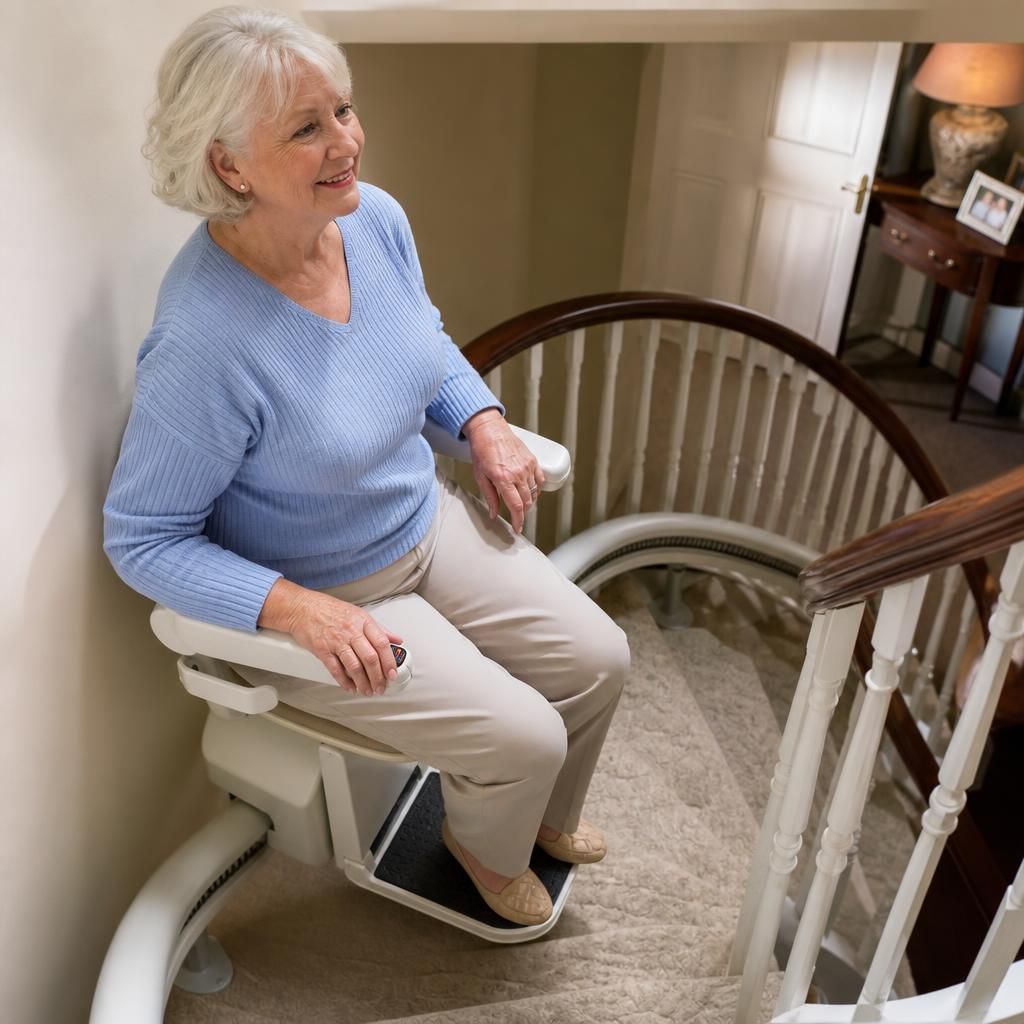
Look for a seat that supports a stable, upright sitting position without making it difficult to transfer. Important features may include a padded seat and backrest, supportive armrests, an adjustable footrest and a seat height that suits your knees and hips. The seat should feel secure while travelling and provide enough room without making the stairlift unnecessarily wide.
A powered swivel seat can be particularly useful where the top or bottom of the stairs has limited space. It turns the seat towards the landing, helping you get on or off while facing away from the staircase. Depending on your needs, you may also be able to choose a manual swivel mechanism, a powered folding seat or other seating adjustments. Ask for the seat to be positioned and demonstrated so you can judge whether you can transfer safely and comfortably.
Safety features
A suitable curved stairlift should include safety features that reduce the risk of falls, collisions and unintended movement. These commonly include:
- A seat belt or harness that is easy to fasten and release, with the level of support matched to your needs.
- Sensors that stop the lift if the footrest, carriage or another part of the stairlift encounters an obstruction.
- Secure armrests and a stable footrest to help maintain your position during travel.
- A braking system that controls movement when the lift stops or is parked.
- Controls that prevent the stairlift from operating unless key safety conditions are met.
- Emergency controls or an alarm, where included in the chosen specification, so assistance can be requested if necessary.
Controls should be clearly marked and usable without excessive grip strength or complicated movements. A remote control can allow a family member to call or send the stairlift between floors, while controls on the armrest let you operate it from the seat. If more than one person uses the lift, make sure everyone understands the controls and safety belt.
Rail design and staircase access
The rail should be measured and manufactured to follow the exact route of your staircase, including bends, landings and changes in gradient. A bespoke rail can be designed around many layouts, including stairs with intermediate landings, tight curves or limited clearance. The design should leave practical access for people who continue to use the stairs and should not create an avoidable trip hazard at the top or bottom.
Ask where the stairlift will park when it is not in use. A parking position may be at the top, bottom or another suitable point, depending on the staircase and available space. If the rail extends beyond the first or last step, this may make transfers easier by allowing you to get on or off on a level surface. The installer should explain how the rail affects doorways, hallways and access to nearby rooms.
A folding rail can be useful where a doorway, passage or entrance is close to the bottom of the stairs. It reduces the amount of rail left across the access route when the stairlift is parked. Whether this is required depends on the layout, so it should be assessed as part of the survey rather than added automatically.
Power supply and battery performance
Most domestic stairlifts use rechargeable batteries, allowing the lift to continue operating for a period during a mains power failure. Consider how the batteries are charged, whether the lift charges at more than one parking position, and whether you will be able to park it correctly after use. Leaving the stairlift in its charging position when not in use is important for reliable operation.
Ask what warning is provided when the battery needs charging or replacing and what happens if the power supply is interrupted. Battery performance can be affected by age, usage and whether the lift is regularly returned to its charging point. The installation and handover should include clear instructions for normal charging and for contacting support if the lift does not operate.
Ease of use and controls
The best feature set is one you can use consistently and confidently. Check that the operating switch can be moved with the hand you prefer, that the remote controls are comfortable to hold, and that the start and stop functions are easy to understand. A key switch or similar control may be useful where you want to prevent unsupervised use.
Consider whether you need to carry anything between floors. A small, secure storage option may be available on some stairlift configurations, but bags and other items should never obstruct the controls, seat belt, footrest or sensors. The stairlift should not be used to carry another person, pets or loose objects unless the equipment and its instructions specifically allow it.
Capacity and individual suitability
Check the stairlift’s stated weight capacity and ensure it accommodates you comfortably, including suitable clothing and any regular items you may carry. The seat, belt, footrest and armrests must all provide an appropriate fit. If you have reduced movement, balance difficulties, joint pain or a condition that may progress, discuss this during the assessment so the specification supports safe use now and remains practical for your likely needs.
Some users benefit from additional seat support, a different belt arrangement, a powered swivel or a control positioned for limited reach. These options should be considered alongside your ability to stand, turn and sit at each end of the journey. A stairlift does not remove the need for a safe transfer, so the space around the seat is as important as the travelling position.
Noise, finish and household use
Ask about the lift’s operating noise, particularly if a bedroom or living area is close to the staircase. The rail and seat finish should be suitable for your home, but appearance should not take priority over safe access, correct positioning or ease of use. Fold-away components can help preserve stair width when the lift is not being used.
If other household members use the stairs, consider how easily the seat, footrest and armrests fold away and whether the remaining stair width is adequate. A professional survey should identify any areas where the lift could interfere with doors, handrails, radiators or normal foot traffic.
Installation, demonstration and ongoing support
Before choosing a specification, ask for a clear explanation of how the rail will be fitted, where the lift will park, what electrical work is needed and how the finished installation will affect the staircase. You should receive instructions on charging, cleaning, safe operation and what to do if a warning appears or the lift stops.
It is also sensible to confirm the available warranty, servicing arrangements, battery replacement process and breakdown support. Keep the operating instructions accessible and report unusual noises, repeated stopping, reduced travel speed or battery warnings rather than continuing to use a lift that may need attention.
During your assessment, demonstrate the movements you will make in everyday use, including approaching the seat, fastening the belt, operating the control, turning at the top and bottom, and folding the equipment away. This allows the specification to be based on your actual mobility and staircase rather than on a standard package. Independent Stairlifts can use these details to recommend a curved stairlift configuration that balances comfort, safety, access and practical use within your home.
A powered swivel seat is an important curved stairlift feature when transferring on or off the lift is difficult. It turns the seat towards the landing, helping you sit down and stand up while facing away from the stairs rather than twisting beside the staircase.
During your assessment, check that the seat height, armrests, belt and footrest suit your movements. The installer should also confirm that the swivel position leaves enough clear space at the top and bottom of the stairs. A manual swivel seat may be suitable if you have sufficient strength and reach, while a powered option can reduce the effort required to operate the seat.
Book your curved stairlift assessment
Book your curved stairlift assessment with Independent Stairlifts to discuss your staircase layout, mobility needs and the features that would make everyday use safer and more comfortable.