
What factors should I consider when choosing a curved stairlift for my home?
When choosing a curved stairlift for your home, consider the shape and dimensions of your staircase, available space, user comfort, safety features, installation requirements, reliability and overall cost. A professional home assessment can confirm the most suitable rail design and options for your stairs, while ensuring the lift is comfortable and practical to use every day.
Choosing a curved stairlift involves assessing the staircase, the person who will use it and the way the lift will work within the home. The main factors are the shape and width of the stairs, the available space at the top and bottom, seating comfort, safety, installation requirements, reliability, future needs and the total cost. A professional home assessment is essential because a curved stairlift is made to follow the individual staircase rather than selected from a standard straight-rail model.
Staircase layout and rail design
Curved stairlifts are suitable for staircases with bends, landings, multiple flights, intermediate steps or changes in direction. The rail is measured and configured to follow the contours of the stairs, so the design must take account of every section of the staircase. The assessment should consider:
- the direction and severity of each bend;
- the position and size of any landing;
- the width of the staircase and the remaining walking space beside the lift;
- the height and shape of the top and bottom steps;
- doorways, radiators, bannisters and other nearby obstructions; and
- whether the rail should finish at the top or bottom in a way that improves access and reduces obstruction.
A skilled surveyor can identify whether a standard configuration is suitable or whether the rail needs a more tailored design. The position of the lift when parked is also important, particularly in a narrow hallway or where the staircase is part of an escape route.
Space at the top and bottom of the stairs
The lift must allow the user to get on and off safely. At the top, a suitable landing position may be needed so the user can turn away from the stairs without twisting or stepping close to the edge. At the bottom, the lift should finish where the user can dismount onto a clear, level area. In some homes, a hinged or retractable rail may help prevent the rail from projecting into a doorway or walkway.
Consider how the stairlift will affect other household members. A parked chair should not unnecessarily block access, and the folded seat, arms and footrest should leave as much usable stair width as the layout allows. These practical details should be checked during the survey rather than assumed from photographs or general stair measurements.
User comfort and ease of use
The chair should suit the user’s height, weight, mobility and confidence. Important points include the seat width and depth, the height of the armrests, the position of the controls and whether the user can operate the lift without excessive reaching. A powered swivel seat can assist with turning towards the landing, while a powered footrest may be useful if bending down is difficult.
Where more than one person may use the stairlift, the controls and seating need to be practical for everyone. A perch-style or standing-support seat may be considered where bending the knees or sitting fully is difficult, but it will not be suitable for every user or staircase. A trial or detailed discussion with the assessor can help establish which seating arrangement provides the best balance of support, comfort and available space.
Safety features
Safety should be considered alongside comfort, not as an optional extra. Features to discuss may include a seat belt, swivel or powered swivel seat, sensors that stop the lift if an obstruction is detected, secure armrests, a stable footrest and controls that are easy to identify. The lift should also start and stop smoothly, with a speed and movement that the user can manage confidently.
Controls may be fitted to the armrest and supplied as call-and-send controls, allowing the chair to be moved when it is parked at another level. If the user has limited hand strength, arthritis or reduced dexterity, the type and resistance of the control should be checked carefully. A manual or powered swivel function should be assessed in relation to the user’s ability to turn and transfer safely.
Power supply and operation during an outage
Most modern stairlifts use rechargeable batteries, with charging points incorporated into the rail or parking areas. Ask where the chair charges, whether it can charge at more than one location and how it behaves if the household power supply fails. Battery condition, charging habits and warning indicators should be explained at handover. The user should also know what to do if the lift stops away from a charging point or displays a fault message.
Installation and effect on the home
A curved stairlift is normally installed to the stairs rather than the wall, although the exact fixing method depends on the property and the manufacturer’s design. The installation team should protect the surrounding area, explain any work required and confirm how the lift will be tested. Ask whether the rail can be removed in the future and whether removal would leave significant fixings or alterations.
The survey should identify potential complications such as uneven steps, unusual bannisters, fragile surfaces, limited access for equipment or a staircase shared with another household. If building alterations or electrical work are necessary, these requirements should be explained before the installation date. The completed lift should be demonstrated, including starting, stopping, parking, charging, folding the seat and using the safety features.
Reliability, servicing and aftercare
Consider the support available after installation, not just the equipment itself. Confirm what is covered by the warranty, how faults are reported, whether servicing is available and what assistance is provided outside normal working hours. You should also receive guidance on routine cleaning, battery care and safe use.
Keep the rail and charging areas clear, avoid placing objects on the steps and follow the recommended maintenance instructions. Do not attempt to dismantle the chair, rail or battery system yourself. Promptly report unusual noises, jerky movement, repeated stopping or a battery that does not appear to charge, as early attention can prevent a minor issue from affecting continued use.
Cost and value
The cost of a curved stairlift reflects the complexity of the staircase, the length and configuration of the rail, the seating and safety options selected, installation requirements and the level of aftercare included. A bespoke curved lift generally requires more design and manufacturing work than a straight lift, so a direct price comparison is not meaningful unless the specification and service are comparable.
When reviewing a quotation, check whether it includes the home assessment, design and manufacture of the rail, installation, testing, user instruction, warranty and any agreed follow-up support. Ask about the treatment of optional features and whether future servicing, battery replacement or removal is charged separately. A clear quotation should explain what is included and identify any conditions that could change the price.
Future needs and household changes
The most suitable stairlift should work not only for the user’s current mobility but also for foreseeable changes. Consider whether getting on and off may become more difficult, whether another person may need to use the lift and whether the staircase needs to remain accessible to others. A configuration that is comfortable now may not be practical later if the user has increasing difficulty bending, standing or operating small controls.
Before making a decision, discuss the assessment findings, try the proposed seating and controls where possible, and ask how the lift will fit into daily routines. The right curved stairlift is one that follows the staircase accurately, leaves sensible space for other people, supports safe transfers and can be maintained with dependable assistance throughout its working life.
A curved stairlift is designed around the exact shape of your staircase, so a professional survey is essential before choosing a model. The assessment considers bends, landings, step width, obstructions and the space available for getting on and off safely.
The surveyor will also check where the rail should start and finish, how the chair can be parked without blocking a doorway or walkway, and whether a hinged or retractable rail is appropriate. This helps ensure the finished installation provides a clear route for other household members while allowing the user to transfer comfortably.
Use the assessment to discuss seating, controls, swivel options and any changes in mobility that may affect future use. A clear quotation should then explain the proposed rail design, installation work, included safety features, warranty and aftercare.
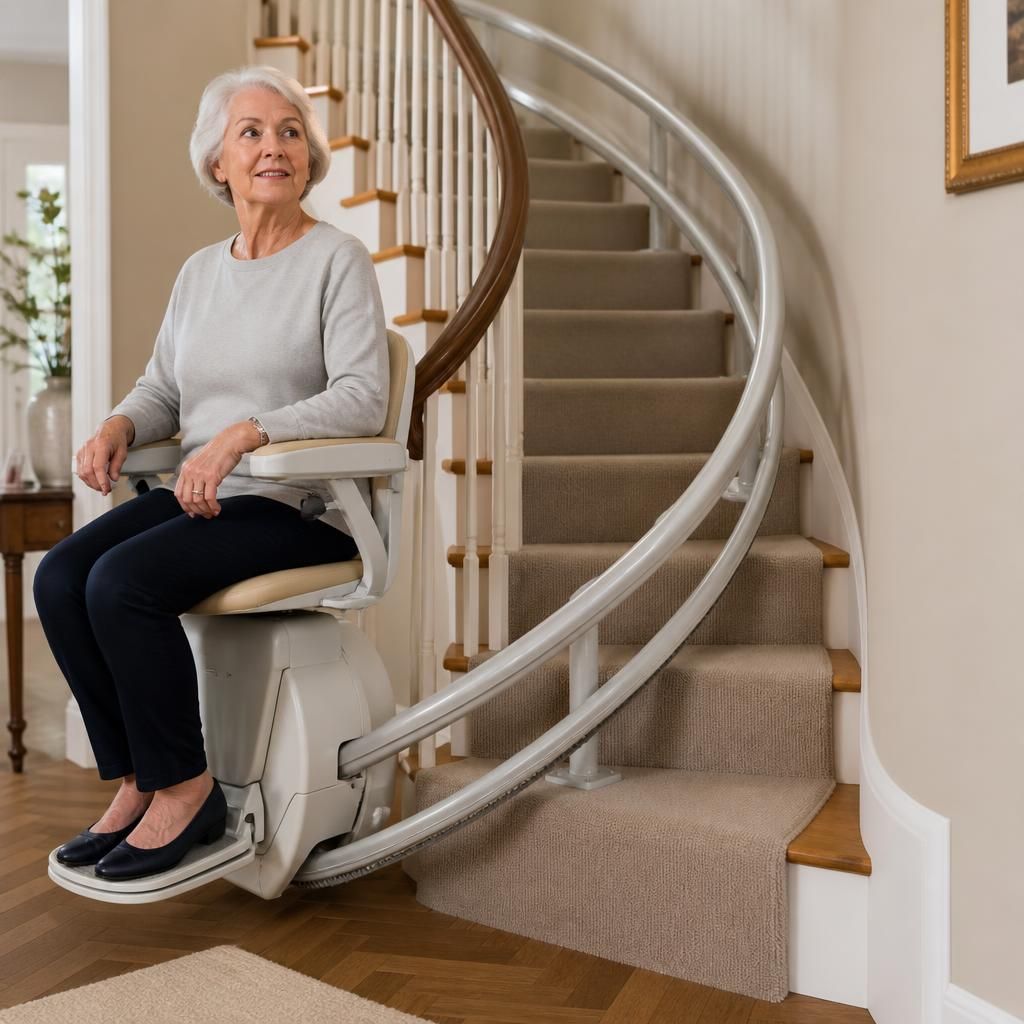
Arrange Your Curved Stairlift Assessment
Arrange your curved stairlift assessment to review your staircase layout, available space, seating needs and suitable safety features. Our team can then recommend an appropriate design and provide a clear quotation for your home.