
How do curved stairlifts differ in safety features compared to straight stairlifts?
Curved and straight stairlifts use core safety features such as a safety belt, obstruction sensors, controlled movement and emergency controls. Curved models may also require bespoke rail positioning, powered swivel or folding seats and additional sensors to manage bends, landings and tighter spaces, so safe performance depends particularly on accurate assessment and professional installation.
Curved and straight stairlifts share the same essential safety systems, including a seat belt, obstruction sensors, controlled acceleration and braking, emergency controls and battery backup. The main difference is that a curved stairlift must manage changes in direction, gradients, landings and tighter clearances, so its safety also depends more heavily on accurate surveying, bespoke rail positioning and the correct choice of seat and powered options.
Safety features common to both types
A properly specified stairlift should keep the user secure throughout travel and allow the lift to stop safely if a problem occurs. Common features include:
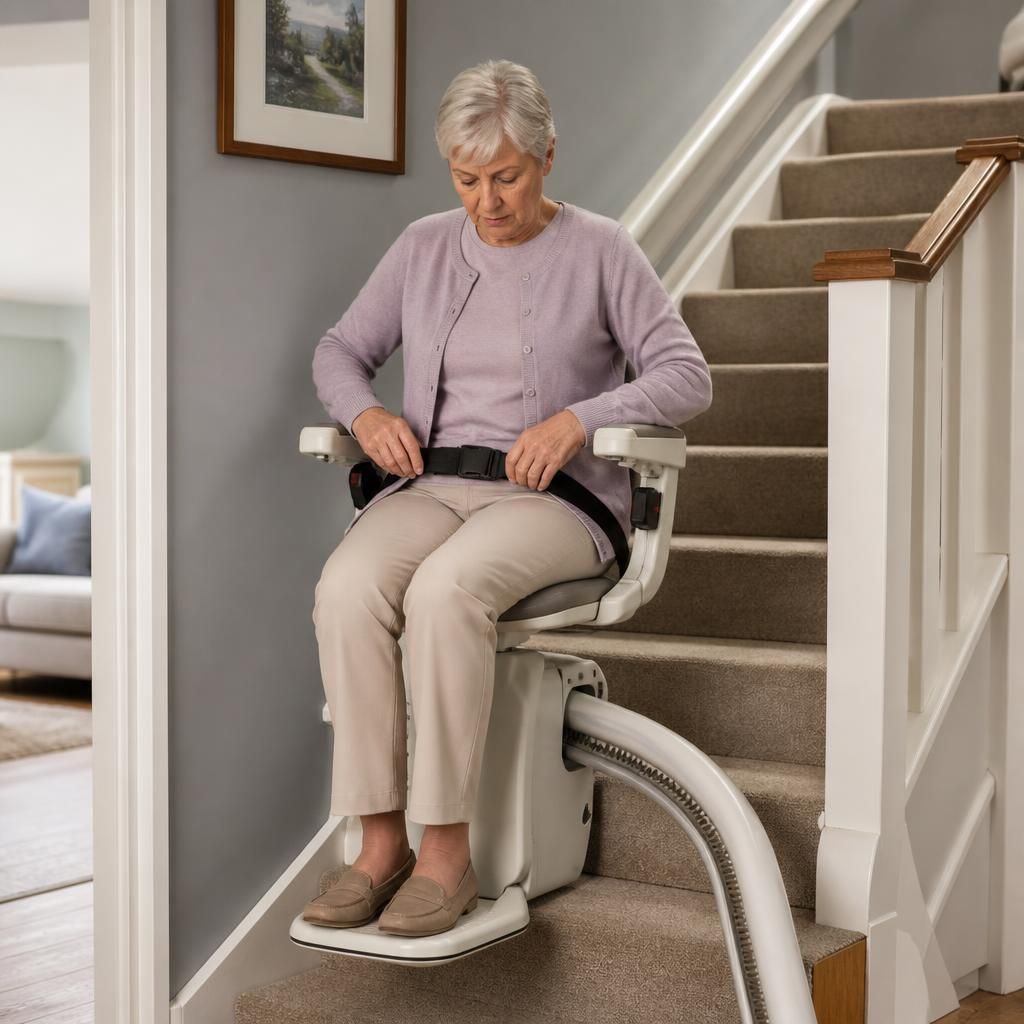
- Safety belt: The belt helps keep the user correctly positioned while the lift is moving. It should be fastened before travel and adjusted so it is secure without restricting comfort.
- Obstruction sensors: Sensors around the footrest, carriage or other vulnerable areas detect objects on the stairs and stop the lift or prevent it from continuing. The exact sensor arrangement varies by model.
- Controlled movement: The lift should start, travel and stop smoothly rather than moving abruptly. Speed is controlled by the stairlift system and may be managed differently when the carriage is negotiating a bend.
- Emergency stop and controls: Controls on the armrest normally allow the user to start, stop and steer the lift. An emergency stop control can interrupt travel if necessary, while remote controls allow the lift to be called to the required level.
- Battery backup: Rechargeable batteries allow the stairlift to operate during a power cut, provided they have been maintained and charged. Charging contacts or a charging point should be available at the appropriate parking position or positions.
- Locking and safety switches: The lift should not operate unless key safety conditions are met, such as the seat being correctly positioned or the armrests and seat being securely set for travel.
Why curved stairlifts need additional safety consideration
A straight stairlift travels along one consistent flight, so its rail and travel path are comparatively simple. A curved stairlift follows a made-to-measure rail around bends, intermediate landings or changes in direction. The rail must be positioned to provide suitable clearance from walls, banisters, doors and the edge of the stairs while keeping the carriage stable through each section.
This makes the survey and installation part of the safety solution, rather than merely an installation detail. The assessor needs to consider the staircase layout, the user’s height and mobility, how the user approaches the seat, where they transfer on and off, and whether the lift will be parked without creating an obstruction. A rail that is technically capable of following the staircase may still need careful positioning to make transfers and access safe and practical.
Powered swivel seats and transfer safety
Curved stairlifts often require more attention at the top and bottom of the stairs, particularly where there is limited landing space. A swivel seat can turn the user away from the stairway before they stand up, reducing the need to twist or step off while facing the stairs. On some layouts, the seat swivels automatically or is operated by a powered control; on others, a manual swivel may be appropriate.
The safest option depends on the individual and the available space. A powered swivel can be useful for someone with limited strength, balance or movement, but it must be used as intended and completed before standing. The installer should check that the seat can rotate fully without striking a wall, door or other obstruction, and that there is enough room for a stable transfer at the parking position.
Rail position, landings and folding components
On a curved staircase, the rail may extend around a landing or finish close to a doorway or walkway. The design may therefore include a folding or retractable rail, a powered hinge or a different parking arrangement to keep access routes clear. These components need to be specified for the particular staircase and used according to the manufacturer’s instructions.
Where the stairlift has a folding seat, armrests or footrest, these should be fully raised or lowered as instructed before the user transfers. A powered folding mechanism may reduce the effort needed, but it does not remove the need to check that the staircase is clear. Other household members should also understand how the lift is parked and how to avoid leaving objects in its travel path.
Features that help manage bends and tighter spaces
Curved models can incorporate safety switches and sensors suited to their carriage, rail and seat configuration. These may help detect obstructions near the footrest, carriage or folding rail as the lift approaches a bend or landing. The exact features differ between manufacturers and models, so they should be confirmed during the assessment rather than assumed.
Some curved stairlifts can be configured with a seat that swivels, a different seat height, adjustable arms or alternative controls. These are not simply comfort choices: they can affect posture, visibility, transfer technique and the user’s ability to operate the controls. A suitable configuration should allow the user to sit back securely, keep their feet supported and reach the controls without leaning into the stairwell.
Installation has a direct effect on safety
Professional fitting is particularly important for a curved stairlift because the rail is manufactured or adjusted for the specific staircase. The installer should check the rail fixings, carriage movement, clearances, charging positions, seat rotation, safety belt, sensors, controls and stopping points. The lift should be tested along the complete route, including bends, landings and parking positions, rather than only on the straight sections.
After installation, the user should be shown how to fasten the belt, operate the controls, use the swivel seat, respond to an obstruction stop, park and charge the lift, and use the emergency controls. If the user cannot operate a particular control comfortably, this should be discussed before the installation is completed. Family members or carers may also need a demonstration, especially where they will help with transfers or troubleshooting.
Which type is safer?
Neither curved nor straight stairlifts is automatically safer in every home. A straight lift may have a simpler travel path, while a curved lift can be the safer practical solution when a staircase has bends, landings or a layout that a straight lift cannot serve appropriately. Safety depends on the suitability of the design, the user’s abilities, the space available for transfers, correct fitting and regular servicing.
During an assessment, explain any difficulty with balance, bending, grip, vision, memory or transferring from a chair. Also mention whether other people need to use the stairs, whether doors open near the rail, and where the lift will be parked. This information helps determine whether additional options, such as a powered swivel seat, powered folding parts, alternative controls or a different parking position, are warranted.
Safe use and ongoing checks
- Fasten the safety belt before the lift moves and remain seated with your back against the seat.
- Keep feet on the footrest and avoid carrying loose items that could fall into the stairwell or interfere with the controls.
- Check that the route is clear before travelling, even though the lift has obstruction sensors.
- Do not attempt to stand until the lift has reached its designated stop and the seat has been swivelled as instructed.
- Keep charging points clear and report unusual noises, jerky movement, repeated obstruction stops or battery problems.
- Arrange servicing in line with the manufacturer’s guidance and do not bypass, remove or modify safety switches and sensors.
If a curved stairlift stops unexpectedly, leave it stationary, follow the user instructions and use the agreed support procedure rather than trying to move the carriage manually. If the lift is at an unsafe position or the user is unable to transfer, seek assistance and contact the service team promptly. A thorough assessment, accurate installation and appropriate user training are the most important differences in achieving safe day-to-day use, whether the stairlift is curved or straight.
The main safety difference between curved and straight stairlifts is the complexity of the travel route. A straight stairlift follows one consistent flight, whereas a curved model must negotiate bends, landings and tighter clearances. Its safety therefore depends not only on built-in features such as sensors and controlled braking, but also on accurate surveying and bespoke rail positioning.
The rail should be positioned to leave suitable clearance from walls, banisters, doors and walkways, while providing a stable route through every turn. The installer should also check the parking and transfer areas, including whether a swivel seat or folding rail is needed. These features can reduce twisting or standing close to the stair edge, particularly where landing space is limited.
After fitting, the complete route should be tested, including bends, stopping points and parking positions. You should be shown how to use the safety belt, obstruction controls, swivel seat and emergency stop, and should report unusual movement or repeated sensor stops rather than bypassing any safety device.
Arrange Your Curved Stairlift Safety Assessment
Arrange a curved stairlift safety assessment so we can review your staircase layout, transfer areas and the features needed for safe, practical use. We will explain the suitable options and answer any questions about installation and ongoing support.