
Are curved stairlifts more expensive than straight stairlifts, and what factors contribute to the cost difference?
Yes. Curved stairlifts usually cost more than straight stairlifts because they are bespoke-built to follow the exact shape of your staircase, with the price also affected by the rail design, number of bends or landings, installation requirements and selected features.
Yes. Curved stairlifts are generally more expensive than straight stairlifts because the rail is made to follow the precise shape of your staircase rather than being supplied as a standard straight section. The final cost depends on the design of the staircase, the amount of bespoke rail work required, the installation conditions and the specification of the stairlift itself.
A straight stairlift usually travels along one uninterrupted flight between two points. Its rail can often be manufactured from standard components and adapted to the required length. A curved stairlift, by contrast, may need to travel around bends, through turns, across landings or between several flights. The rail must be measured, designed and manufactured for the individual staircase, which increases both production and fitting costs.
The main factors that contribute to the difference in price include:
- Rail design and manufacture: The rail is the most significant difference between the two types of stairlift. A curved rail is created to match the staircase and may include bends, changes of direction, gradients or transitions between flights. More intricate designs require additional planning and manufacturing.
- The number and severity of bends: A stairlift serving a simple curved staircase may cost less than one navigating several tight bends. The radius and direction of each bend affect the rail design, the stairlift’s movement and the work required during installation.
- Landings and multiple flights: If the stairlift needs to travel around a landing or continue up more than one flight, the rail will be longer and more complex. Some layouts also require careful positioning so that the seat can stop safely without obstructing a doorway or access route.
- Staircase dimensions: The width of the stairs, the available headroom, the height of the steps and the position of walls, doors and banisters all influence the design. Narrow or unusually shaped staircases may require a more carefully tailored solution.
- Installation requirements: Curved installations normally involve more preparation and adjustment than a straightforward installation. The installer must position and secure the bespoke rail accurately, check clearances and test the stairlift throughout its route. Difficult access to the property or additional work to remove an existing stairlift can also affect the quotation.
- Seat and control options: Features such as a powered swivel seat, powered footrest, automatic folding or a powered hinge can add to the cost. These options may be useful where the user has limited movement, where the stairs are narrow or where the rail would otherwise extend into a doorway or passage.
- Parking and folding arrangements: A stairlift may need to park at the top or bottom of the stairs, or fold away to preserve access for other people. A powered or hinged rail may be needed if the rail would interfere with a door, hallway or landing.
- Electrical work or alterations: Most stairlifts are designed to use a domestic electrical supply, but the installation may require attention to the power connection or minor alterations to accommodate the equipment. Any additional work should be identified during the home assessment.
The price difference is not simply based on the length of the staircase. Two staircases with a similar number of steps can have very different costs if one has a tight bend, a split-level landing or restricted space at the top and bottom. Conversely, a longer but relatively uncomplicated route may be more straightforward to design and install than a shorter staircase with several changes of direction.
The condition and type of the staircase can also be relevant. Most stairlifts are attached to the stair treads rather than the wall, but the installer still needs to check that the stairs and surrounding structure are suitable. Features such as unusual steps, glass panels, ornate banisters, radiators or doors close to the staircase may affect the positioning of the rail or the choice of equipment.
A curved stairlift is not necessarily the right solution for every staircase. On some layouts, two straight stairlifts connected by a landing transfer may be considered, although this depends on the staircase and on the user’s ability to move safely between seats. A professional assessment is important because the most suitable arrangement is determined by both the physical environment and the person using the stairlift.
Reconditioned equipment may provide a lower-cost option in some circumstances, but a curved rail is still made for the individual staircase. A previously used curved stairlift cannot normally be transferred directly to a different staircase unless its rail, layout and components are compatible. The suitability, condition, warranty and aftercare arrangements should therefore be checked carefully before choosing a reconditioned option.
When comparing quotations, look beyond the headline price. Check whether the quote includes the home survey, bespoke rail, installation, delivery, demonstration, warranty and any agreed removal of existing equipment. It is also useful to confirm what happens if the staircase design changes after the survey, whether servicing is available and which items are covered if a fault occurs.
VAT treatment can vary according to the circumstances of the customer and the type of work supplied. Some disabled or chronically ill people may qualify for VAT relief on eligible goods and services, subject to the relevant rules and declarations. The installer can explain what information is needed, but eligibility should not be assumed automatically.
The most accurate way to establish the cost is to arrange a detailed assessment of the staircase and discuss the user’s needs. During the assessment, the installer can measure the route, identify access or parking issues, compare suitable configurations and explain which features are essential and which are optional. This produces a tailored quotation rather than relying on a general price range that may not reflect the complexity of your home.
In summary, straight stairlifts are usually less expensive because they use a simpler rail and require a more standard installation. Curved stairlifts cost more because they are individually designed, manufactured and fitted to negotiate the specific bends, landings and restrictions of the staircase. A careful survey and an itemised quotation will show which parts of the cost relate to the staircase itself and which relate to the chosen features or installation requirements.
The main reason curved stairlifts cost more than straight stairlifts is that their rails are designed and manufactured for the exact shape of the staircase. The rail must follow every bend, change of direction and landing while maintaining safe clearances for the user and other people using the stairs.
During the assessment, the installer considers the staircase dimensions, available headroom, nearby doors and banisters, and where the stairlift can park safely. A staircase with several tight bends or restricted space may require a more involved rail design than a longer, simpler route. Optional features such as a powered swivel seat, folding footrest or hinged rail can also affect the quotation.
For this reason, a home survey and itemised quotation are more useful than a general price estimate. They show which costs relate to the staircase itself, which relate to installation, and which arise from features selected for the user’s comfort, safety or access needs.
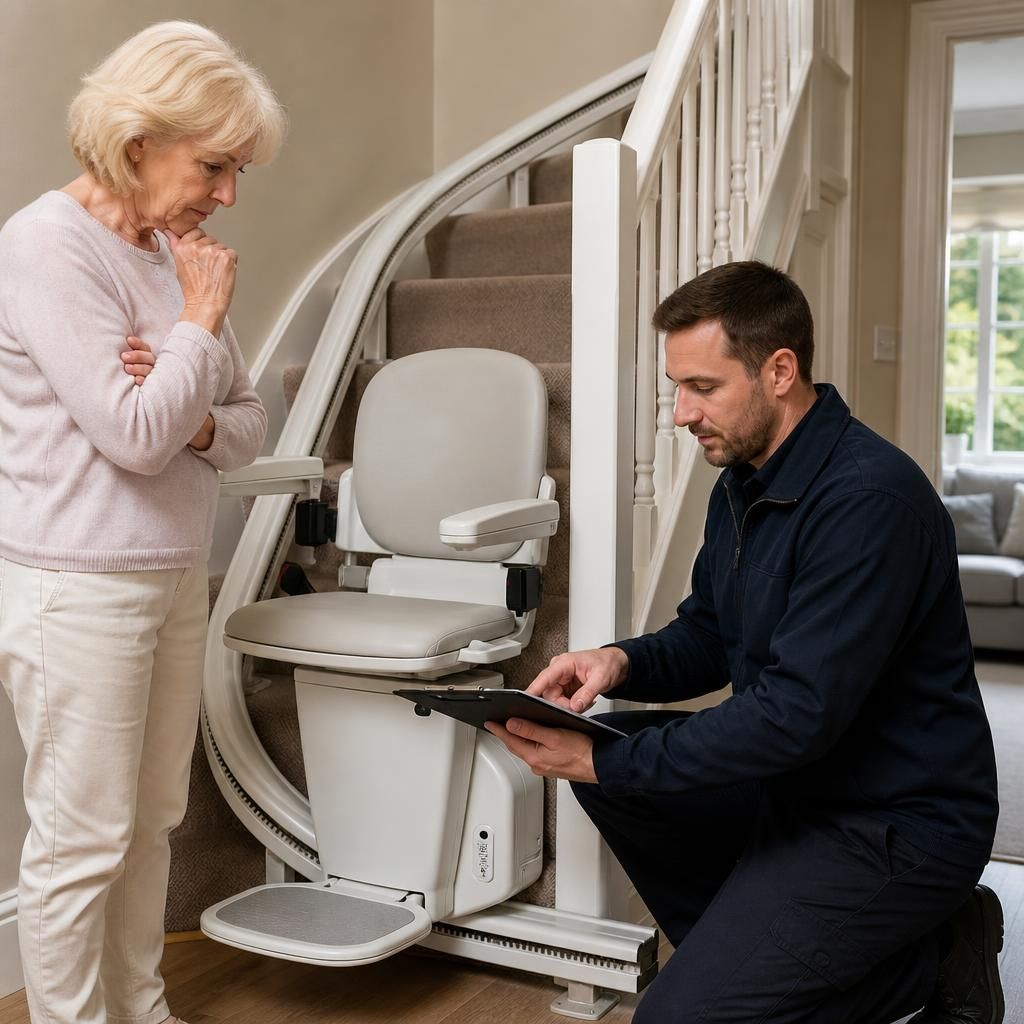
Arrange your bespoke curved stairlift assessment
Arrange a bespoke curved stairlift assessment with Independent Stairlifts to confirm the most suitable design and receive an itemised quotation for your staircase.