
How do I determine the right type of swivel seat for my curved stairlift?
Choose a swivel seat for your curved stairlift according to how safely and comfortably you can get on and off, the available landing space, and the position needed at the top or bottom of the stairs. A seating assessment will help determine whether a standard, powered, adjustable-height or other specialist swivel option is most suitable for your mobility and home.
The right swivel seat for a curved stairlift is the one that allows you to transfer on and off the stairlift safely, with the least unnecessary twisting or reaching. The decision depends on your balance, leg strength, hip and knee movement, the direction and size of the landing, and whether you can operate a manual swivel mechanism. A proper assessment should consider both your mobility and the position of the stairlift when it reaches the top or bottom of the stairs.
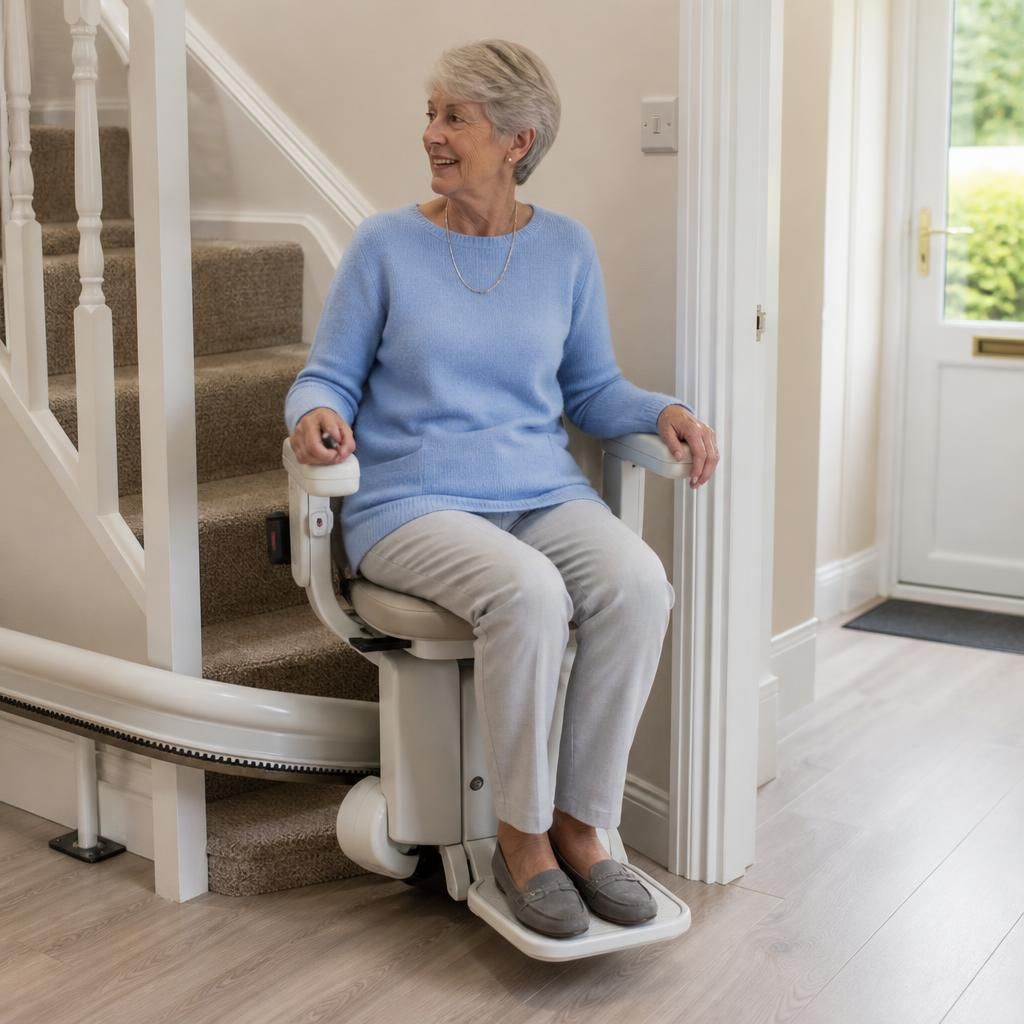
A swivel seat turns the chair away from the staircase, usually at the landing, so you can sit down or stand up facing the safer transfer area rather than facing directly towards the steps. On a curved stairlift, the rail and parking position are designed around the shape of your staircase, so the swivel seat must also work with the available space and the way you use the stairs.
Start with the transfer you need to make. Consider where you currently sit or stand before using the stairlift and where you need to be after leaving it. At the top of the stairs, you may need to turn towards a hallway, bedroom or landing. At the bottom, you may need to transfer towards a lounge, entrance hall or another room. The safest seat is one that positions you towards a clear, level area with enough room for your feet and any walking aid.
- Check the transfer direction: a standard swivel may turn towards one side, while some stairlift designs or configurations can accommodate different transfer requirements.
- Consider the landing space: a narrow landing, doorway or nearby furniture may affect how far the seat can rotate and where you can stand.
- Allow for your walking aid: if you use a stick, frame or crutches, there must be a safe place to position it before you sit down or after you stand.
- Think about both ends of the staircase: the most suitable arrangement at the top may not be identical to the safest arrangement at the bottom.
Choose between a manual and powered swivel according to your ability to operate it. A manual swivel seat is rotated using a lever or handle, normally when the stairlift has reached its parking position. It can be appropriate if you have sufficient hand strength, arm movement and coordination to release the mechanism and turn the seat in a controlled way. The seat should not be forced or rotated while the stairlift is moving.
A powered swivel operates using the stairlift controls, reducing the physical effort needed to turn the seat. This can be more suitable if arthritis, reduced grip, shoulder problems, tremor, weakness or poor balance makes a manual lever difficult to use. It may also help if you need to keep both hands available for stability during the transfer. The exact controls and operating sequence vary, so you should practise them during the assessment and installation.
Consider whether you need height adjustment. A standard seat height may be suitable when you can sit down and stand up from a normal chair without difficulty. If the seat is too low, standing can place extra demand on the knees and hips. If it is too high, your feet may not rest securely on the floor when you are seated, which can affect comfort and stability. An adjustable-height or lift-up seat may help achieve a safer relationship between the seat, your feet and the landing, but its suitability depends on the stairlift model and the space available.
Some specialist options combine powered swivelling with a lifting or raising movement. These can assist a person who finds the final part of standing particularly difficult. They are not suitable for every staircase or user, because the seat must still provide stable support and leave sufficient clearance from walls, doors and other obstructions. Your installer should confirm whether this type of seat is compatible with the curved rail and the intended parking position.
Assess the seat itself, not only the swivel function. The seat should provide firm, comfortable support without making it difficult to rise. Important points include:
- Seat height and depth: your feet should be supported appropriately and your knees should remain in a comfortable position.
- Armrests: sturdy armrests can provide useful support when sitting down and standing up. Check that their width does not make the transfer more difficult.
- Back support and cushioning: the seat should support your posture for the length of the journey without causing pressure or discomfort.
- Footrest position: your feet should be fully supported, with enough clearance for the stair edges and any nearby wall or obstruction.
- Seat belt: you should be able to fasten and release it comfortably. If dexterity is limited, the buckle position and ease of use are particularly important.
- Folding parts: folding arms, seat or footrest may help preserve access to the stairs when the stairlift is parked, provided you can operate them safely.
Your physical abilities should be considered as they are on an ordinary day, rather than only when you feel at your best. Tell the assessor about difficulty with standing, turning, sitting, grip, vision or fatigue. Also mention whether you transfer from a wheelchair, use a frame, or need another person nearby. A seat that appears suitable in a showroom may not be appropriate if the transfer at home involves a tight turn, a slope, a doorway or a change in floor level.
Test the complete movement before deciding. During an assessment, try approaching the seat, applying the brake if required, sitting down, fastening the belt, operating the controls, swivelling at the landing and standing up. Repeat the transfer in the direction you will use at home. You should be able to complete each step without leaning beyond the armrest, twisting sharply, reaching behind you or relying on furniture for support.
Ask the assessor to demonstrate what happens if the seat is not fully swivelled, if the stairlift stops at the landing, or if you need to operate the controls with one hand. The swivel should have a secure locking mechanism and clear operating instructions. Safety features such as a seat belt, armrests, obstruction sensors and a suitable parking position remain important, but they do not replace a safe transfer technique.
The layout of a curved staircase can make the choice more specific than simply selecting a seat style. A tight turn, intermediate landing, low ceiling, radiator, door or restricted hallway may affect where the chair can park and how it can rotate. The curved rail can usually be designed around the staircase, but the swivel seat still needs adequate clearance at the transfer points. Measurements should therefore be taken with doors, furniture and your usual walking route in mind.
If more than one person will use the stairlift, the seat should be assessed for the person with the greater mobility needs. A manual swivel that works for one user may be unsuitable for another, particularly if hand strength or balance varies. Where needs are changing, discuss whether powered operation, adjustable height or another specialist configuration could provide greater practical independence.
Do not select a swivel seat solely because it is the most compact or the least expensive option. Compatibility with the curved stairlift, transfer direction, user weight and staircase measurements must be confirmed by the installer. Some features may also affect the folded dimensions of the stairlift, available headroom and the way other household members use the stairs.
Before installation, confirm which controls operate the swivel, whether the seat can be used at both parking points, how it locks into position, and what happens during a power interruption. You should receive clear instructions and have the opportunity to practise under supervision. If your mobility changes later, contact Independent Stairlifts for a reassessment rather than adapting the mechanism yourself or using the seat in a way it was not designed for.
In practical terms, choose a standard manual swivel when you can operate it reliably and the landing provides a straightforward transfer. Choose a powered swivel when turning the seat manually is difficult or unsafe. Consider height adjustment or a specialist lifting option when the main challenge is sitting down or standing up, subject to a technical assessment. The final recommendation should match your movement, your transfer route and the precise geometry of your curved staircase.
The most suitable swivel seat is determined by how you transfer on and off the curved stairlift, rather than by the seat style alone. A manual swivel can be appropriate if you have the grip, arm movement and coordination to operate the lever safely. If arthritis, weakness, tremor or poor balance makes this difficult, a powered swivel may reduce the effort required.
The seat must also rotate towards a clear, level landing with enough room for your feet and walking aid. During your assessment, practise approaching the seat, fastening the belt, swivelling it at the parking position and standing up. This confirms that the chosen mechanism works with your mobility and the precise layout of your staircase.
Book your swivel seat assessment
Book a personalised swivel seat assessment with Independent Stairlifts to confirm which option suits your mobility, transfer needs and curved staircase layout.