
What factors should I consider when choosing between renting and buying a curved stairlift?
When choosing between renting and buying a curved stairlift, compare the expected length of use, total costs, ownership, flexibility and the suitability of the stairlift for your staircase. Renting may suit temporary or uncertain needs, while buying can offer better long-term value when the stairlift is likely to be needed for an extended period.
The choice between renting and buying a curved stairlift mainly depends on how long it is likely to be needed, the total cost over that period, and whether the stairlift can be reused if your circumstances change. Renting can provide flexibility for a temporary or uncertain need, while buying is often more economical when the stairlift is expected to remain in use for several years. With a curved stairlift, the design of the rail is also important because it is usually made to follow the exact shape of the staircase.
Consider how long the stairlift is likely to be needed
Expected duration is usually the most important factor. Renting may be appropriate when the stairlift is needed during recovery from an injury, while a property is being adapted, or when the future need for a stairlift is unclear. It can also be useful if a family member is temporarily moving into the property.
Buying may provide better long-term value when a permanent mobility need is expected. It avoids continuing rental payments after the initial purchase has been covered, although ownership means taking responsibility for ongoing servicing and any repairs outside the warranty or service agreement.
It is not always possible to predict future needs precisely. If the intended period of use is uncertain, ask for a clear comparison based on different possible timeframes rather than relying only on the monthly rental price or the purchase price.
Compare the total cost, not just the starting price
A rental agreement may involve an initial installation charge, a refundable or non-refundable deposit, regular rental payments, and charges for removal or damage at the end of the agreement. The exact structure varies, so check what is included before making a decision.
Buying normally involves a larger upfront cost, but the stairlift becomes yours. You should still allow for servicing, batteries, call-outs, and repairs after any included warranty period. Ask whether the quotation includes delivery, installation, demonstrations, aftercare and removal if the stairlift is no longer required.
For a fair comparison, calculate the likely overall cost for the period you expect to use the stairlift. For example, compare the purchase price plus anticipated ownership costs with the rental payments and all associated charges over the same period. A written quotation should make clear whether prices include VAT and whether any VAT relief may apply to your circumstances. Eligibility depends on individual and product requirements, so this should be confirmed rather than assumed.
Understand how curved stairlift rental differs from straight stairlift rental
A curved stairlift is normally designed around the staircase, including bends, landings, changes in direction and transitions between floors. This means the rail may not be readily transferable to another property or staircase. Some rental arrangements are therefore based on a bespoke rail being made for the home, while others may use a suitable reconditioned system where one is available.
Ask whether the rental includes a new or reconditioned stairlift, whether the rail is made specifically for your staircase, and what happens to the equipment when the agreement ends. A reconditioned stairlift can be a practical option, but it should be professionally inspected, refurbished where necessary and installed by a competent provider.
Check what is included in the rental agreement
- The length of the minimum rental term and the notice needed to end the agreement.
- Whether the agreement continues automatically and how payments are collected.
- Installation, removal and any charges for changing or ending the arrangement.
- Routine servicing, battery replacement and repairs caused by normal use.
- How quickly technical faults will be assessed and whether emergency call-outs are included.
- Responsibility for accidental damage, misuse or changes to the staircase.
- What happens if the user moves home, enters long-term care or no longer needs the stairlift.
These details can make a significant difference to the real cost and convenience of renting. Do not rely on verbal assurances alone; ask for the terms in writing and raise any unclear conditions before installation.
Consider ownership and future flexibility
When you buy a stairlift, you own the equipment and can usually decide when it is removed, retained or replaced, subject to any finance or warranty terms. Ownership may be useful if the stairlift is expected to remain in the home for a long time or if you want to keep it available for future occupants.
However, buying does not guarantee that the stairlift can be moved to another property. The curved rail is made for a particular staircase, and a new home may have different dimensions or a different layout. The carriage may potentially be reusable, but the rail and other components would need to be assessed. Always ask for advice before assuming a purchased stairlift can be relocated.
Think about your housing situation
If you rent your home, obtain the landlord’s permission before arranging installation. A curved stairlift is attached to the stairs rather than normally being fixed to the wall, but the work can still affect the property and may need to be removed later. Clarify who will pay for installation, removal and making good any affected areas.
Homeowners should also consider whether they may move in the foreseeable future. Renting may offer a simpler exit route, but it is not automatically transferable to another staircase. Buying may be worthwhile if you intend to stay and the stairlift is likely to be used regularly.
Assess the stairlift and the user’s requirements
The decision should not be based on price alone. A proper assessment should consider the staircase, available space, landing positions, access to controls, transfer points, the user’s height and weight, and their ability to sit, stand and operate the controls safely. Features such as a powered swivel seat, powered footrest or folding mechanism may affect the price but can make daily use safer and more manageable.
A rental option is only suitable if the available equipment can meet the user’s needs and fit the staircase correctly. Do not accept a less suitable model simply because it has a lower initial cost. A bespoke assessment is particularly important on narrow stairs, multi-storey staircases and layouts with tight corners or unusual landings.
Consider servicing and reliability
Both rented and purchased stairlifts need regular care. Ask who arranges servicing, whether it is included in the agreement, and how repairs are handled. A purchased stairlift may be covered by a manufacturer’s warranty for an initial period, but warranty terms vary and may not cover every call-out or consumable component. With a rental agreement, maintenance may be included, although this should be confirmed in writing.
Keep the service records and follow the manufacturer’s instructions. Report unusual noises, jerky movement, charging problems or changes in braking promptly. Do not attempt to repair the stairlift yourself.
Ask about payment options
If buying is preferable but the upfront cost is difficult to manage, ask whether staged payments or finance are available. Check the total amount repayable, interest, fees, deposit requirements, payment length and what happens if the stairlift is no longer needed. Finance is a credit arrangement, so make sure the repayments are affordable and read the agreement carefully.
Use a personal comparison before deciding
Renting is generally worth considering when the need is temporary, the duration is uncertain, or preserving short-term flexibility is more important than ownership. Buying is generally worth considering when the stairlift is likely to be used regularly for an extended period, the home is likely to remain suitable, and you can manage the upfront cost and future maintenance.
Ask for both options to be assessed against the same staircase and specification. A useful written comparison should show the installation cost, recurring payments, servicing, warranty, repairs, removal arrangements and likely total cost over the expected period of use. This allows you and your family to choose based on suitability and long-term value rather than on the headline price alone.
Choosing whether to rent or buy a curved stairlift mainly depends on how long it is likely to be needed and the total cost over that period. Renting can suit a temporary or uncertain requirement, while buying may offer better long-term value when the stairlift is expected to remain in regular use.
Compare more than the headline monthly rental payment or purchase price. Check installation, servicing, repairs, batteries, removal, deposits and any end-of-agreement charges. Because a curved rail is usually made to match one specific staircase, also ask whether the rental equipment is new or reconditioned and what happens if your circumstances change.
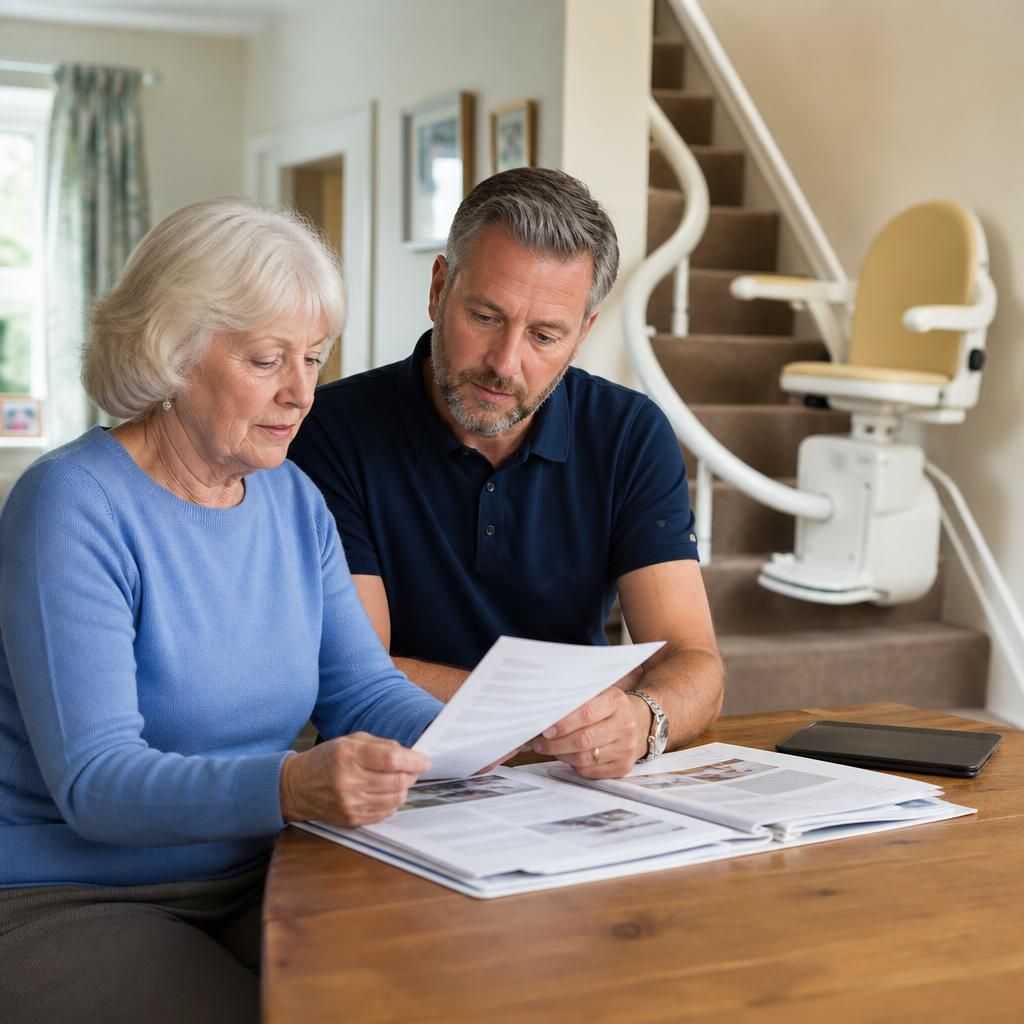
Discuss your curved stairlift rental or purchase options
Discuss your curved stairlift rental or purchase options with our team, using your staircase layout, expected length of use and budget to compare the most suitable arrangements. We can explain what is included in each option and help you request a tailored assessment.