
What are the main maintenance requirements for a curved stairlift?
A curved stairlift mainly requires regular professional servicing, safety checks, battery testing and cleaning of the rail, seat and controls. You should also follow the manufacturer’s guidance, keep the track clear and report unusual noises, movement or fault indicators promptly.
A curved stairlift mainly requires scheduled professional servicing, routine safety checks, battery testing, cleaning and prompt attention to faults. Because the rail follows the individual shape of the staircase, the technician must check not only the seat and drive unit but also the rail, bends, charging points, sensors and any powered swivel or folding features.
Professional servicing
Arrange servicing in line with the manufacturer’s instructions and the terms of your warranty or service agreement. A qualified technician will normally inspect the complete stairlift, test its operation at different points on the curved rail and check that it starts, stops and parks correctly. They may also examine the drive mechanism, fixings, wiring, charging contacts, seat belt, armrests, footrest and safety sensors.
There is no single servicing interval that applies to every curved stairlift. Usage, the age and model of the lift, the stair layout and the manufacturer’s recommendations all affect the appropriate schedule. Regular servicing is particularly important where the stairlift is used frequently, carries heavier loads within its rated capacity or operates in a home with more than one user.
Battery and charging checks
Most curved stairlifts use rechargeable batteries and should be left on their designated charging points when not in use. Check that the lift reaches its charging position fully and that any charging indicator behaves as described in the user instructions. If the stairlift begins moving more slowly, stops before completing its journey, needs repeated charging or displays a low-battery warning, report it rather than continuing to use it until the battery is completely discharged.
Batteries are consumable components and eventually need replacing. The timing depends on use, charging conditions and the equipment itself. Battery replacement should be carried out with the correct type specified for the stairlift; fitting an unsuitable battery can affect performance and safety.
Cleaning the rail and stairlift
Keep the rail, seat, footrest and controls free from dust, pet hair and other debris. Use a soft, slightly damp cloth where appropriate and follow the cleaning instructions supplied with the lift. Do not pour water or cleaning products onto the equipment, spray directly into controls or apply lubricant unless the manufacturer specifically requires it. Incorrect lubrication can attract dirt or affect the drive system.
The curved rail should remain clear along its full route. Check for objects, furniture, rugs, clothing or decorations that could obstruct the lift, particularly at bends, landings and parking positions. Do not alter the rail, move its brackets or attempt to adjust the drive unit yourself.
Routine checks you can carry out
- Check that the seat belt latches securely and is not frayed or damaged.
- Make sure the seat, armrests, footrest and swivel mechanism lock in their intended positions.
- Test the controls and remote controls for a clear response, following the user manual.
- Keep safety edges and sensors clean and unobstructed.
- Look for loose covers, damaged wiring, unusual wear or changes in the way the lift travels.
- Check that the staircase and landing areas remain clear of items that could interfere with the lift or the user.
These checks are useful between services but do not replace professional maintenance. Never remove covers or try to repair electrical, mechanical or safety components yourself.
Signs that the stairlift needs attention
Contact the service team if you notice unusual noise, vibration, jerky movement, reduced speed, unexpected stopping, difficulty reaching a charging point or a fault indicator that does not clear. Also report a seat that does not swivel or lock correctly, a footrest that is difficult to operate, a belt that will not latch or any visible damage to the rail, controls or wiring.
If the stairlift stops unexpectedly, follow the instructions in the user manual. Avoid repeatedly overriding a safety sensor or attempting to force the lift to move. If someone is left on the stairs, use the agreed emergency procedure and contact the appropriate support service. Where a fault could affect safe operation, stop using the stairlift until it has been assessed.
What maintenance is usually covered
For a rented stairlift, the rental agreement should explain which servicing, repairs and replacement parts are included and which responsibilities remain with the user. For a purchased lift, cover depends on the warranty and any maintenance plan selected. Keep the service records and report problems through the stated contact route, as unauthorised repairs or modifications may affect warranty cover.
When a curved stairlift has been serviced, ask the technician to explain any work completed, parts replaced and recommendations for future attention. Keeping this information with the user instructions helps maintain a clear service history and supports safe, reliable use.
Professional servicing is the most important maintenance requirement for a curved stairlift. A qualified technician checks the complete lift, including the bespoke rail, drive unit, charging points, safety sensors, seat belt, swivel seat and footrest. They also test how the stairlift starts, stops, travels around bends and parks at the top or bottom of the staircase.
Follow the servicing schedule in your user instructions, warranty or service agreement. Between visits, keep the rail and charging points clear, leave the stairlift on its designated charger when not in use, and report unusual noises, jerky movement, reduced speed or fault warnings promptly. Do not remove covers, adjust the rail or attempt electrical repairs yourself.
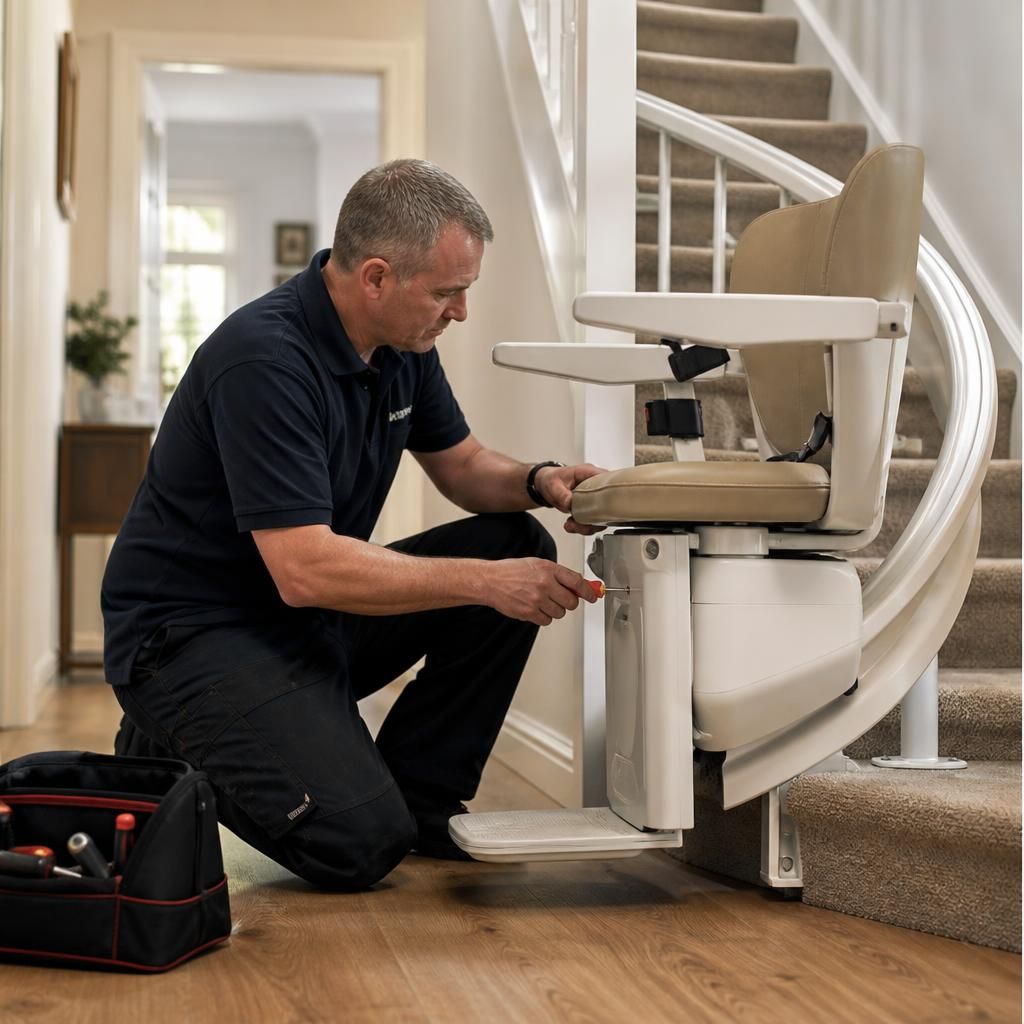
Arrange professional curved stairlift servicing
Arrange professional curved stairlift servicing with Independent Stairlifts to keep the rail, drive system, batteries and safety features working reliably. Contact our team to discuss servicing for your existing stairlift or any maintenance support you require.