
Can curved stairlifts be installed on narrow staircases?
Yes, curved stairlifts can often be installed on narrow staircases using a bespoke rail designed to follow the exact shape of your stairs. A tailored assessment will confirm whether there is sufficient clearance for safe travel, boarding and movement around landings or corners.
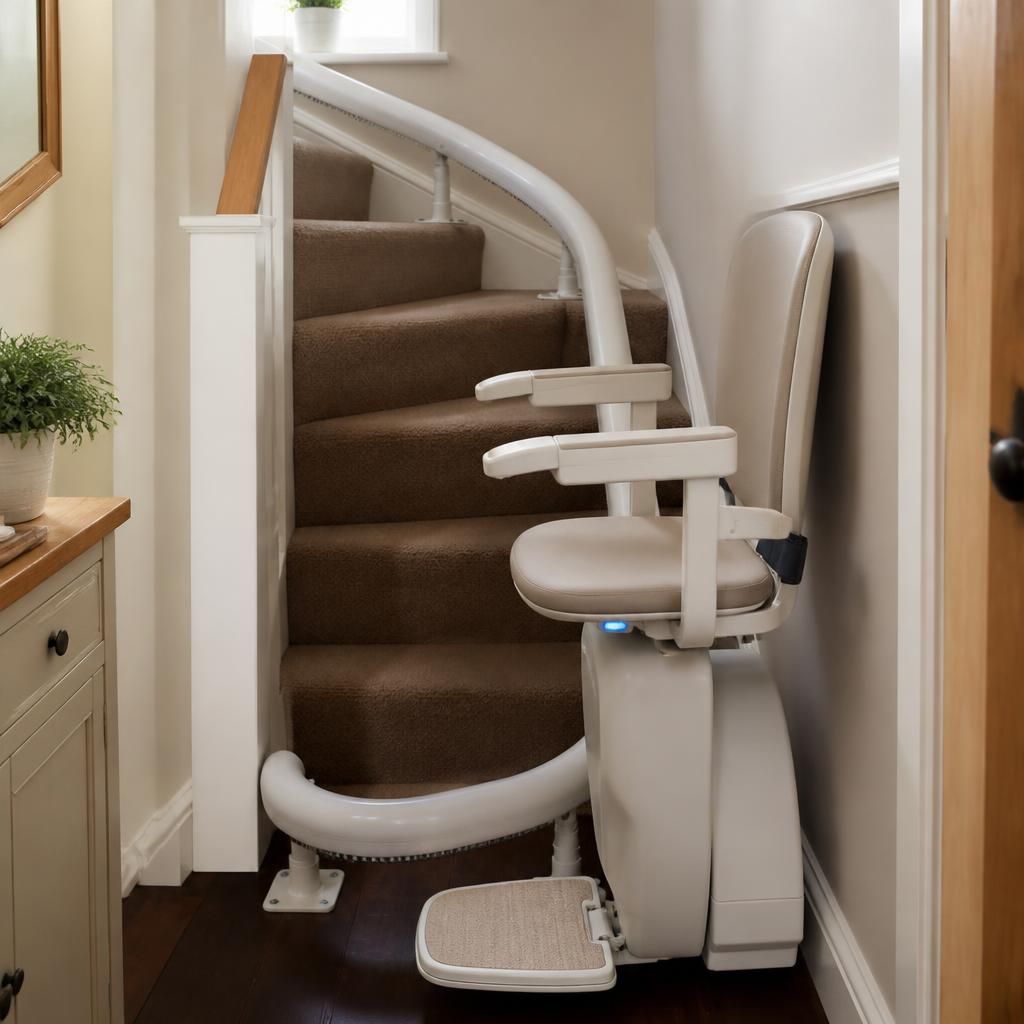
Yes, a curved stairlift can often be installed on a narrow staircase. Unlike a standard straight stairlift, its rail is made to follow the exact route of the stairs, including bends, landings and changes in direction. However, suitability depends on more than the width of the stairs alone. The stairlift chair, rail position, available headroom and space to get on and off must all be assessed together.
How a curved stairlift works on narrow stairs
A bespoke curved rail can usually be positioned close to the edge of the steps or around the inside or outside of a bend, depending on which arrangement provides the safest route. The rail is fixed to the staircase rather than relying on the wall, so it can normally accommodate staircases with limited or irregular wall space.
On a narrow staircase, the chair may be specified with features that reduce its parked size, such as a slim seat, folding arms, a folding footrest or a powered swivel seat. These options can help preserve access around the stairlift when it is parked. The correct combination depends on the user’s mobility, balance, transfer ability and available space, so a smaller chair is not automatically the best choice.
What is checked during the assessment?
- Stair width and shape: the assessor measures the usable width of each section and records bends, landings, winders and changes in gradient.
- Clearance: there must be enough room for the chair and user to travel without contacting walls, banisters, doors or other obstructions.
- Boarding and dismounting: the user needs a safe position at the top and bottom of the stairs, or at an intermediate landing where appropriate.
- Headroom: low ceilings, beams or overhanging landings may affect the route or require the chair to use a particular position while travelling.
- Obstructions: radiators, cupboards, window ledges, doorways and handrails can influence where the rail is installed and where the chair is parked.
- Structural fixing points: the staircase and its supporting structure must be suitable for the rail brackets and the operating loads.
- User requirements: the assessor considers the user’s height, weight, posture, transfer method and ability to operate the controls safely.
Measurements are normally taken with the user in mind, rather than treating the staircase as an empty passageway. A route that appears technically possible may still be unsuitable if it leaves insufficient room to transfer safely or creates difficulty for other people using the stairs.
Will a narrow staircase still be usable by other people?
Installing a stairlift reduces the available space while the chair is travelling, although folding components can make the staircase easier to use when the lift is parked. Whether other household members can pass safely depends on the stair width, rail position, chair design and the presence of handrails or other fixtures. The assessment should establish how the lift will affect normal access before any installation is agreed.
Where space is particularly restricted, the stairlift may be designed to park at the top or bottom, away from the main walking line. A powered swivel or folding feature may also help with transfers, but these features must be selected for practical benefit rather than simply to make the equipment smaller.
Can every narrow staircase accommodate a curved stairlift?
No. Some staircases do not provide enough clearance for safe travel, or do not have a suitable area for boarding and dismounting. Very tight corners, restricted landings, unusually steep sections, low headroom or structural limitations can affect feasibility. In other cases, a stairlift may be possible only with a particular rail route or a change to the position of a handrail or other obstruction.
A home assessment is therefore essential. Photographs or general stair measurements cannot reliably confirm suitability because the relationship between the staircase, chair, rail and user must be checked in three dimensions. The proposed route should also be reviewed with the user seated in the chair so that comfort, visibility and transfer safety can be considered.
What if a curved stairlift is not suitable?
If the assessment identifies a safety or access problem, possible alternatives may include changing the rail route, adjusting an obstruction where practical, using a different chair configuration or considering another mobility solution for the relevant part of the home. A standard straight stairlift is not normally a solution for a staircase with bends or intermediate landings unless the layout is altered, because it cannot follow a continuous curved route.
Reconditioned equipment may be available for some requirements, but a curved rail is generally made to match the individual staircase. A previously used rail is therefore unlikely to fit a different staircase without modification, and suitability should never be assumed from the appearance of the equipment alone.
How Independent Stairlifts can help
Independent Stairlifts can assess the staircase, the available clearance and the user’s requirements before recommending a suitable curved stairlift configuration. The assessment should explain where the rail will run, where the chair will park, how the staircase will remain accessible and whether any practical limitations need to be considered. This gives you a clear basis for deciding whether a bespoke curved stairlift is appropriate for your home.
A narrow staircase does not automatically prevent curved stairlift installation, but the available clearance must be assessed with the chair, rail and user considered together. The rail may be positioned to follow the safest route around bends and landings, while the chair can be specified with folding components to reduce its parked footprint.
The important consideration is not simply whether the chair fits on the steps. There must also be enough space for safe boarding and dismounting, comfortable travel, and access for other people when the stairlift is parked. Features such as a folding footrest, folding arms or a powered swivel seat may help, although the most compact option is not always the most suitable for the user’s mobility and transfer needs.
An assessment at home will identify obstructions, check headroom and establish where the chair can park without restricting doorways or landings. This provides a practical answer for the particular staircase rather than relying on general measurements or photographs.
Arrange a Bespoke Narrow-Staircase Assessment
Arrange a bespoke assessment with Independent Stairlifts to confirm whether your narrow staircase can accommodate a curved stairlift and identify the safest rail and chair configuration.