
Are there specific maintenance requirements for curved stairlifts, and how often should they be serviced? Curved stairlifts require regular cleaning, safety checks and professional servicing, usually at least once a year, to keep the lift safe, reliable and suitable for its individual track and staircase.
Curved stairlifts need regular cleaning, basic safety checks and professional servicing, usually at least once a year. Because the rail is bespoke to your staircase, servicing should check the track, drive system, batteries, seat, sensors and safety features to keep the lift safe and reliable.
Curved stairlifts should receive regular cleaning and user safety checks, together with professional servicing at least once a year in normal domestic use. Since the rail is made to follow an individual staircase, a service should assess the complete installation rather than just the lift itself, including the track, drive system, batteries, seat, sensors, charging points and safety controls.
The manufacturer’s servicing guidance should always take priority. A lift used particularly frequently, by more than one person, or in a demanding environment may need attention more often. Arrange an inspection sooner if the stairlift has developed a new noise, judder, hesitation, reduced travel distance, charging problem or fault indication.
Routine care for the user
- Keep the rail, seat, footplate and armrests free from dust, dirt and household items.
- Wipe accessible surfaces with a slightly damp cloth and a suitable mild cleaner. Do not pour liquid onto the controls, motor or charging contacts.
- Keep the staircase and the area around the top and bottom landing clear so the stairlift can start, stop and park safely.
- Check that the lift is being parked at its recommended charging position when it is not in use.
- Look for loose trim, visible damage, unusual movement or anything obstructing the rail.
- Test the seat belt, swivel mechanism and controls as part of normal use, without forcing any component that feels stiff.
Do not lubricate the rail or drive components unless the manufacturer or service engineer specifically instructs you to do so. Using the wrong lubricant can attract dirt or affect components that are designed to operate without user-applied lubrication. Avoid dismantling covers, adjusting the rail or attempting electrical repairs.
What a professional service normally checks
- The curved rail, brackets, joins and fixings for security, alignment, wear or obstruction.
- The motor, gearbox, drive mechanism and rollers for smooth and controlled travel.
- The batteries, charger, charging points and electrical connections.
- The seat, swivel and folding mechanisms, armrests, footplate and seat belt.
- Safety sensors, limit controls, emergency stop functions and other protective features.
- Remote controls and any diagnostic or fault indicators.
- The lift’s operation on the full route, including bends, transitions, stopping points and parking positions.
Battery condition is particularly important because batteries gradually lose capacity with age and use. A stairlift may continue to move while its batteries are deteriorating, but it may travel more slowly, fail to hold charge or stop away from a charging point. A service engineer can test the batteries properly and advise whether replacement is needed. Battery replacement intervals vary according to the equipment, usage and charging conditions, so they should not be replaced solely according to a fixed calendar.
Contact us promptly if the stairlift stops unexpectedly, makes a persistent unusual sound, moves unevenly, fails to charge, shows a warning light or becomes difficult to operate. Stop using it if there is visible damage, a burning smell, exposed wiring or a safety feature that does not work, and report the fault rather than trying to bypass it.
If your curved stairlift is rented, check the agreement for the arrangements covering routine servicing, repairs and replacement batteries. For an owned lift, keep a record of services and report any change in performance between visits. If the staircase or surrounding area is altered, or the lift is moved, the installation should be checked by a suitably qualified stairlift engineer before regular use resumes.
In practical terms, clean and observe the stairlift as part of normal use, follow the supplied instructions, and plan a professional service at least annually unless the manufacturer recommends a different schedule. Regular servicing cannot prevent every fault, but it helps identify wear early and confirms that the bespoke track and the lift’s safety systems continue to work together correctly.
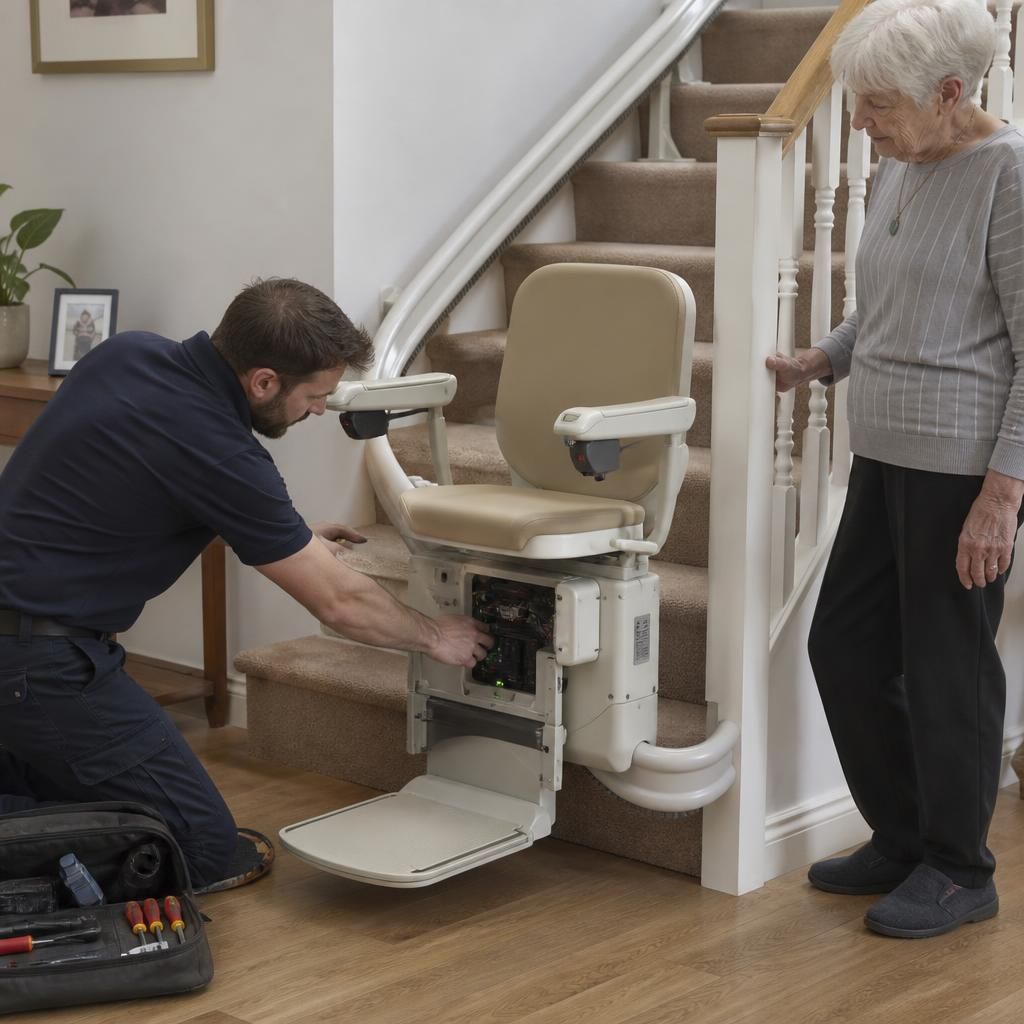
Professional servicing is important because a curved stairlift’s rail is made for one staircase and must remain correctly aligned with its drive system. A qualified stairlift engineer should normally inspect the complete installation at least once a year, or more often if the manufacturer recommends it or the lift is used heavily.
A service typically includes checking the rail and fixings, drive mechanism, rollers, batteries, charging points, seat, seat belt, sensors and emergency controls. The engineer should also run the lift over its full route, including bends, transitions and parking positions. Between services, keep the rail and footplate clear, park the lift at its charging point and report unusual noises, hesitation, uneven movement or charging problems promptly.
Arrange your curved stairlift service
Arrange a professional curved stairlift service with Independent Stairlifts to check the rail, drive system, batteries and safety features. Contact us to discuss servicing, repairs or any change in your lift’s performance.