
Are there any weight limitations for curved stairlifts?
Yes, curved stairlifts have a manufacturer-rated maximum user weight, which varies by model and can be affected by the staircase layout, seat design and installation configuration. During your assessment, we will confirm the suitable weight capacity and recommend an appropriate bespoke stairlift for your needs.
Yes. Curved stairlifts have a manufacturer-rated maximum user weight, and the limit varies between models and installation configurations. The correct capacity will be confirmed during your assessment, when we consider your weight, the staircase layout, the seat design and the equipment needed for a safe installation.
What the weight limit means
The stated limit is the maximum load the stairlift is designed to carry safely while travelling along its track. It includes the person using the stairlift and, where applicable, clothing or small personal items carried on their person. It should not be treated as a target capacity or exceeded occasionally, as the lift’s motor, braking system, seat, carriage and track are all specified for a particular load.
Weight limits are usually given by the manufacturer for a specific stairlift model. A bespoke curved rail is made to follow the staircase, but the customised shape of the rail does not automatically increase the lift’s weight capacity. The chosen carriage and seat must be suitable for the user’s requirements as well as the route.
What can affect the suitable specification?
- Staircase design: Tight bends, intermediate landings, steep sections and changes in direction can affect the track route and the space available for the seat and carriage.
- Seat and support options: A larger or reinforced seat, additional support, powered swivel functions and other options may influence which model is appropriate.
- How the lift is used: The user should remain seated, use the safety belt where provided and avoid carrying bulky or heavy objects while travelling.
- Installation conditions: The fixing points, rail position and available clearance must be checked as part of the survey. A technically suitable model must also allow the user to get on and off safely at the top and bottom of the stairs.
- Changing needs: If your weight, mobility or ability to transfer in and out of the seat changes, the original assessment may need to be reviewed.
Some manufacturers offer higher-capacity or heavy-duty models. These are not suitable for every curved staircase, so choosing one involves more than selecting a lift with the highest published rating. The seat width, turning space, parking position, track design and the staircase structure must all work together. A higher-capacity model may also require different clearances or installation arrangements.
How the capacity is checked
During a home assessment, we will discuss the intended user’s current weight and any relevant changes that may be expected. It is important to provide accurate information. This allows us to recommend equipment with an appropriate safety margin rather than relying on an unsuitable standard model. We will also assess the staircase, landings, access points and transfer areas before confirming the specification.
For a reconditioned curved stairlift, the same principle applies. Availability does not override the manufacturer’s rating or the requirements of the individual installation. A used lift should only be supplied and fitted where its capacity, condition and configuration are suitable.
Do not use a curved stairlift if the user’s weight is above its stated rating, and do not attempt to compensate by travelling without the belt or by carrying less equipment on the seat. If you are unsure about the capacity of an existing stairlift, check its documentation or contact us before use. We can review the model and installation and advise whether it remains appropriate.
A curved stairlift’s weight limit is set by its manufacturer-rated seat and carriage, not by the fact that its rail is bespoke. The rail is shaped to follow the staircase, while the carriage, motor, seat and braking system must still be suitable for the user’s weight and the route.
During the home assessment, we check the staircase, bends, landings, clearances and transfer points before confirming the specification. Where appropriate, a higher-capacity model may be considered, but it must fit the available space and allow the user to sit, travel and get off safely. Never exceed the stated limit or rely on removing the safety belt or personal items to compensate; contact us if your circumstances or the capacity of an existing stairlift changes.
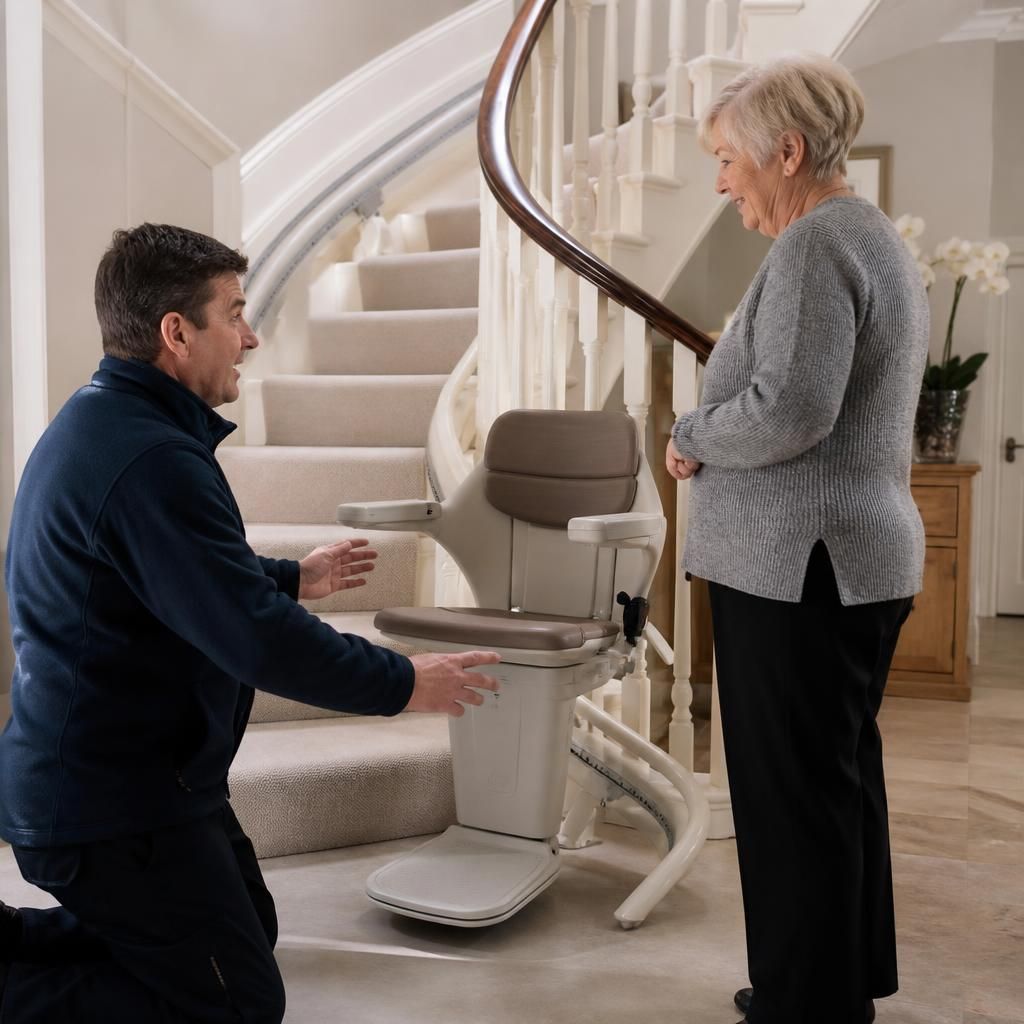
Arrange a curved stairlift weight assessment
Arrange a curved stairlift weight assessment with Independent Stairlifts so we can check your staircase, discuss your needs and confirm a suitable model and capacity.