
What factors should I consider to ensure a curved stairlift is a worthwhile investment for my home?
A curved stairlift is a worthwhile investment when its bespoke rail, safety features and ongoing support match your staircase, mobility needs and available budget. Consider the total cost, expected frequency of use, installation requirements, warranty and servicing, as well as whether a reconditioned model or another access solution would provide better value for your home.
A curved stairlift is a worthwhile investment when its bespoke rail, safety features and ongoing support are appropriate for your staircase, mobility needs and budget. The right decision depends on more than the initial price: assess the total cost of ownership, how often the lift will be used, the complexity of the staircase, the quality of the installation and the support available after fitting.
Start with the practical need. Consider which parts of daily life are currently difficult or unsafe. If the stairs are becoming a barrier to essential rooms, a stairlift may allow you to continue using your home without moving bedroom, adapting the property extensively or relying on assistance. The likely frequency of use is also relevant. A lift used several times each day needs to be comfortable, dependable and easy to operate, while occasional use may affect which features and specification offer the best value.
Think about both current and anticipated needs. A user who has difficulty standing for long periods may benefit from a powered swivel seat or a powered footrest. Someone with limited hand movement may need simple controls, a suitable joystick and a remote control for calling the lift between floors. If more than one person will use the stairlift, the seating position, weight capacity and operating controls should be suitable for everyone.
Assess the staircase carefully. Curved stairlifts are made for staircases with bends, intermediate landings, changes in gradient or multiple floors. Their rails are normally measured and manufactured to follow the staircase rather than installed as a standard straight section. This provides a close fit, but the design and price can be affected by the shape of the stairs, available space at the top and bottom, ceiling height, doorways and the position of the rail.
A proper home assessment should consider where the user will transfer on and off the seat, whether the lift can be parked without obstructing a hallway, and whether other household members can still use the stairs safely. The rail may be positioned to preserve as much stair width and access as possible. Ask the surveyor to explain any compromises required by a particularly narrow, steep or complicated staircase before accepting a quotation.
Compare the complete cost rather than the headline price. The quotation should make clear what is included in the stairlift, bespoke rail, survey, manufacture, delivery, installation, demonstration and initial aftercare. Confirm whether removal of an old stairlift, additional options, alterations to electrical supplies or work around unusual access conditions are included or charged separately.
Also consider ongoing costs. These may include servicing, replacement batteries outside the warranty period, repairs and any extended support arrangement. A cheaper initial quotation may not represent better value if it excludes important installation work or offers limited after-sales assistance. Conversely, paying for features that will not be used may add cost without improving day-to-day access.
Request a written quotation with the specification and warranty terms clearly set out. It is reasonable to ask what happens if the final measured rail differs from the initial design, whether the quoted price is fixed, and whether future call-outs or servicing are covered. These details help you compare like for like and avoid making a decision based only on the purchase price.
Give safety and usability priority. Useful safety features may include a seat belt, obstruction sensors, swivel or powered swivel seating, a braking system, armrests and controls that are easy to reach. The most suitable specification depends on the user rather than on the number of features available. For example, a manual swivel seat may be adequate for one person, whereas powered movement may be more appropriate if turning or transferring is difficult.
Check that the user can sit comfortably, reach the controls, fasten the belt and operate the lift without assistance. The footrest should provide stable support, and the seat height should allow a safe transfer at the landing. Ask for the controls to be demonstrated and, where possible, allow the user to try the seating position before installation. A stairlift that is technically suitable but difficult to operate is unlikely to deliver good value.
Consider the installation and its effect on the home. Curved stairlift installation involves fitting the rail securely to the stairs or supporting structure, checking clearances and testing the lift through its full route. The installer should explain how long the work is expected to take, what preparation is required and whether any furniture or household items need to be moved.
Most installations are planned to minimise disruption, but a complex staircase may require additional preparation. Confirm how the lift will be parked when not in use, whether it can be folded to leave more room on the stairs and how charging points will be positioned. A suitable design should support safe use by the stairlift user while keeping the remaining staircase practical for other occupants.
Review warranty, servicing and technical support. A curved stairlift is a mechanical and electrical product, so dependable support is part of its value. Check the length and scope of the warranty, which components are covered, whether labour and call-outs are included, and how faults are reported. Ask whether routine servicing is recommended and whether replacement parts will remain available for the expected period of use.
Good aftercare should include clear operating instructions, a demonstration for the user and contact details for assistance. If the stairlift is essential for getting between floors, response arrangements for a fault are particularly important. Discuss battery charging, safe use during a power cut and what to do if the lift stops away from a charging point.
Consider a reconditioned curved stairlift where appropriate. A reconditioned model may reduce the initial cost, but it still needs a rail designed for the particular staircase and should be inspected, tested and installed professionally. Establish which parts are new or refurbished, what warranty is provided, whether the model has the required safety and comfort features, and whether the rail is being made specifically for your home.
A reconditioned option may be suitable where the specification is straightforward and budget is a significant consideration. It may be less suitable if the user needs specialist powered features, has changing mobility requirements or has an unusually complex staircase. The decision should be based on condition, suitability and aftercare as well as price.
Compare the stairlift with realistic alternatives. If the staircase is used infrequently, another adaptation may sometimes meet the need more effectively. Depending on the property and the user, alternatives could include relocating essential facilities to one level, improving lighting and handrails, or considering a different type of mobility equipment. These options should not be assessed in isolation: account for their installation, maintenance, space requirements and effect on independence.
A straight stairlift may cost less where the staircase genuinely has a single, uninterrupted flight, but it cannot normally follow bends or landings without a suitable bespoke design. A curved stairlift may therefore be the more practical investment when the layout would otherwise restrict access. The appropriate comparison is not simply between two prices; it is between solutions that can safely serve the required route.
Check that the property and future plans support the decision. Consider how long you expect to remain in the home and whether the stairlift will continue to meet your needs if your mobility changes. If you may sell or rent the property, ask whether the equipment can be removed and whether the rail can be reused. Curved rails are generally made for a particular staircase, so they are less likely than standard straight equipment to transfer directly to another home.
Before proceeding, discuss your budget openly during the assessment. The specification may be adjusted by prioritising essential safety and access features over optional additions. You can also ask about payment arrangements, reconditioned equipment and whether any relevant assistance or tax relief may apply to your circumstances. Eligibility for concessions depends on the individual and the terms in force, so it should be confirmed rather than assumed.
In practical terms, a curved stairlift is likely to provide good value when it is used regularly, solves a clear access problem, fits the staircase without creating hazards, and is backed by transparent pricing and reliable aftercare. A home assessment and detailed quotation should establish whether the proposed design meets those tests. Taking time to compare suitability, total cost and long-term support will give you a more reliable basis for deciding than comparing purchase prices alone.
A home assessment is essential for deciding whether a curved stairlift will be a worthwhile investment because it confirms that the proposed design is safe, usable and suitable for the staircase. The assessment should consider bends, landings, stair width, available space at the top and bottom, transfer points and where the lift can be parked without obstructing other users.
It should also establish whether the user can operate the controls, sit comfortably, fasten the seat belt and get on and off safely. Ask for the quotation to identify what is included, such as the bespoke rail, installation, demonstration, warranty and aftercare. Comparing this complete specification, rather than the initial price alone, gives a more accurate indication of long-term value.
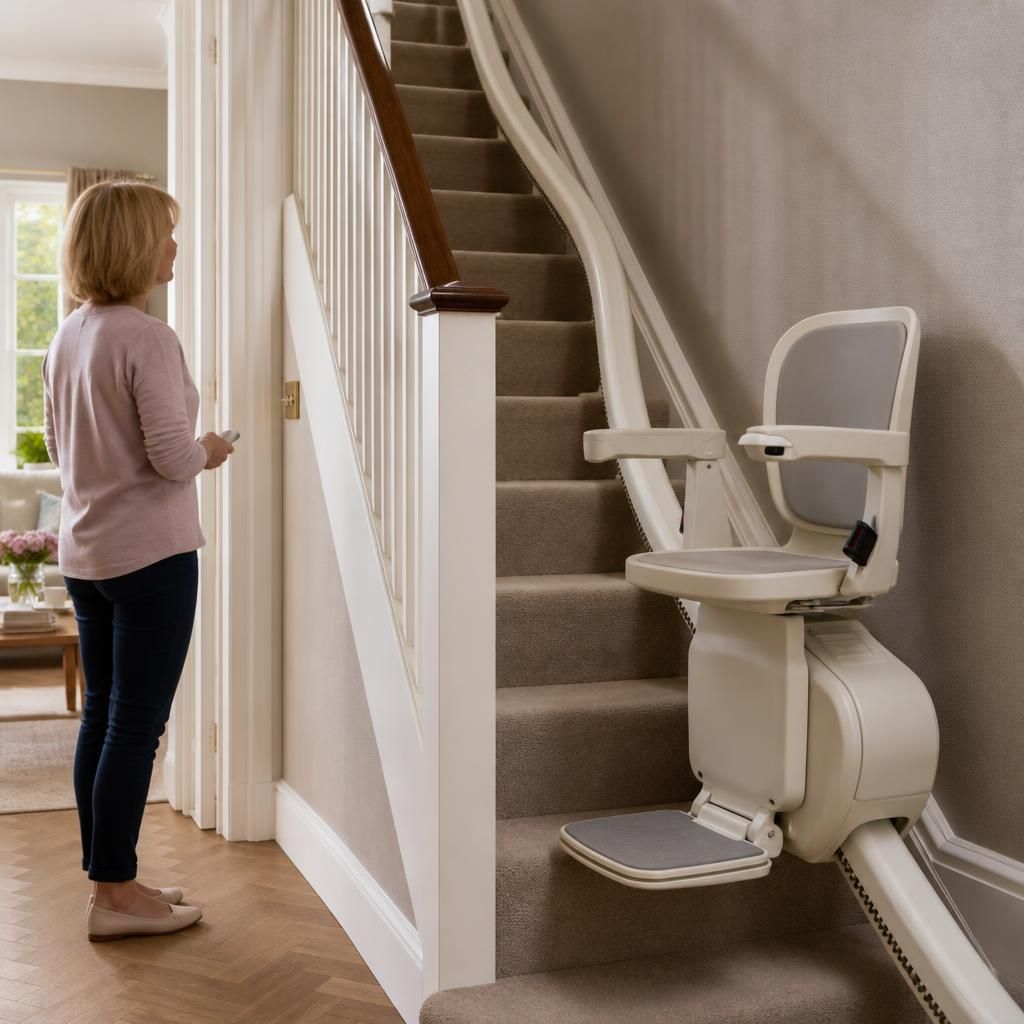
Arrange Your Curved Stairlift Assessment
Arrange a home assessment to review your staircase, mobility needs and the total cost of a suitable curved stairlift. We can provide a clear quotation and explain the available options before you decide.