
How does the price of a curved stairlift compare to that of a straight stairlift?
A curved stairlift usually costs more than a straight stairlift because its rail is made to measure for the bends, landings and changes in direction of your staircase. A straight stairlift uses a standard rail and is therefore generally the more affordable option, although the exact price depends on your staircase, chosen features and whether you select a new or reconditioned model.
A curved stairlift generally costs more than a straight stairlift. The main reason is that a straight stairlift normally uses a standard rail, while a curved stairlift requires a rail designed and manufactured for the exact shape of your staircase. Bends, intermediate landings, changes in direction and variations in stair width all add to the design, manufacturing and installation work. The final price depends on the staircase itself, the model and features selected, and whether the stairlift is new or reconditioned.
A straight stairlift is usually the more straightforward option where the stairs run in one continuous direction without a bend or landing. The rail is manufactured in a standard configuration and can often be installed relatively quickly. This reduces the amount of surveying, engineering and fitting required, which is why straight stairlifts are normally the more affordable choice.
A curved stairlift is made to measure. Its rail may need to follow one or more bends, turn around a landing, serve multiple flights or finish in a particular position at the top or bottom of the stairs. The rail must be accurately designed so that the stairlift travels safely while leaving sufficient clearance for people using the staircase. These individual requirements make a curved installation more complex and increase its price compared with a standard straight installation.
The comparison is not based on the rail alone. The quotation may also reflect:
- the length and layout of the staircase;
- the number and tightness of bends;
- whether the stairlift needs to travel between more than one flight;
- the position of the parking point and whether a hinged or folding rail is needed;
- the condition, width and accessibility of the stairs;
- the type of seat, controls, safety features and upholstery selected;
- the complexity of delivering and installing the equipment; and
- whether the stairlift is new or reconditioned.
A reconditioned curved stairlift may reduce the cost, but the rail is still specific to a particular staircase. This means that a suitable used curved system cannot always be transferred directly from another property. The rail may need to be adapted or replaced, and compatibility with the staircase and the stairlift mechanism must be checked carefully. A reconditioned straight stairlift can also be more affordable, particularly where the available rail matches the required layout, but its condition, warranty and installation requirements should be confirmed before purchase.
Features can affect either type of stairlift’s price. For example, powered swivel or powered folding seats, automatic footrests, upgraded upholstery, remote controls and different charging or parking arrangements may increase the quotation. These additions should be considered in relation to the user’s mobility and the layout of the home rather than selected simply because they are available. A feature that improves safe and independent use may provide practical value, while an unnecessary option may add to the cost without improving suitability.
The most useful comparison is therefore between like-for-like quotations. Check whether each quotation includes the survey, manufacture or preparation of the rail, delivery, installation, demonstration, warranty and any required aftercare. Confirm whether structural alterations, removal of an existing stairlift, electrical work or adaptations to the staircase are included or charged separately. A lower initial price may not represent better value if essential work or support has been left out.
An assessment is needed before a reliable price can be given. During the assessment, the staircase can be measured and checked for bends, landings, obstructions, available clearance and suitable parking positions. The user’s mobility, transfer ability and preferred operating side should also be considered. This establishes whether a straight stairlift is appropriate or whether the staircase requires a curved design, and identifies the features that are genuinely necessary.
Although a curved stairlift has a higher initial cost in most cases, it may be the appropriate solution where a straight model cannot safely or practically serve the whole staircase. The right choice should be based on the complete installation, the user’s needs and the expected length of use, rather than on the rail price alone. Independent Stairlifts can assess the staircase and explain the differences between suitable new and reconditioned options before you decide.
The price difference between a curved and straight stairlift is mainly due to the rail and installation requirements. A straight stairlift usually uses a standard rail, whereas a curved stairlift has a rail designed to follow the exact bends, landings and changes in direction of the staircase.
When comparing prices, check that quotations cover the complete installation rather than the equipment alone. This may include the assessment, rail manufacture or preparation, delivery, fitting, user demonstration, warranty and aftercare. Ask whether removal of an existing stairlift, electrical work, structural alterations or special parking arrangements would be charged separately.
A like-for-like comparison is particularly important when considering a reconditioned stairlift. A lower price may not include a rail that matches your staircase or the work needed to adapt it. The most suitable option is the one that safely meets the user’s needs and includes the necessary installation and support.
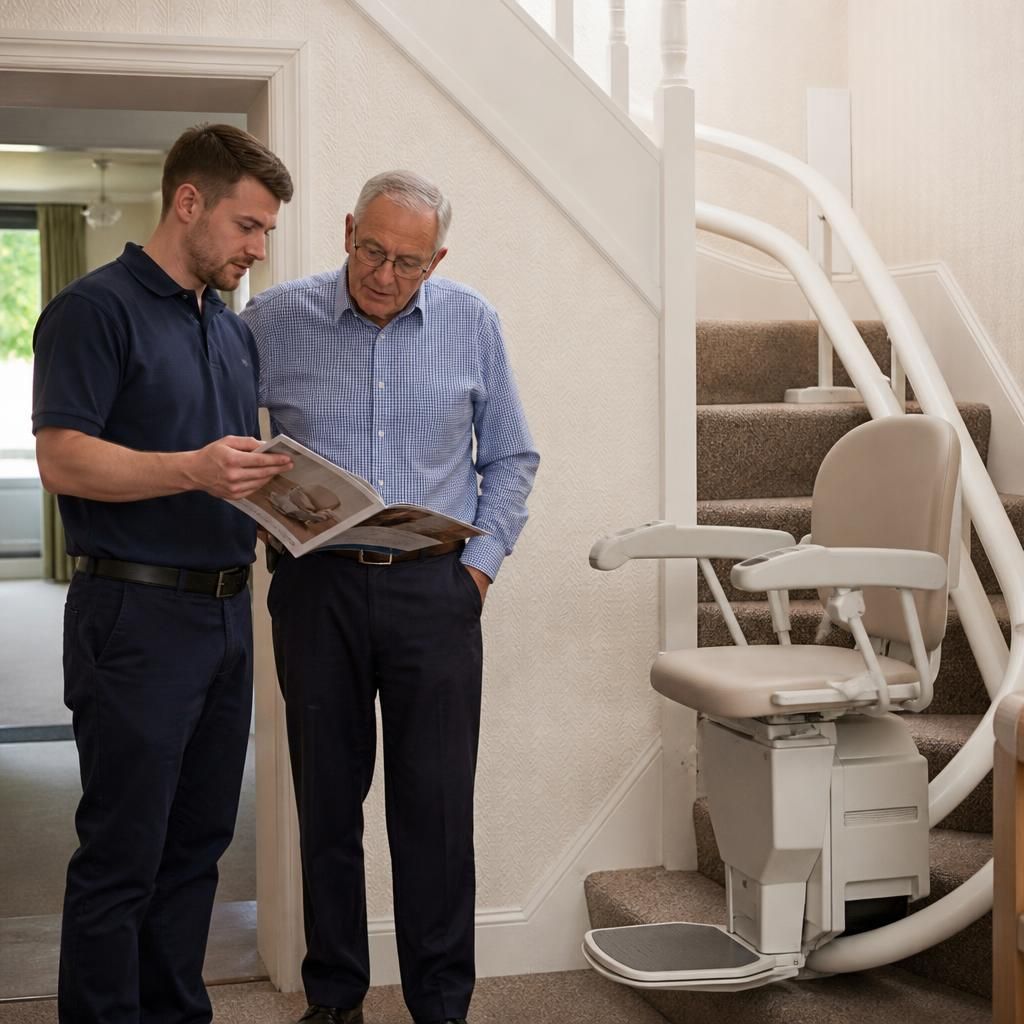
Arrange an assessment to compare curved and straight stairlift options
Arrange an assessment with Independent Stairlifts to compare suitable curved and straight stairlift options for your staircase, including new and reconditioned models.