
What should I consider when choosing a curved stairlift for durability and ease of use?
When choosing a curved stairlift, prioritise a bespoke rail fitted to your staircase, a reliable drive system, durable upholstery and safety features that are simple to operate. An in-person assessment should also confirm that the seat, controls, charging points and powered options suit the user’s mobility and the available space.
Choosing a curved stairlift for durability and ease of use means assessing the complete system rather than focusing on the seat or rail alone. The most important factors are the quality and accuracy of the bespoke rail, the reliability of the drive and battery systems, the suitability of the seat and controls for the user, and the standard of installation and ongoing servicing.
Start with an accurate assessment of the staircase
A curved stairlift should be designed around the staircase, not selected as a standard unit. During an assessment, the installer should consider bends, landings, changes in gradient, available headroom, doorways and the position of the charging points. The rail should follow the stair profile closely while leaving sufficient clearance for other people to use the stairs safely.
A careful assessment also identifies whether the lift needs to stop at more than one level, park out of the way, or include a powered option to help with folding or swivelling. Accurate measuring and design are important for reliability because a rail that is correctly aligned places less strain on the carriage and drive system.
Check the rail design and installation quality
The rail is the part of a curved stairlift that is made specifically for the property. It should be rigid, securely mounted and finished to suit the staircase without creating avoidable obstructions. Ask how the rail will be supported at bends and landings, and whether the proposed parking position will keep the stairway and nearby access routes usable.
Installation quality matters as much as the equipment itself. The stairlift should be fixed securely to the stair treads or another suitable structural position, with the installer checking alignment and operation throughout the fitting. A properly installed rail should allow the carriage to travel smoothly without excessive vibration, hesitation or unusual noise.
Consider the drive system and battery performance
A durable curved stairlift needs a drive system suited to the route, including its bends and changes in angle. Ask what checks are carried out to confirm smooth travel, controlled stopping and reliable operation under normal use. The lift should accelerate and stop steadily rather than lurching, particularly when approaching a landing.
Battery-powered operation allows the stairlift to be used during a mains power interruption, provided the batteries are charged and maintained correctly. Confirm where the lift charges, whether it has more than one charging position if required, and what indicators show the battery status. Leaving the stairlift at a designated charging point when it is not in use helps preserve battery performance.
Choose a seat that supports safe, comfortable transfers
Seat design has a direct effect on ease of use. The seat should provide stable support, with upholstery that is durable and easy to clean. The armrests should give the user confidence when sitting down and standing up, while the footrest should provide adequate support without making transfers unnecessarily difficult.
A swivel seat can help the user turn towards the landing before standing. Depending on the user’s mobility, a powered swivel or powered folding mechanism may be useful if operating a manual lever or footrest would be difficult. These features should be demonstrated during the assessment so the user can confirm that the controls are comfortable and understandable.
Make sure the controls are simple and accessible
Controls should be positioned where the user can reach them without stretching or twisting. The hand control should have clear, tactile operation and should not require excessive grip strength. Remote controls at the landings can be useful when the stairlift is needed from either end of the staircase, particularly in a shared household.
Ask for the controls, safety sensors and emergency stop function to be explained before the installation is completed. The user should know how to start and stop the lift, respond to an obstruction warning, park the stairlift correctly and report a fault. Simple instructions reduce the risk of misuse and make everyday operation more confident.
Review the safety features
- Safety sensors should stop the lift if an object is detected in its path.
- A secure seat belt or harness should be easy to fasten and release.
- The seat, armrests and footrest should lock or remain stable during travel.
- The lift should stop accurately at the intended landing positions.
- Controls and indicators should make the operating status clear.
- The design should include a safe way to deal with a loss of power or a fault.
Safety features should support the user without making the stairlift complicated to operate. An installer should explain how each feature works and check that the user can use it independently where possible.
Ask about materials and everyday wear
High-use parts should be robust enough for regular operation. Look at the quality of the upholstery, armrests, footrest, swivel mechanism, seat belt, hand control and visible carriage components. Materials should be suitable for the home and straightforward to wipe clean. If the stairlift will be used outdoors or in a damp location, it requires equipment specifically designed for those conditions rather than an indoor model placed outside.
Durability also depends on how the lift is used. Avoid placing bags or objects on the footrest, keep the rail clear and do not force the seat, swivel or folding mechanisms. Small changes in sound or movement should be reported before they develop into a larger fault.
Compare new and reconditioned options carefully
A reconditioned stairlift may be suitable where the equipment can be matched safely to the staircase and the user’s needs. However, curved rails are bespoke, so a rail from another property will not normally be a direct fit. Ask what parts have been inspected or replaced, whether the carriage and batteries have been tested, what guarantee applies and whether servicing support is available.
With any option, the relevant consideration is not simply the age of the equipment. The condition of the drive system, battery, controls, safety components and rail, together with the quality of the installation, will have a greater bearing on dependable use.
Confirm servicing, support and warranty arrangements
Before choosing a stairlift, check what support is available after installation. You should receive operating instructions, details of routine care, contact information for reporting a problem and clear information about warranty coverage. Ask whether servicing can be arranged locally and which parts or call-outs are included.
Regular maintenance can identify worn rollers, batteries, sensors, contacts or mechanical components before they affect operation. Keep charging contacts and accessible surfaces clean as advised, but do not remove covers or attempt electrical repairs yourself. Any unusual noise, jerky movement, repeated stopping or failure to charge should be assessed by a qualified engineer.
Use the assessment to test practical compatibility
The person who will use the stairlift should try the seat, controls and transfers during the assessment wherever possible. Consider footwear, clothing, walking aids and whether another person may need to use the stairs at the same time. Check that the folded lift leaves suitable access and that the proposed parking position does not obstruct a doorway or landing.
The best choice is a curved stairlift that fits the staircase precisely, provides stable and comfortable travel, and can be operated consistently by the intended user. An individual assessment with Independent Stairlifts can confirm the appropriate configuration, explain the available options and identify any practical changes needed before installation.
A bespoke rail is central to a curved stairlift’s durability and ease of use because it is shaped to follow the exact bends, landings and gradients of the staircase. Accurate measuring and secure installation help the carriage travel smoothly, reduce unnecessary strain on the drive system and preserve usable access on the stairs.
During the assessment, check where the stairlift will park, whether it needs to serve more than one landing and how much clearance remains for other people. The installer should also confirm that the seat, controls, charging points and any powered swivel or folding features are suitable for the user. These practical checks are as important as the equipment specification when choosing a dependable curved stairlift.
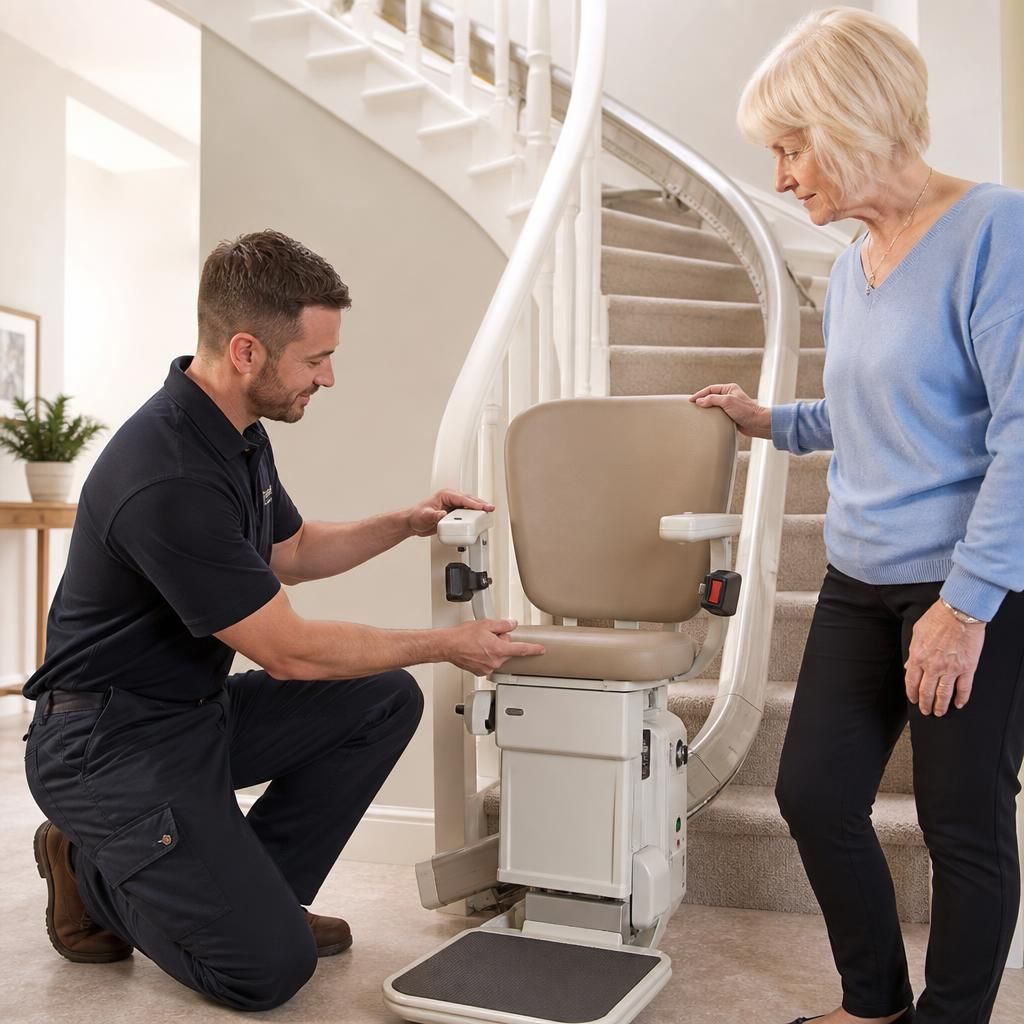
Arrange your curved stairlift assessment
Arrange your curved stairlift assessment with Independent Stairlifts to confirm the right rail design, seating, controls and safety features for your staircase and mobility needs.