
How does the installation process of a curved stairlift ensure compatibility with multi-landing staircases?
A curved stairlift is made compatible with a multi-landing staircase through a detailed home survey, where each flight, bend, landing, and clearance is measured before the rail is designed. The bespoke rail is then manufactured and precisely fitted to follow the staircase, with the installer checking safe travel, comfortable positioning, parking points, and access at every landing.
Compatibility with a multi-landing staircase is achieved through a detailed survey, computer-aided rail design and precise installation. Each flight, bend, landing and transition is measured so the curved stairlift follows the actual shape of the staircase rather than relying on a standard straight section. The finished system is then tested for safe travel, comfortable positioning and suitable access at every level.
A multi-landing staircase may include several flights, half-landings, intermediate landings, winders or changes in direction. These features affect the rail’s curve, gradient, position and parking arrangements. During the home survey, the installer assesses the complete route, including:
- the width, length and gradient of each flight;
- the shape and depth of each landing and bend;
- available headroom and clearance from walls, doors, bannisters and other obstructions;
- the position of radiators, light switches, furniture and other items that could affect use;
- the condition and strength of the stair treads or other surfaces used for fixing; and
- where the stairlift can park without restricting access through the hallway or landing.
These measurements are used to create a bespoke rail profile. Unlike a straight stairlift, the rail for a multi-landing staircase must account for changes in direction and the way the chair approaches and leaves each landing. The design may include carefully calculated bends, transitions and parking points so the chair remains stable and the user is not exposed to an abrupt change in movement.
The survey also considers how the stairlift will be used in practice. A suitable parking position should leave enough room for the user to get on and off safely, while avoiding unnecessary obstruction of the stairs. Depending on the layout, the chair may park at the top, bottom or another suitable point. The installer will also check that the seat, armrests and footrest have adequate clearance throughout the journey and that the swivel seat can be used safely at the selected access points.
Once the design has been confirmed, the rail is manufactured to the surveyed staircase. Installation normally involves securing the rail to suitable fixing points along the stairs, rather than altering the overall shape of the staircase. The installer positions each part accurately so the rail maintains the intended distance from the wall and follows the designed route around every landing. Any charging points, controls and remote call stations are positioned to support convenient use without creating additional hazards.
On a multi-landing staircase, particular attention is paid to the transitions between flights. The chair must move smoothly through each curve while maintaining appropriate clearance from the wall, ceiling, bannister and landing edges. The installer checks that the footrest does not catch on stair nosings or nearby surfaces and that the chair is correctly aligned when it reaches each stopping and parking position.
After fitting, the stairlift is tested along its full route rather than only on individual flights. This includes checking:
- smooth movement through every bend and landing;
- correct stopping and starting at each access point;
- seat swivelling and locking correctly where required;
- the safety sensors responding to obstructions;
- the controls, remote call stations and charging system operating correctly;
- adequate clearance for the user and other people using the staircase; and
- the stairlift remaining secure and stable during repeated journeys.
If the survey identifies a particularly tight landing, restricted headroom or an obstruction, the installation plan can be adjusted before manufacture. This might involve changing the rail’s parking position, refining a curve, selecting a different seat configuration or discussing a practical alteration to an obstruction. Any proposed modification should be explained and agreed before work begins.
The final handover includes guidance on operating the controls, using the swivel seat and footrest, parking the chair and responding to basic safety warnings. You should also know where the stairlift can be left when it is not in use and how to keep the route clear. A properly surveyed and fitted curved stairlift should provide a consistent, controlled journey across all flights and landings while preserving as much usable staircase space as the layout allows.
A curved stairlift is made compatible with a multi-landing staircase by surveying and designing the complete route as one bespoke system. The installer measures every flight, bend, landing and change in direction so the rail can follow the staircase accurately, rather than treating each section as a separate straight run.
Particular attention is given to the transitions between flights. The rail profile must provide smooth movement while maintaining clearance from walls, bannisters, ceilings, stair edges and other obstructions. The survey also identifies suitable parking and access positions, ensuring the seat, armrests and footrest can be used safely at each level without unnecessarily blocking the staircase.
Before handover, the fitted stairlift is tested over its full route. This includes movement through every curve and landing, stopping positions, seat swivelling, safety sensors, controls and charging. Any restricted clearance or obstruction should be considered during the design stage, before the bespoke rail is manufactured.
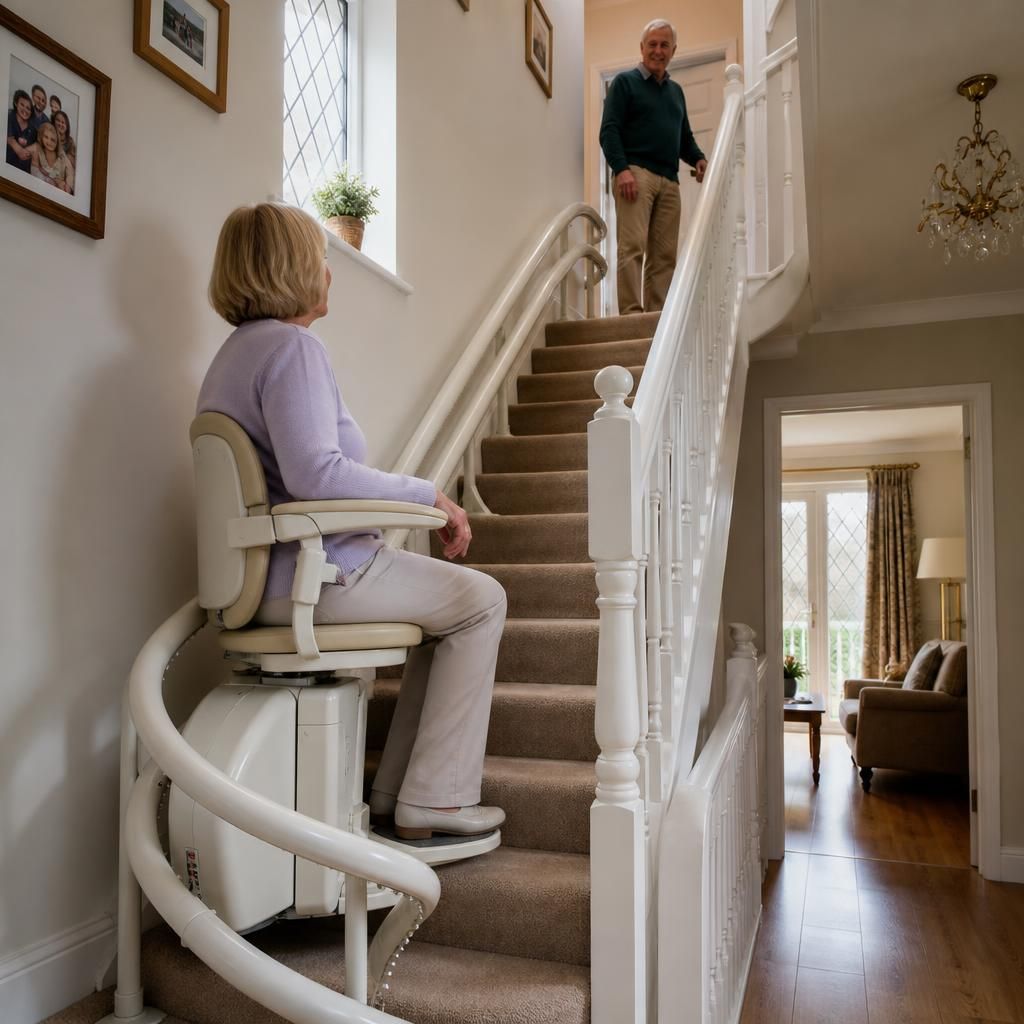
Arrange Your Curved Stairlift Survey
Arrange your curved stairlift survey so we can assess every flight, landing, bend and clearance before designing a compatible bespoke rail. Contact Independent Stairlifts to discuss your staircase and suitable installation options.