
Does the installation of a curved stairlift require modifications to my staircase?
A curved stairlift usually does not require structural modifications to your staircase, as its bespoke rail is secured to the stair treads rather than the wall. Minor adjustments, such as moving an obstruction or adapting a handrail, may sometimes be needed and will be identified during the assessment.
A curved stairlift does not usually require structural modifications to your staircase. Its bespoke rail is normally secured to the stair treads or landing floor rather than fixed to the wall, so the staircase itself does not need to be rebuilt or substantially altered. Any minor adjustments needed to accommodate the rail, seat or access points should be identified during the home assessment before installation.
Unlike a straight stairlift, a curved system is measured and manufactured to follow the exact shape of your stairs. The rail can be designed around bends, intermediate landings, changes in direction and varying stair widths. This avoids the need to change the staircase layout simply to make the equipment fit.
Installation commonly involves fixing brackets to suitable stair treads. The installer will check that the treads and supporting structure can safely take the intended fixings and that the rail has adequate clearance from walls, banisters, doors and other obstructions. The fixings are positioned carefully to preserve as much usable stair width as possible while maintaining a stable, smooth-running system.
Some properties do require minor adaptations. These are not normally structural changes, but may include:
- Adjusting or removing a section of handrail where it conflicts with the stairlift or reduces access at the top or bottom of the stairs.
- Repositioning an obstruction such as a radiator, cupboard door or light fitting.
- Making a small alteration to skirting or trim where necessary to provide clearance for the rail or its brackets.
- Creating a suitable parking position on a landing, where the rail may need to extend beyond the main flight.
- Protecting or adapting flooring at the top or bottom landing if the rail or a charging point needs to cross that area.
These points are assessed individually. A handrail will not be removed or altered without discussing the practical effect on your access and safety. If a handrail is important for people who will continue to use the stairs without the lift, the design may be adjusted to retain it where possible.
Curved stairlift rails can sometimes be installed on narrow or steep staircases, but the available width, stair geometry and safe clearance must be checked carefully. The installer will also consider whether the seat can swivel or rotate safely at the top and bottom, whether a passenger can get on and off without obstruction, and whether doors or walkways remain usable when the stairlift is parked.
Where the staircase includes unusual construction, damaged treads, weak flooring, a particularly tight bend or an unsupported landing, further work may be recommended before installation. This could involve repairing the stairs or strengthening a fixing point rather than modifying the whole staircase. You should be told about any such requirement, why it is needed and whether it is included in the installation arrangements.
The assessment is therefore an important part of a bespoke curved stairlift installation. The surveyor will normally review the staircase, landings, walls, handrails, access routes and nearby fixtures. They will take measurements and may discuss your preferred parking position, which floors you want to access and whether other people in the household need to continue using the stairs normally.
After installation, the stairlift should be tested through its complete route, including bends, landings and parking positions. The installer should also check that the rail is secure, the seat and footrest have adequate clearance, charging takes place correctly and the remaining staircase can be used safely. If you are concerned about drilling into the treads, changes to a handrail or the effect on your flooring, raise this during the assessment so suitable options can be considered before the rail is made.
In most homes, the result is a fitted system with limited and localised alteration rather than a major building project. The exact requirements depend on the construction and layout of your staircase, so an individual survey is the reliable way to confirm whether any modifications will be necessary.
A bespoke curved stairlift is designed to fit the existing staircase, so major structural alterations are not normally required. The rail is measured to follow the stairs and is usually secured to the treads or landing floor rather than the wall.
During the home assessment, the installer checks the stair width, bends, landings, handrails, doors and nearby fixtures. This identifies whether minor changes are needed, such as adjusting a handrail, moving an obstruction or creating a suitable parking position. These points should be discussed before the rail is manufactured, particularly if other household members need to continue using the stairs.
If the staircase has damaged treads, weak fixing points or unusual construction, repairs may be recommended to provide a safe foundation. The completed stairlift should then be tested along its full route, including access points and parking positions, to confirm that the rail is secure and the remaining staircase remains usable.
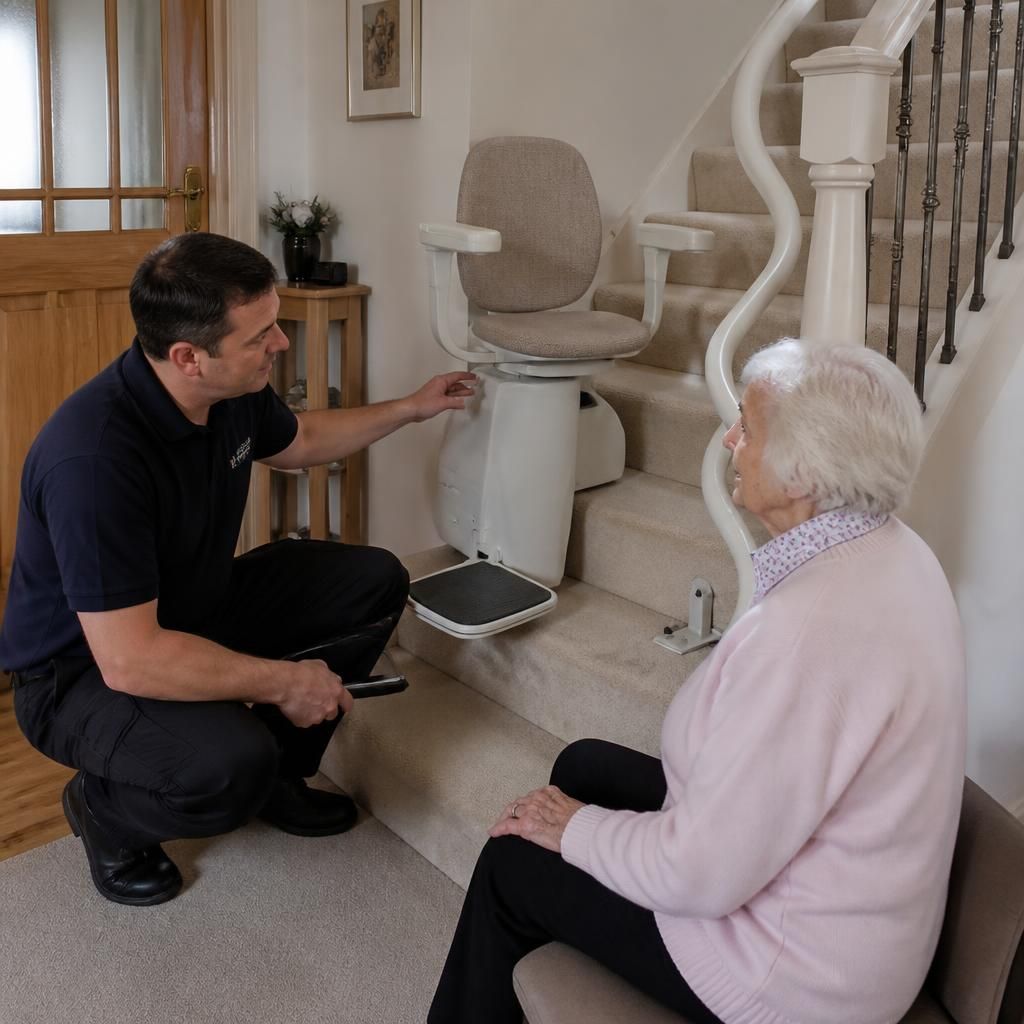
Arrange Your Curved Stairlift Assessment
Arrange your curved stairlift assessment so we can check your staircase, access points and any modifications that may be needed before installation. Our surveyor will explain the options and identify any required adjustments in advance.