
Can a curved stairlift be installed on narrow or steep staircases?
Yes. A bespoke curved stairlift can often be installed on narrow or steep staircases, as its track is designed around the staircase’s width, gradient, bends and landings; an expert home assessment is needed to confirm the safest and most practical configuration.
Yes. A bespoke curved stairlift can often be installed on narrow or steep staircases because its track is made to follow the staircase’s actual width, gradient, bends and landings. However, suitability depends on the available clearance, the staircase structure and how safely the user can get on and off the stairlift. A home assessment is therefore essential before a suitable design can be confirmed.
How curved stairlifts work on narrow staircases
A curved stairlift does not rely on a standard straight rail. The track is measured and manufactured to follow the individual staircase, including changes in direction, intermediate landings and upper or lower curves. This allows the lift to be positioned as efficiently as possible on a staircase where a standard straight model would not be appropriate.
On a narrow staircase, the assessment will consider the width available for the stairlift, the user’s seated position, the size of the chair and the space needed for safe boarding and disembarking. Features such as folding arms, a folding footrest or a compact seat may help reduce obstruction when the stairlift is parked, although the options available depend on the model and the user’s needs.
The track may be designed close to the edge of the stairs or positioned to preserve useful space elsewhere, provided this does not compromise safety. The surveyor will also check whether doors, handrails, radiators, bannisters or nearby furniture affect the route. A narrow staircase may still be suitable, but the final arrangement must leave adequate clearance for the passenger and other people using the stairs.
Installing a stairlift on steep stairs
Curved stairlifts can be designed for many steep or uneven staircases. The rail follows the pitch of the stairs, while the carriage and seat are configured to keep the passenger in a stable, comfortable position during travel. The installation design must account for the angle of the stairs, the transition onto each landing and the position of the seat when the lift stops.
On a steep staircase, particular attention is given to:
- the seat position and support during travel;
- safe entry and exit at the top and bottom;
- clearance between the passenger, stairwell and surrounding walls;
- the location of bends, landings and changes in gradient;
- the position of the footrest and arms when the stairlift is parked; and
- access for other people who may still need to use the stairs.
A powered swivel seat, adjustable seat position or other assisted feature may be recommended where turning at the top or bottom is difficult. These features should be selected according to the user’s balance, strength, flexibility and ability to transfer safely, rather than solely on the shape of the staircase.
What the home assessment checks
A specialist surveyor will inspect the complete staircase rather than measuring width alone. This normally includes the condition and construction of the stairs, the available headroom, the shape and size of landings, the position of doors and the space available at both ends of the rail. The surveyor should also discuss how the stairlift will be used, including whether the user can stand, turn, sit down and leave the seat safely.
The assessment is also an opportunity to identify practical issues that may not be obvious from photographs. For example, a staircase may be technically wide enough for a lift but have insufficient room at the top to turn into a hallway. Alternatively, a steep staircase may be suitable for the rail itself but require a different seat or stopping position to make transfers safe.
Will the staircase need altering?
In many installations, the curved track is fixed to the staircase structure with minimal alteration to the property. The exact fixing method depends on the stair construction and the manufacturer’s installation requirements. Minor adjustments or the removal of an obstruction may sometimes be necessary, but this should be identified and explained during the survey. A competent installer will not proceed with a configuration that leaves unsafe clearance or relies on an unsuitable fixing point.
When a narrow or steep staircase may not be suitable
Not every staircase can accommodate a curved stairlift. Restrictions may arise from extremely limited clearance, inadequate structural support, unusual steps, restricted landing space or a layout that prevents safe boarding and exit. In some homes, the safest solution may involve changing the rail position, using a different seat configuration or considering an alternative access arrangement.
A bespoke design can overcome many difficult layouts, but it cannot remove the need for safe transfers, adequate clearance and secure installation. The most reliable way to establish whether your staircase is suitable is to arrange an assessment that considers both the property and the person who will use the stairlift.
A curved stairlift can often be fitted to a narrow or steep staircase because its rail is designed to follow the staircase’s individual shape, rather than relying on a standard straight section. The design must still allow enough room for the passenger, safe boarding and exit, and other people to use the stairs where necessary.
During the home assessment, the surveyor checks the staircase width, gradient, landings, headroom, surrounding obstructions and the user’s ability to transfer safely. Seat position, folding components and powered swivel options may help on restricted layouts, but the final configuration must be based on both the staircase and the passenger’s needs.
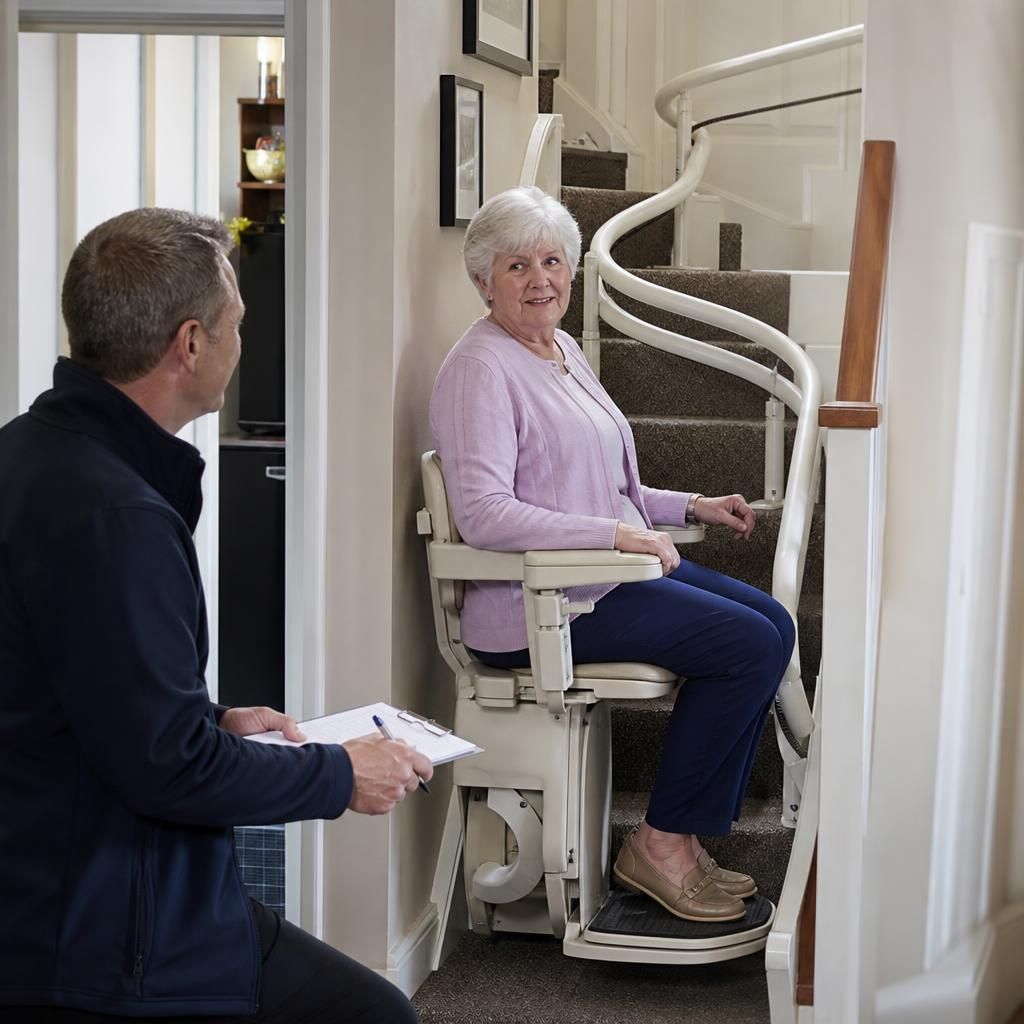
Book a home assessment for your staircase
Book a home assessment to confirm whether your narrow or steep staircase can accommodate a curved stairlift and identify the safest configuration for your needs. Our surveyor will assess the staircase, landings, clearances and transfer points before recommending a suitable solution.