
Are curved stairlifts more prone to breakdowns than straight stairlifts?
Curved stairlifts are not inherently more prone to breakdowns than straight stairlifts, although their bespoke rails, bends and additional moving components can make servicing more complex. With professional installation, sensible use and regular maintenance, a curved stairlift can provide dependable daily operation; faults are more often linked to wear, batteries, obstructions or missed servicing than to the stairlift’s curved design.
Curved stairlifts are not inherently more prone to breakdowns than straight stairlifts. A curved model has a bespoke rail, bends and usually more complex controls, so diagnosing or repairing a fault can be more involved. However, when it is correctly designed, installed and maintained, it should provide dependable daily operation. In both types, breakdowns are more commonly associated with battery wear, obstructions, component wear, charging problems or missed servicing than with the shape of the staircase itself.
Why straight stairlifts can seem more reliable
A straight stairlift normally runs along one continuous rail with a relatively simple route. It has fewer changes of direction and may use fewer rail-mounted components, which can make installation and servicing more straightforward. Replacement parts are also often more readily available for standard configurations. This does not mean that every straight stairlift will be more reliable, or that a curved model is less dependable; the condition of the equipment and the quality of the installation remain important factors.
What makes a curved stairlift more complex
A curved stairlift is made to follow the individual staircase, including bends, intermediate landings and changes in direction. Its rail must be accurately measured and manufactured, and the carriage must negotiate the route smoothly without contacting walls, landings or other obstacles. Depending on the design, it may also include additional sensors, powered swivel or folding functions, and controls that coordinate movement around the bends.
These features introduce more parts that require correct adjustment and maintenance. A fault may therefore take longer to identify than on a simple straight run. Complexity should not be confused with poor reliability: a properly fitted curved stairlift is designed to operate safely and consistently on its specific route.
Common causes of faults in both types
- Batteries: Rechargeable batteries gradually lose capacity. A stairlift that moves more slowly, stops before completing the journey or needs frequent charging may need its batteries checked.
- Charging problems: If the stairlift is not parked correctly on its charging point, or the charging equipment is not working, the batteries may not receive a full charge.
- Obstructions: Objects, carpet edges, clothing or other items on the stairs can activate safety sensors and prevent movement.
- Wear and contamination: Dust, dirt and general wear can affect the rail, drive system, sensors, seat mechanism or controls. Lubrication should only be carried out where specified by the manufacturer, as applying the wrong product can attract debris or affect braking and traction.
- Safety switches: Folding footrests, swivel seats, armrests and other safety features must be in their correct position before the stairlift will move.
- Electrical or control faults: Handsets, keys, switches and control boards can develop faults, particularly if they have been damaged, exposed to moisture or used incorrectly.
Why installation quality matters
Accurate surveying and installation are particularly important for a curved stairlift. The rail needs to provide suitable clearance throughout the route, while the carriage must be aligned correctly at bends and landings. Poor measurements, inadequate fixing or incorrect adjustment can lead to unusual noise, vibration, uneven travel, premature wear or repeated safety stops.
A professional assessment should consider the staircase structure, available clearance, the user’s posture and transfer needs, parking positions, power supply and any doors or walkways near the route. It should also confirm that the finished installation can be accessed for routine checks and future servicing. These steps reduce avoidable faults and help ensure that the stairlift is appropriate for the environment rather than simply fitted to it.
How to reduce the risk of a breakdown
- Keep the rail, steps and areas around the charging points clear.
- Park the stairlift as instructed so that it can charge properly when not in use.
- Use the controls and safety features as intended, without forcing the seat, footrest or swivel mechanism.
- Keep liquids away from the carriage, controls, batteries and charging equipment.
- Arrange servicing in line with the manufacturer’s recommendations and have unusual symptoms investigated promptly.
- Do not attempt to bypass a safety sensor or dismantle electrical or mechanical parts.
- Tell the service provider about changes to the staircase or surrounding area, such as new flooring, decorating or furniture that could affect clearance.
Regular servicing normally includes checking the rail and fixings, drive mechanism, batteries, charging system, safety sensors, controls, seat functions and general operation. The exact checks depend on the model and the installation. A service is not a substitute for daily care, but it can identify wear before it develops into a loss of service.
Signs that a curved stairlift needs attention
Contact the service team if the stairlift becomes noticeably slower, noisier or less smooth, stops at the same point repeatedly, fails to charge, gives warning sounds or displays a fault indicator. Repeated stops around a bend should not be treated as a normal feature of a curved model. They may indicate an obstruction, sensor issue, alignment problem, battery weakness or another fault that needs assessment.
If the stairlift stops between floors, follow the user instructions and avoid attempting to move it manually unless the manufacturer specifically permits this. Keep the user safe, do not force the controls and seek technical assistance. If there is smoke, a burning smell, visible damage or water near electrical components, switch off the equipment only if it is safe to do so and obtain urgent advice.
Overall, a curved stairlift involves more bespoke engineering than a straight model, but this does not make breakdowns inevitable or automatically more frequent. The main safeguards are an accurate survey, a suitable installation, correct everyday use and planned maintenance. If your stairlift’s performance has changed, reporting the symptom rather than waiting for a complete failure gives the engineer a better opportunity to identify the cause and restore safe, reliable operation.
Curved stairlifts are not automatically more prone to breakdowns than straight stairlifts, but their bespoke rails and additional bends require precise installation. The rail must be measured, fixed and aligned so the carriage can travel smoothly around corners, landings and changes in direction without rubbing against nearby surfaces or repeatedly triggering safety sensors.
Professional surveying and fitting help prevent avoidable faults such as unusual noise, vibration, uneven movement and repeated stops. Once installed, regular servicing can identify wear in the drive system, batteries, charging points and safety switches before it affects everyday operation. In practice, installation quality, correct use and planned maintenance are usually more important to reliability than whether the stairlift is curved or straight.
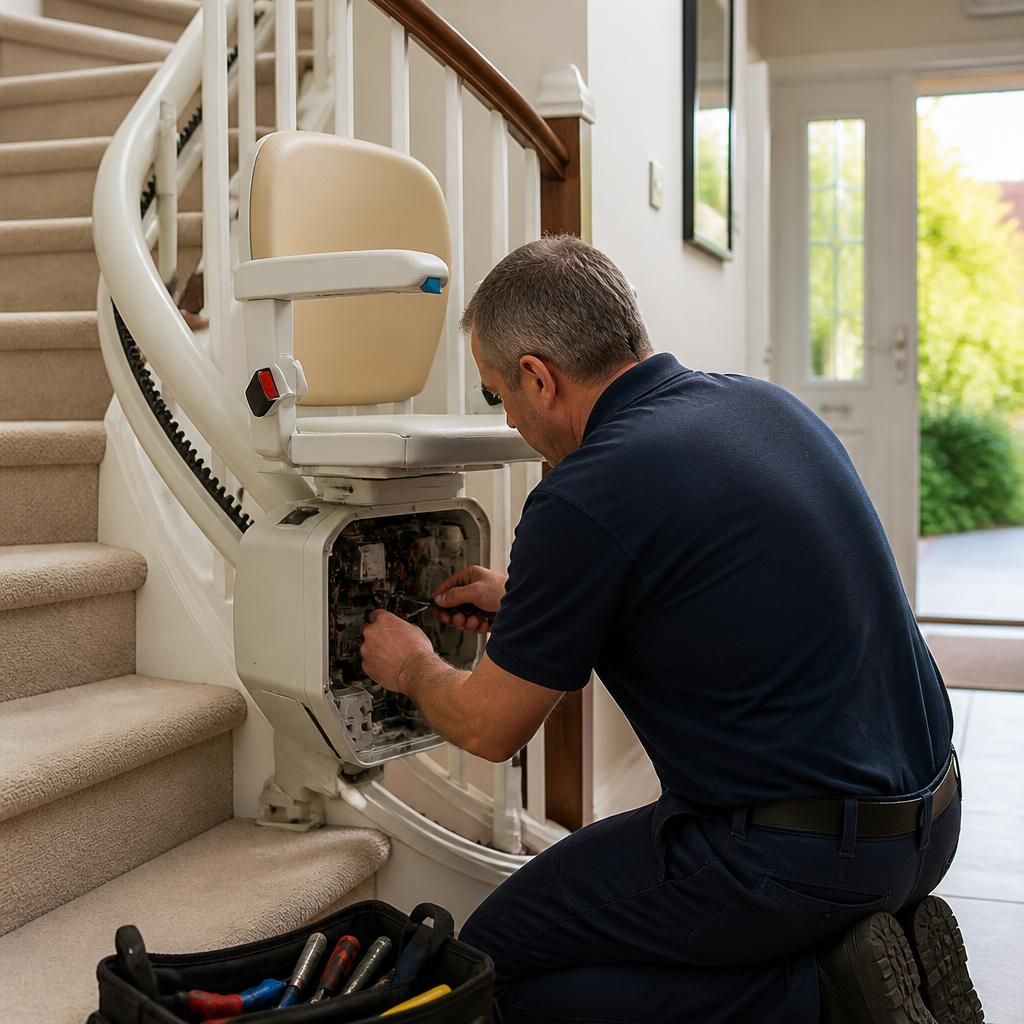
Arrange a professional curved stairlift service
If your curved stairlift is making unusual noises, stopping unexpectedly or failing to charge, arrange a professional curved stairlift service so the cause can be assessed safely. Contact Independent Stairlifts to discuss servicing or technical support.