
Are curved stairlifts more expensive than straight stairlifts?
Yes. Curved stairlifts are usually more expensive than straight stairlifts because the rail is custom-made to follow the exact shape of your staircase, whereas straight stairlifts use a standard straight rail.
The final price also depends on the staircase layout, seat and safety features selected, installation requirements, and whether you choose a new or reconditioned stairlift. A home assessment provides the most accurate quote.
Yes. Curved stairlifts are usually more expensive than straight stairlifts because their rails are made to follow the exact shape of the staircase. A straight stairlift generally uses a standard rail fitted along one continuous flight, while a curved model may need to travel around bends, landings, changes in direction or more than one flight. The final cost depends on the staircase layout, the equipment selected and the work required in your home.
Why curved stairlifts cost more
The rail is the main difference. A curved stairlift requires an accurate survey of your stairs before the rail can be designed and manufactured. The measurements must account for the width of the staircase, the position of walls and doors, the shape of each bend, the available space at the top and bottom, and the way the stairlift needs to park. This makes the rail more complex than the standard rail used for many straight stairlifts.
Curved stairlifts can also require more detailed installation work. The fitting team may need to assemble a rail made from several sections, position it precisely around landings or corners, and check that the stairlift travels safely without obstructing doors or walkways. The condition of the staircase and the available electrical supply can also affect the installation.
What affects the price of a curved stairlift?
- The shape of the staircase: A single bend may be less complex than a staircase with several turns, intermediate landings or multiple flights.
- The length of the rail: Longer travel distances and more extensive rail systems can increase the overall cost.
- Parking arrangements: A stairlift that needs to park around a corner, away from the stairs or on a different landing may require additional rail design.
- The seat and controls: Options such as powered swivel seats, powered folding mechanisms, adjustable seats and alternative control positions can affect the price.
- Safety requirements: Extra sensors, a retractable seat belt, powered footrests or other features may be suitable depending on your mobility and the layout of the stairs.
- Installation conditions: Restricted access, unusual stair construction, limited landing space or electrical work may add to the installation requirements.
- New or reconditioned equipment: A reconditioned stairlift may offer a lower-cost option, subject to availability and whether the existing rail and equipment are suitable for your staircase.
How straight and curved stairlift costs compare
A straight stairlift is normally the more economical option because its rail can often be produced in a standard format and installed on one uninterrupted flight. It may be suitable where the stairs run directly from one level to another without a bend or landing that needs to be negotiated.
A curved stairlift is designed for the staircase you actually have. Although the initial cost is generally higher, it can provide a more practical solution where a straight stairlift would stop at a landing or require separate equipment for another flight. In some homes, one curved stairlift can cover the complete route, subject to the design and assessment.
The cheapest option is not necessarily the most suitable. A stairlift must allow you to board and leave the seat safely, use the stairs without unnecessary obstruction and park in a position that works for the household. A lower-priced model may not provide the seat movement, controls or parking arrangement needed for your specific mobility and staircase.
Can a reconditioned curved stairlift reduce the cost?
Reconditioned equipment can reduce the cost compared with a new stairlift, but curved rails are made for individual staircases and are not usually interchangeable between homes. The availability of a suitable reconditioned curved stairlift depends on the rail design, the condition of the equipment and whether it can be adapted safely to your staircase. It is important to compare the complete quotation, including the survey, installation, warranty and aftercare, rather than comparing the equipment price alone.
Why a home assessment is important
An accurate price cannot normally be given from the number of steps alone. During an assessment, the stairlift adviser should consider the full route, your height and mobility, how you transfer into the seat, whether other people need to use the stairs and where the stairlift should be parked. The survey also identifies potential issues such as narrow sections, low ceilings, doors opening onto landings and insufficient space to approach the seat.
Ask for the quotation to explain what is included. This should cover the stairlift, bespoke rail where required, installation, testing and the relevant warranty or servicing arrangements. You can also ask whether the quoted price includes any alterations to the electrical supply or other work identified during the assessment.
In summary, curved stairlifts usually cost more than straight stairlifts because they involve a bespoke rail and a more involved design and installation process. The most reliable way to compare options is to arrange a professional assessment and request a clear quotation based on your staircase, preferred features and likely long-term use.
The main reason curved stairlifts cost more than straight stairlifts is that the rail is made to follow the exact shape of your staircase. It may need to travel around bends, landings or changes in direction, so it must be measured, designed and manufactured for your home rather than fitted as a standard straight section.
The final price can also be affected by the required parking position, available space, seat options and installation conditions. A professional assessment confirms the most suitable design and provides a quotation based on the complete installation, rather than the rail alone.
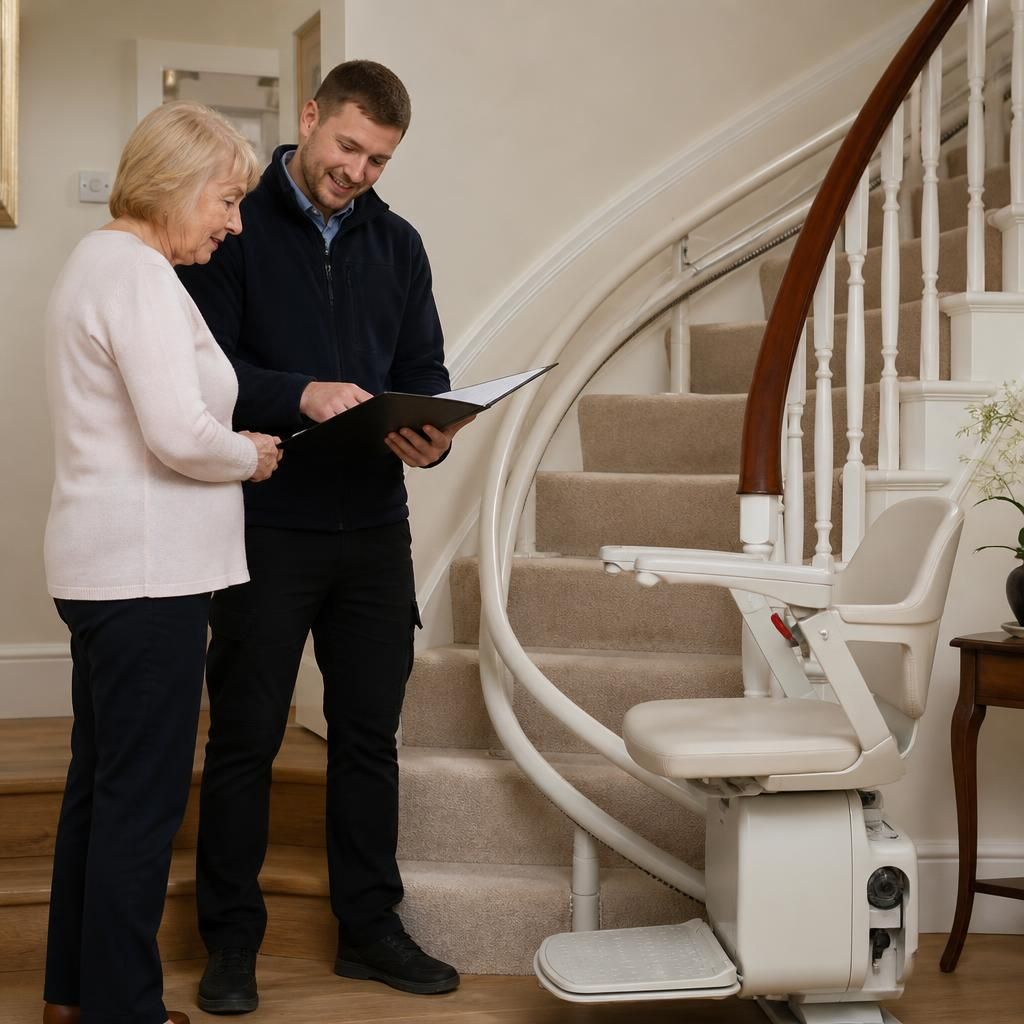
Get a tailored quote for your curved stairlift
Arrange a home assessment for a tailored curved stairlift quotation based on your staircase, mobility needs and preferred features. We will explain what is included, including the bespoke rail, installation and aftercare.