
What steps should I take to maintain my stairlift between professional services?
Between professional services, keep the stairlift charged, wipe the seat and controls with a slightly damp cloth, and check that the track, seat belt, footrest and sensors are clean, secure and free from obstructions. Do not use oil, dismantle covers or attempt electrical repairs; stop using the lift and contact us if you notice unusual noises, movement, damage or a warning light.
Between professional services, maintain your stairlift by keeping it charged, clean and clear of obstructions, while carrying out simple visual and functional checks. Do not dismantle the lift, apply lubricant or attempt electrical repairs yourself. If you notice damage, unusual movement, warning lights or an unfamiliar noise, stop using the stairlift and contact us for advice.
Keep the stairlift charged
- Leave the stairlift parked at its designated charging point when it is not in use, unless your installer or the manufacturer has given different instructions.
- Check that the power supply is switched on and that the charger is connected correctly.
- If the lift does not respond, check the obvious controls first, including the key switch, isolation switch, remote control and household power supply. Do not remove electrical covers.
- After a power cut, allow the stairlift to recharge before relying on it for regular journeys. Contact us if it fails to restart, does not hold charge or repeatedly stops.
Regular charging helps the batteries remain ready for use. If the stairlift is going to be unused for an extended period, follow the instructions supplied with your model or ask us how it should be left safely.
Clean the main contact areas
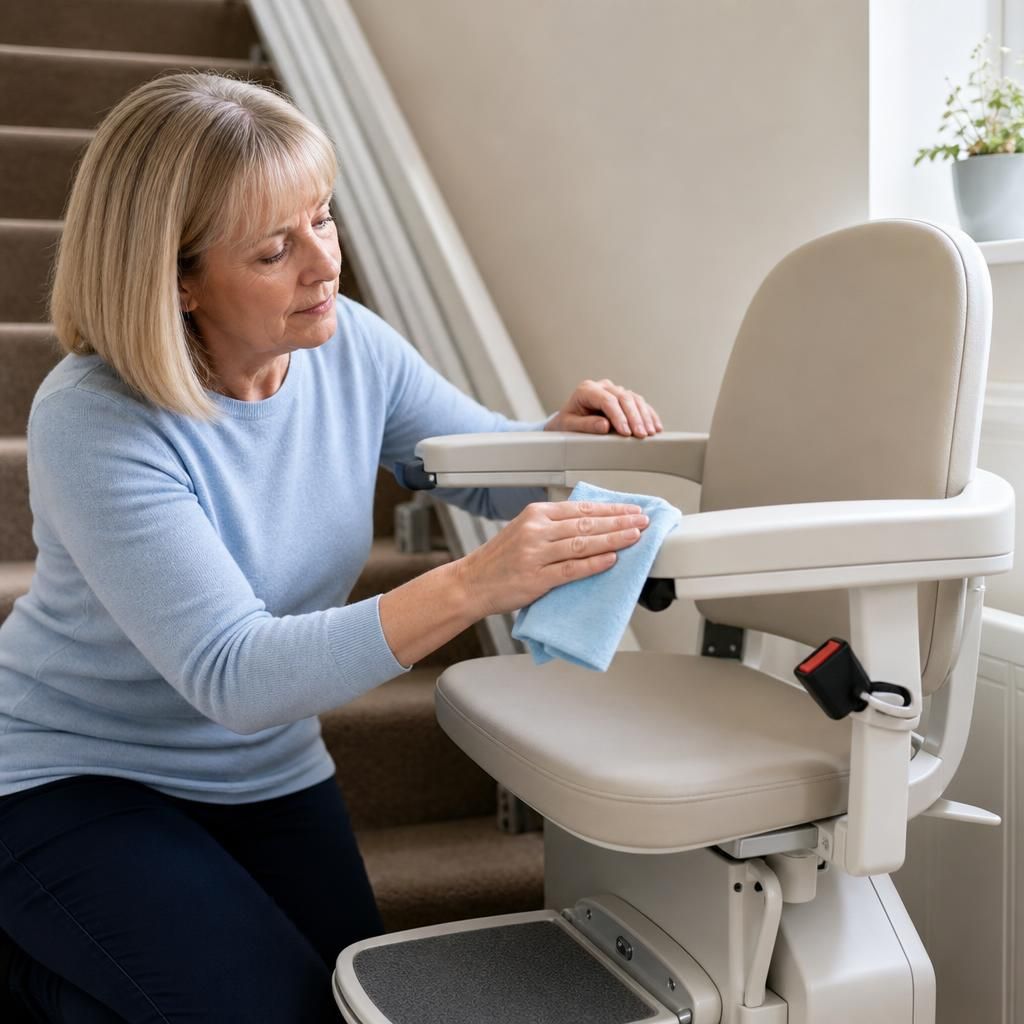
Use a soft, slightly damp cloth to wipe the seat, armrests, joystick or control buttons, footrest and remote control. Dry the surfaces afterwards, particularly around switches and charging contacts. A mild household detergent can be used if it is suitable for the material, but apply it to the cloth rather than spraying it directly onto the lift.
- Do not pour water onto any part of the stairlift.
- Keep liquid away from controls, batteries, charging points and electrical connections.
- Do not use abrasive products, solvents or strong cleaning chemicals unless the manufacturer specifically permits them.
- For an outdoor stairlift, remove dirt, leaves and moisture as recommended in its care instructions, and report weather-related damage or corrosion.
Check the track and surrounding area
Look along the full length of the rail and remove items that could obstruct the stairlift, such as clothing, toys, parcels, cleaning equipment or loose cables. Keep the stairs and landing clear so that the user can get on and off safely. Do not place objects on the track or use it as a support for household items.
Do not oil or grease the rail unless the manufacturer’s instructions specifically require it. Many stairlift tracks use components that are designed to operate without user-applied lubrication, and the wrong product can attract dirt or affect the lift’s operation.
Carry out a visual safety check
Before using the lift, check that:
- the seat, armrests, footrest and seat belt appear secure and undamaged;
- the seat locks correctly in its normal travelling position and swivels only as intended;
- the seat belt fastens and releases properly;
- the joystick, controls and remote appear intact and respond normally;
- the footrest and safety edges are free from dirt and obstructions;
- the rail, brackets and visible fixings show no signs of damage or looseness; and
- there are no warning lights, error messages or unexpected sounds.
Only carry out checks that can be completed safely without removing covers or reaching into moving parts. Never test a safety sensor by deliberately placing an object in the stairlift’s path while someone is travelling on it.
Use the stairlift as intended
Use the seat belt, sit facing the correct direction and keep your hands, feet and clothing within the seat area while the lift is moving. Do not exceed the stated user or load limit, carry bulky items on the stairs or allow another person to ride with you unless the lift is specifically designed and approved for that use. Keep children and pets away from the stairlift while it is operating.
Operate the controls gently and do not force the seat, swivel mechanism, footrest or safety armrests. If the lift stops at a landing or refuses to move, do not repeatedly press the controls or attempt to push it along the rail.
Know when to stop using it
Stop using the stairlift and contact us if you notice jerking, unusual vibration, a burning smell, grinding or repeated beeping, reduced travel speed, a loose component, damaged wiring, a belt that will not latch, or a seat or footrest that does not lock correctly. A warning light or error code should also be reported, even if the stairlift continues to operate.
If the lift stops between floors, remain seated with the belt fastened if it is safe to do so, use the alarm or telephone to request assistance and follow the instructions provided with your stairlift. Do not climb out onto the stairs or try to move the lift manually unless a trained professional has specifically instructed you.
Keep the user manual and our contact details accessible, and make a note of any fault message, when it occurred and what the stairlift was doing at the time. This information can help our engineer identify the problem more efficiently. These checks support safe day-to-day use but do not replace scheduled servicing, which is needed to inspect, test and maintain components that are not accessible to the user.
Between professional services, simple checks help keep your stairlift safe and dependable, but they must not involve dismantling the lift or working on electrical parts. Keep the rail, footrest, seat belt and controls clean, and make sure the stairway and landing are free from objects that could obstruct movement.
- Park the stairlift at its designated charging point when it is not in use, unless your model’s instructions say otherwise.
- Wipe the seat, armrests, controls and footrest with a soft, slightly damp cloth, keeping moisture away from switches and charging contacts.
- Look for loose or damaged parts, warning lights, unusual noises and changes in movement before use.
- Do not apply oil or grease unless specifically instructed by the manufacturer, as the wrong product can affect operation.
Stop using the stairlift and contact us if it jerks, makes an unfamiliar noise, shows a fault message, smells of burning or has a belt, seat or footrest that does not secure correctly. These checks support safe daily use but do not replace scheduled servicing.
Need help maintaining your stairlift?
If you are unsure how to maintain your stairlift or have noticed a change in its operation, contact us for practical advice or to arrange a professional service.