
What steps should a stairlift service provider take to ensure a swift response and effective resolution during emergency repairs?
A stairlift service provider should respond promptly by recording the fault and the user’s circumstances, carrying out a structured diagnosis, and arranging a qualified engineer with the correct parts and equipment. The repair should be completed safely, fully tested, and clearly explained, with advice on what to do if the fault recurs.
A stairlift service provider should manage an emergency repair through clear triage, prompt communication, safe fault diagnosis, and a properly equipped engineer visit. The priority is to protect the user, establish whether the stairlift can be safely reset or used, and restore reliable operation without bypassing safety systems or carrying out an unsuitable temporary fix.
1. Record the fault and the user’s circumstances
When you report a breakdown, the provider should ask practical questions rather than simply booking a routine appointment. These may include:
- What happens when the stairlift is switched on or the controls are used?
- Is the stairlift stopped at the top, bottom, or part-way along the stairs?
- Is anyone sitting in the seat, and can they leave it safely?
- Are there warning lights, an alarm, unusual noises, or a visible obstruction?
- Has there been a power cut, water exposure, impact, or recent work near the stairlift?
- Is there another safe way for the user to move between floors?
This information helps the provider assess urgency and send the right assistance. If a person is stranded or at risk of falling, that should be made clear immediately. A stairlift should not be used to transport someone who cannot sit securely or follow the controls.
2. Give safe advice while assistance is arranged
A responsible provider should give simple, fault-specific instructions and explain what not to do. Depending on the symptoms, this may include checking that the stairlift is switched on, the charging points are unobstructed, the seat or armrests are correctly positioned, and the emergency stop has not been activated. The user should only carry out checks that can be completed safely from a stable position.
Customers should not force the carriage along the rail, remove covers, tamper with wiring, bypass interlocks, or repeatedly reset the stairlift. If it has stopped on the stairs, the user should remain seated only if that is safe and follow the provider’s instructions. If there is smoke, a burning smell, exposed wiring, damage, or a risk of falling, the power should be isolated if this can be done safely and qualified assistance should be obtained.
3. Triage the problem and arrange an appropriate response
The provider should classify the call according to safety risk, the user’s mobility needs, and whether the stairlift is completely unusable or has a limited fault. A person who depends on the stairlift to access essential facilities may need a different response from someone who can safely use an alternative route.
The service team should explain what will happen next, including whether telephone support is available, when an engineer is expected, and whether any access arrangements are needed. If an immediate visit is not possible, the provider should give a realistic update and help identify safe temporary arrangements rather than leaving the customer uncertain.
4. Carry out a structured diagnosis
A qualified engineer should begin by confirming the reported symptoms and inspecting the stairlift, rail, charging points, batteries, controls, safety sensors, drive system, seat mechanism, and relevant electrical connections. Diagnostic checks should be systematic. A fault code or warning light can provide useful evidence, but it should not be treated as the complete diagnosis.
The engineer should also look for contributing conditions such as an obstruction on the stairs, a loose connection, a damaged component, poor charging contact, worn batteries, or a mechanical part that is no longer operating within its intended limits. The underlying cause should be addressed where possible, rather than simply clearing an error and returning the stairlift to service.
5. Arrive with suitable knowledge, tools, and parts
Information gathered during the initial call should be passed to the engineer. The service record should identify the stairlift model, installation details, previous repairs, reported symptoms, and any warranty or service agreement that applies. This improves the chance that the engineer arrives with compatible diagnostic equipment and likely replacement parts.
Where a required part is not available, the provider should explain this clearly and state whether the stairlift must remain out of use. It should not fit an incompatible component or disable a safety feature simply to make the stairlift move temporarily. If a temporary measure is safe and manufacturer-approved, its limitations and any follow-up work should be explained to the customer.
6. Repair the fault without compromising safety
Emergency work should be completed in accordance with the equipment’s instructions, applicable safety requirements, and the engineer’s competence. The repair may involve adjustment, cleaning of suitable contact points, replacing a worn or failed component, correcting a charging issue, or repairing a control or drive fault. The engineer should protect the home while working and leave the staircase clear when the job is finished.
Some faults cannot be resolved safely during the first visit, particularly where specialist parts, additional testing, or further assessment is needed. In that situation, the provider should record the stairlift as unavailable if appropriate, explain the risk of continued use, and arrange the next stage rather than suggesting that the customer takes a chance.
7. Test the stairlift under normal operating conditions
After the repair, the engineer should test the controls, movement, stopping points, charging function, seat and armrest interlocks, swivel or boarding mechanism, safety edges, footrest sensors, and any relevant alarm or emergency features. The exact checks depend on the stairlift design and the fault that was found.
The stairlift should be observed travelling along the rail and stopping correctly at its intended positions. Any abnormal noise, hesitation, uneven movement, or repeat warning should be investigated before the engineer leaves. A successful reset is not, by itself, proof that the underlying problem has been resolved.
8. Explain the outcome and any restrictions
The customer should be told what caused the fault, what work was completed, which parts were replaced or adjusted, and whether any further repair is required. The engineer should demonstrate normal operation if the user is able to observe it and confirm how to report a recurring problem.
Instructions should cover charging, safe boarding, use of the controls, and any temporary restriction. If the stairlift is safe only for limited use, that condition should be stated plainly. The service report should record the diagnosis, work carried out, test results, outstanding parts, and any recommendations for maintenance.
9. Provide appropriate follow-up
A proper emergency repair process does not necessarily end when the engineer leaves. The provider should follow up when a part has been ordered, a second visit is needed, or the fault could not be reproduced. If the same symptom returns, the earlier repair record should be reviewed so that the investigation continues from the existing evidence rather than starting again.
For you as an existing customer, useful information to have ready includes the stairlift’s model or service details, the exact location where it stopped, any warning message, what happened immediately beforehand, and whether the batteries were charging. Report changes in sound or movement early, avoid using a stairlift that appears unsafe, and contact the service team again if the repair does not restore normal operation.
Swift emergency stairlift repairs begin with accurate telephone triage. The service provider should establish where the stairlift has stopped, whether anyone is stranded or at risk, what warning lights or sounds are present, and whether the user can reach another floor safely.
This information allows the provider to set the right priority and send an engineer with suitable knowledge, diagnostic equipment and likely replacement parts. While assistance is arranged, the customer should receive clear safety advice, such as not forcing the stairlift, removing covers or bypassing safety sensors. If there is smoke, a burning smell, exposed wiring or visible damage, the stairlift should remain out of use until it has been assessed safely.
When the engineer arrives, the reported symptoms and service history should already be available. This avoids repeating basic checks, supports a more focused diagnosis and improves the likelihood that the fault can be resolved safely during the initial visit.
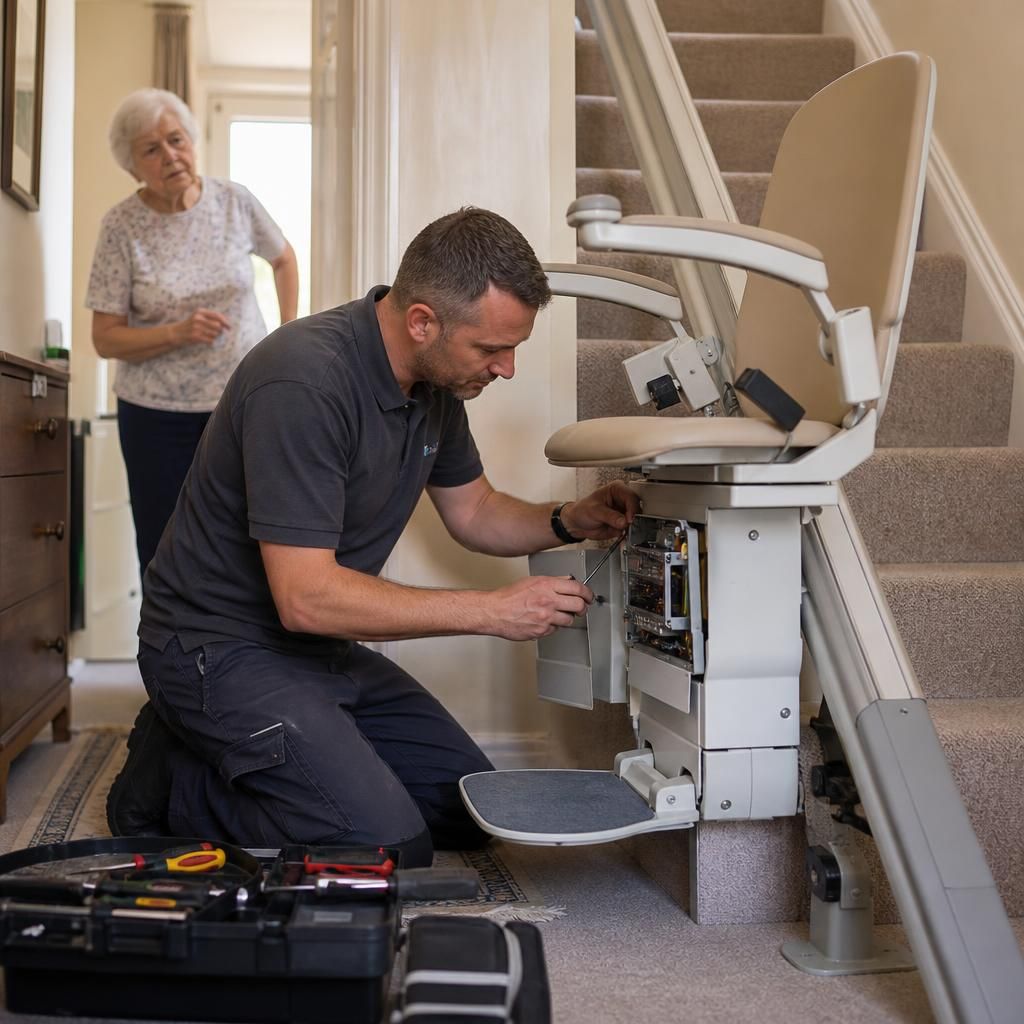
Contact Independent Stairlifts for Emergency Repair Support
If your stairlift has stopped working or appears unsafe, contact Independent Stairlifts for emergency repair support and provide the fault details, warning signs and location where it stopped.