
What should I do if my stairlift suddenly stops working?
If your stairlift suddenly stops working, remain seated if it is safe to do so, switch it off, and check the power supply, key switch, seat position and any visible obstructions. Do not attempt to repair it yourself; contact Independent Stairlifts for advice and arrange an engineer visit if these basic checks do not resolve the fault.
If your stairlift suddenly stops working, stay calm, remain seated if it is safe, and avoid trying to force or repair the lift yourself. Switch it off, remove the key if possible, and carry out a few safe checks involving the power supply, controls, seat position and visible obstructions. If it still does not operate, contact Independent Stairlifts so the fault can be assessed and an engineer can be arranged.
First, make sure you are safe
If you are on the stairs, keep your seat belt fastened and remain seated until you know it is safe to move. Do not try to climb the stairs around the lift, lift it by hand or ask someone to push it along the rail. If you are unable to leave the stairlift safely, are in pain, or have an urgent medical need, call the appropriate emergency service or ask someone nearby for immediate assistance.
If the stairlift has stopped at a landing and you can safely get off without using the stairs, move to a secure position before carrying out checks. Keep children and other people away from the stairlift until the problem has been resolved.
Safe checks to make
- Check the key switch: Make sure the key is inserted and turned to the operating position. Some stairlifts will not respond if the key has been removed or turned off.
- Check the power supply: Confirm that the stairlift is switched on at its usual power socket or fused spur. If the socket is accessible and safe to check, see whether another appliance works from it. Do not remove covers or handle wiring.
- Check the charging position: If the stairlift stopped at one end of the rail, it may not be positioned on its charging point. A loss of battery charge can prevent movement. Do not repeatedly operate the lift if the batteries appear flat.
- Check the seat: The seat normally needs to be locked in its travelling position, with the swivel mechanism returned correctly. Fold-down arms, footplates and safety features must also be in their normal operating positions.
- Look for visible obstructions: Check the footrest, rail and surrounding floor for objects that may have triggered a safety sensor. Only remove an obstruction if it is clearly visible and can be taken away without reaching beneath the lift or touching moving parts.
- Try the usual control carefully: If the stairlift has a remote control, check that it is switched on and has working batteries. Do not use force, repeatedly press the control or attempt to override a safety feature.
Some models show a warning light, audible alert or fault code when they stop. Make a note of what you see or hear, as this can help the engineer identify the problem. If the lift makes an unusual noise, smells of burning, shows signs of damage or has stopped after contact with an object, switch it off and do not use it again until it has been inspected.
What not to do
- Do not dismantle the carriage, motor, batteries, rail or control box.
- Do not bypass the seat belt, armrest, swivel-seat or obstruction sensors.
- Do not use lubricants or cleaning products on electrical parts, the rail or the drive mechanism unless an engineer has specifically advised you to do so.
- Do not attempt to move the stairlift manually or continue using it when it is jerking, slipping, stopping intermittently or making an unfamiliar sound.
- Do not repeatedly switch the power on and off if this does not clear the fault.
These actions can create an additional safety risk, cause further damage or make it more difficult to identify the original fault. Stairlift repairs should be carried out by a suitably trained service engineer using the correct parts and diagnostic procedures.
When to contact Independent Stairlifts
Arrange professional assistance if the basic checks do not restore operation, if the lift stops again after restarting, or if you notice a battery, charger, control, sensor, motor or rail problem. Tell us where the stairlift has stopped, whether anyone is still on it, what happened immediately beforehand, and any warning light, sound or fault message. It is also useful to provide the model information if it is readily available, although you should not delay calling if someone is stranded.
Explain whether the stairlift is completely unresponsive or whether it runs in only one direction. This distinction can help with initial troubleshooting. For example, a lift that works from one control but not another may have a remote-control or handset issue, while a lift that stops at the same point on the rail may require inspection of its sensors, charging arrangement or drive system.
If the power has failed
A power cut may stop the stairlift from charging, but many systems can continue operating for a limited period from their batteries. If the batteries are already low, the lift may stop before reaching its charging point. Do not keep attempting journeys during a power failure. If you can safely reach a landing, leave the stairlift there and wait for the supply to be restored. If you are stranded on the stairs, contact Independent Stairlifts for advice and tell us that the power is unavailable.
After power is restored, allow the stairlift to recharge in its designated charging position. If it does not begin charging, continues to display a warning or remains unable to travel, it needs professional attention. Batteries that no longer hold charge may need replacement, but this should be confirmed during an assessment rather than assumed.
After the stairlift has been repaired
Before using it normally, the engineer should explain the cause of the fault, the work completed and any action you need to take. Ask whether the batteries, charging points, safety sensors and controls have been checked, and whether any part or repair is covered by an existing guarantee or service agreement. Follow the operating instructions provided for your model and report any recurring fault rather than waiting for the stairlift to stop completely.
Regular servicing can identify worn parts, charging problems and safety issues before they cause a breakdown. Keeping the rail and surrounding area clear, using the stairlift as instructed and reporting unusual noises or intermittent operation promptly will also help maintain reliable performance.
If your stairlift suddenly stops working, stay seated with the seat belt fastened if it is safe to do so, and do not try to force the lift or climb around it. Switch the stairlift off, keep other people away from the stairs and seek assistance if you are stranded, in pain or have an urgent medical need.
Once you are safe, make a few simple checks without removing covers or touching wiring:
- Check that the key is inserted and turned on.
- Make sure the power supply is switched on and the lift is positioned correctly for charging.
- Check that the seat, swivel mechanism, arms and footplate are in their normal travelling positions.
- Look for a visible obstruction around the footrest, rail or floor, removing it only if this can be done without reaching beneath the lift.
- Note any warning light, fault code, unusual noise or burning smell.
If the stairlift remains stopped, switch it off and contact Independent Stairlifts. Do not dismantle the lift, bypass a safety sensor, move it manually or continue using it if it is jerking, slipping or stopping repeatedly.
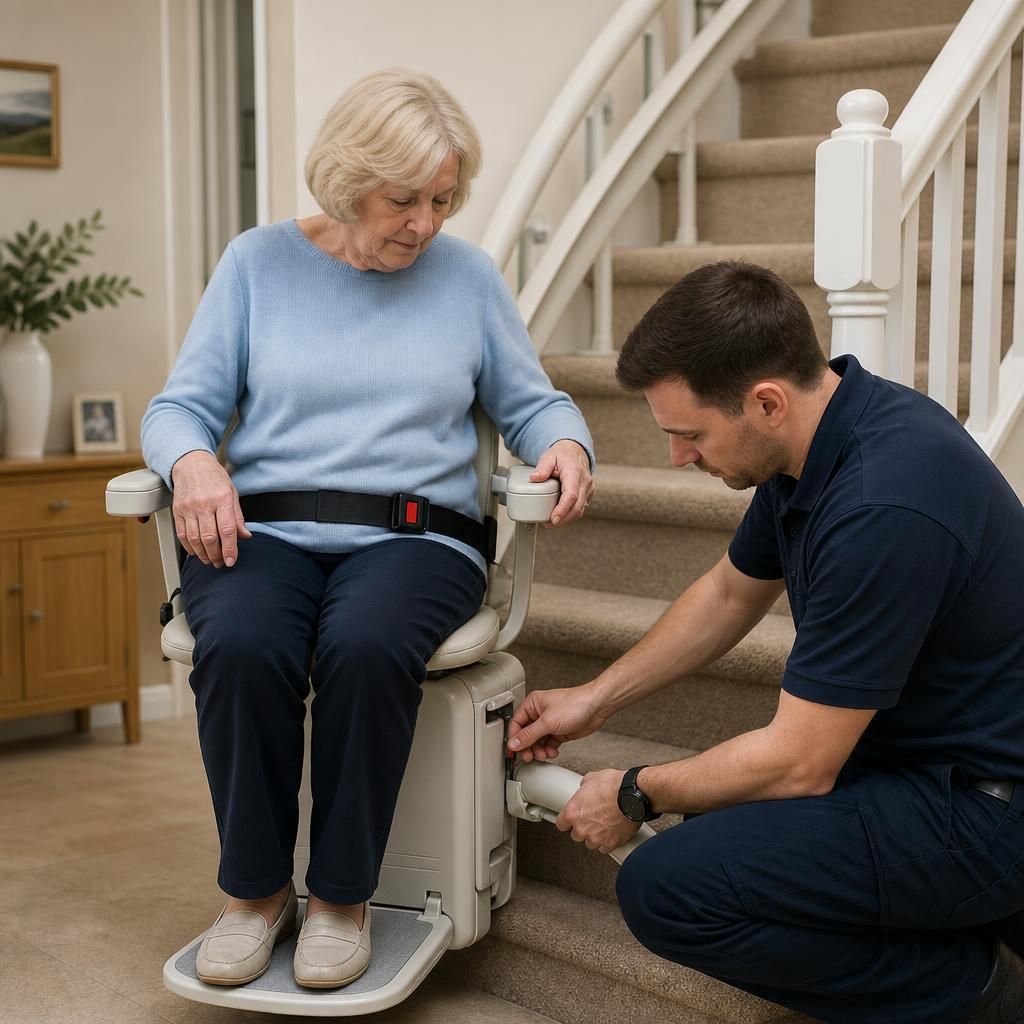
Need help if your stairlift has stopped working?
If your stairlift is still not working after these safe checks, contact Independent Stairlifts for advice and to arrange an engineer assessment. Tell us where the lift has stopped and describe any warning lights, unusual sounds or fault messages.