
What qualifications and certifications should a reliable stairlift service provider have to ensure quality maintenance and repairs?
A reliable stairlift service provider should use engineers who are trained and competent to work on the relevant stairlift models, with manufacturer-specific training where available and a clear understanding of applicable British and electrical safety standards. Look for evidence of suitable trade qualifications, structured ongoing training, documented service procedures, appropriate insurance and membership of recognised industry or quality-assurance schemes.
A reliable stairlift service provider should employ competent engineers with relevant technical training, manufacturer-specific instruction where available, and a documented understanding of UK safety requirements. The provider should also hold suitable public liability and professional indemnity insurance, follow written servicing procedures, keep accurate maintenance records and demonstrate that its engineers receive ongoing training rather than relying solely on experience.
Qualifications and certifications are important, but they should be considered alongside practical competence. A certificate by itself does not prove that an engineer is suitably trained to inspect, diagnose and repair your particular stairlift. Ask whether the engineer has current experience with the make and model installed in your home, including its charging system, controls, safety sensors, batteries, seat mechanism and track.
Manufacturer-specific training
Stairlift manufacturers use different control systems, diagnostic procedures, components and fault codes. A dependable provider should be able to explain what training its engineers have completed for the equipment they service. This may include manufacturer-led courses, technical assessments, service bulletins and access to approved repair information.
Manufacturer training is particularly useful for curved, outdoor and bespoke stairlifts, where the track, drive system and safety features may be configured for an individual staircase. It is also relevant when replacement parts or software-based diagnostics are required. If a provider is not manufacturer-authorised, that does not automatically mean it is unsuitable, but it should be transparent about its competence, parts sources and access to technical information.
Relevant engineering and electrical competence
Engineers should have suitable mechanical and electrical knowledge for the work they carry out. This includes the ability to:
- inspect the track, drive mechanism, seat, armrests, footrest, swivel system and safety edges;
- test controls, interlocks, sensors, limit switches, batteries and charging contacts;
- identify damaged, worn or incorrectly adjusted components;
- work safely on the stairlift’s electrical supply and charger; and
- complete functional and safety checks after a repair.
Where work involves the fixed electrical installation, the provider should use an appropriately qualified person and follow the relevant requirements of BS 7671. Ask precisely what the engineer is qualified to do, as a general electrical certificate may not cover every type of installation or repair. Work should not be described as electrically tested if the provider has only carried out a basic visual inspection.
Knowledge of applicable British and safety standards
A competent provider should understand the safety principles that apply to stairlifts and related equipment, including the relevant requirements of BS EN 81-40 for stairlifts where applicable. Engineers should know how to assess safe travel, braking, obstruction detection, charging, seat operation, restraint systems and the clearances around the lift.
Other legislation or standards may apply depending on the setting and the work involved. For example, requirements can differ between a private domestic installation, rented accommodation, a care setting and a commercial or public building. A responsible provider will consider the circumstances instead of applying a generic checklist to every visit.
Equipment safety regulations are not the same as engineer qualifications. UKCA or CE marking relates primarily to the conformity of a product, not to the competence of the person maintaining it. Similarly, membership of a trade association or possession of an ISO quality-management certification can support confidence in a company’s processes, but neither replaces model-specific technical competence.
Evidence of continuing professional development
Stairlift technology, replacement components and safety guidance can change. Reliable providers should keep engineers’ knowledge current through refresher training, technical updates, supervised practical work and internal quality checks. You can ask whether training records are reviewed and whether engineers are assessed after completing relevant courses.
Ongoing training matters when an engineer is servicing an older or reconditioned stairlift. The correct procedure may depend on the equipment’s age, previous modifications, discontinued parts and current safety condition. An engineer should be willing to recommend repair, replacement or withdrawal from use when the lift cannot be maintained safely.
Quality-assurance systems and professional memberships
Membership of a recognised mobility, healthcare or engineering trade association can indicate that a provider has agreed to follow a code of practice. Look for evidence of clear complaints procedures, responsible advertising, customer documentation and suitable aftercare. Check what the membership actually covers, because membership alone is not proof that every individual engineer holds the qualifications needed for your repair.
A quality-management certification such as ISO 9001 may show that the business operates documented processes for training, records, purchasing, complaints and corrective action. It is a company-level certification rather than a stairlift engineering qualification. The most useful providers can explain how their quality procedures affect your service visit, from booking and risk assessment through to testing and reporting.
Insurance and legal business documentation
The provider should hold appropriate public liability insurance and, where relevant, employers’ liability insurance. Professional indemnity cover may also be appropriate where the company provides technical advice, assessments or design recommendations. Ask what the policy covers and whether the level of cover remains current.
A trustworthy business should provide clear company details, written quotations, service terms, warranty information and an accessible complaints process. It should not pressure you to approve unnecessary work or refuse to explain why a component is being replaced. Before work begins, you should know whether the visit includes diagnosis, labour, travel, parts, follow-up visits and any emergency charges.
What should be recorded after maintenance or repair?
After a visit, the engineer should provide a service or repair report identifying the stairlift, work completed, parts fitted, faults found and tests carried out. The report should record any safety concerns and state whether the lift has been left in normal working order, restricted for use or taken out of service.
Good records help identify recurring faults and support warranty or aftercare claims. They should include relevant battery, charging, sensor and safety-device observations, without claiming that a component is safe indefinitely. If the engineer recommends monitoring rather than immediate replacement, the recommendation and reason should be written down.
Questions to ask before choosing or renewing a service provider
- Are the engineers trained on my stairlift’s make, model and configuration?
- What technical or electrical qualifications are relevant to the work being proposed?
- How are engineers kept up to date with new models, repairs and safety guidance?
- Which standards and inspection procedures are followed during a service?
- Will the engineer provide a written report and explain any safety limitations?
- Are replacement parts new, approved, reconditioned or compatible, and what warranty applies?
- What insurance and quality-assurance arrangements does the company maintain?
- Who will respond if the stairlift develops a fault after the repair?
For an existing customer, the practical test is whether the provider can give a clear answer about the engineer attending your home and the equipment being serviced. Keep your previous service reports and warranty documents available, report changes in performance promptly and ask for an explanation whenever a repair recommendation is unclear. A properly qualified provider will welcome those questions and make its competence, process and aftercare arrangements easy to verify.
The most useful qualification is evidence that the attending engineer is competent to maintain your particular stairlift safely. Ask whether they have relevant mechanical and electrical training, current experience with your make and model, and manufacturer-specific instruction where available.
A reliable service provider should also be able to explain the checks included in a visit, such as inspection of the track, drive system, controls, safety sensors, batteries, charging contacts and seat mechanism. After the work, request a written report recording faults found, parts replaced, tests completed and whether the stairlift has been left safe for normal use. This practical evidence should support any certificates or trade-association memberships claimed by the company.
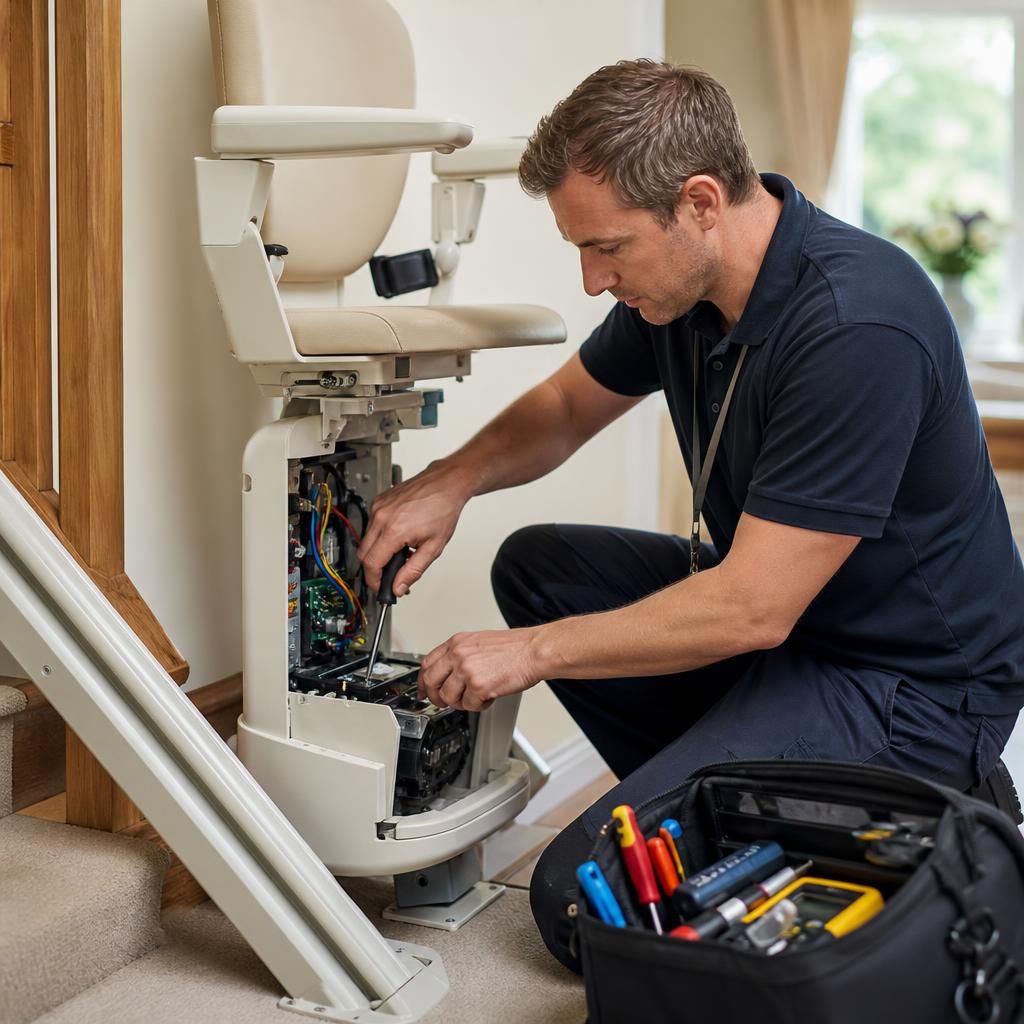
Speak to Our Stairlift Service Team
Speak to our stairlift service team for advice about servicing, repairs, engineer qualifications or ongoing aftercare for your stairlift.