
What factors should be considered when evaluating a stairlift service provider's ability to customise solutions for unique home layouts and specific user needs?
Evaluate whether the provider carries out a thorough, in-home assessment of the staircase, access points and surrounding space, then recommends a suitable straight, curved or outdoor stairlift rather than relying on standard specifications. They should also consider the user’s mobility, posture, weight, transfer ability, controls and future needs, while explaining bespoke options, installation requirements, safety, costs and aftercare clearly.
A stairlift provider’s ability to customise a solution should be judged by the quality of its assessment, not simply by the range of models it supplies. A suitable provider will examine the staircase and surrounding space in your home, understand the user’s mobility and daily routine, and explain how the recommended stairlift can be adapted, installed and supported safely.
Look for a thorough home assessment
A proper assessment should take place at the property rather than relying only on photographs, general measurements or a telephone description. The assessor should inspect:
- The staircase’s width, length, gradient and shape.
- Landings, bends, intermediate floors and changes in direction.
- Available space at the top and bottom of the stairs.
- Doorways, corridors, radiators, furniture and other possible obstructions.
- Suitable parking, access and working space for installation.
- Electrical supply arrangements and where the stairlift will be parked or charged.
These details help determine whether a straight stairlift is appropriate or whether a curved stairlift, compact configuration or alternative arrangement is needed. Outdoor stairs, unusually narrow staircases, split-level layouts and stairs with limited landing space may require additional planning. A competent assessor should identify these issues before recommending a product or issuing a final quotation.
Check that the user’s needs are assessed individually
The stairlift must suit the person using it, not just the staircase. The provider should discuss mobility, balance, posture, leg strength, transfer ability and confidence when getting on and off the seat. They should also consider:
- Whether the user can sit upright comfortably throughout the journey.
- Whether the seat, armrests and footrest provide adequate support.
- Whether the controls can be operated with the user’s available hand movement and grip.
- Whether a swivel seat, powered footrest, hinged rail or other option would make transfers safer.
- Whether the user needs a more supportive seat or a design that accommodates their size and weight.
- Whether another household member may use the stairlift.
- Whether the user’s condition or ability is likely to change, creating future requirements.
A useful assessment allows the user to try relevant features where possible. It should also include a clear discussion with family members or carers, provided the user is happy for them to be involved. The aim is to identify practical risks and preferences before installation, rather than expecting the user to adapt to an unsuitable design.
Ask how the provider handles unusual layouts
Customisation is particularly important where the stairs do not follow a simple, uninterrupted line. Ask whether the provider has experience with narrow staircases, multiple bends, half-landings, staircases that change direction and homes where doors or living areas are close to the stairway. The proposed design should explain how the rail will follow the stairs, where the seat will stop and how much space will remain available for other people to use the staircase.
For a curved installation, the provider should be able to explain how the rail is measured and made to follow the staircase. For a straight installation, they should still consider parking positions, rail length, the top landing and the possibility of a hinged or shortened rail where an obstruction is present. If the stairs lead to an external entrance, an outdoor stairlift may need weather-resistant materials, suitable charging arrangements and a plan for protecting the equipment when it is not in use.
Review the proposed features rather than accepting a standard specification
A reliable provider should explain which features are essential for the user and which are optional. Depending on the assessment, these may include a powered swivel seat, adjustable seat height, different control positions, a folding or powered footrest, a diagnostic display, safety sensors, remote controls or a hinged rail. The provider should explain the practical benefit of each feature and whether it affects the price, installation or future servicing.
Customisation does not mean adding every available option. Unnecessary features can complicate operation or increase cost. The recommendation should balance safety, comfort, ease of use, available space and the user’s budget.
Consider installation quality and disruption
Ask how the installation will be carried out and whether the proposed method suits the structure of the property. The installer should explain where the rail and charging points will be positioned, how fixings will be made, and whether any preparation or minor alterations are required. A stairlift is normally fitted to the staircase rather than the wall, but the provider should confirm the exact arrangement for your property.
The installation plan should also cover protection of floors and furnishings, safe access during the work, removal of packaging and demonstration of the completed equipment. If the provider identifies a structural, electrical or access issue that could affect the installation, it should be explained before work begins. Do not rely on a quotation that omits important site-specific requirements.
Check safety, suitability and compliance
The provider should be able to describe the safety features fitted to the stairlift and how they relate to the user’s needs. These may include obstruction sensors, seat-belt arrangements, swivel-seat locks, braking systems and battery backup. The user should receive clear instructions on safe transfers, operating the controls, using the seat belt and responding to an obstruction or power interruption.
Ask whether the equipment and installation are supplied in accordance with applicable UK requirements and manufacturer instructions. The provider should use appropriately trained installers and provide documentation covering operation, servicing, warranty terms and emergency contact arrangements. If the provider cannot explain how safety is checked after installation, this is a reason to seek clarification before proceeding.
Compare the quotation in practical terms
A customised solution should be supported by a written quotation that describes the proposed stairlift, important features, installation work, removal of any existing equipment and aftercare. Check whether the price includes assessment, delivery, fitting, demonstration, VAT where applicable, servicing arrangements and any adaptations required for the layout.
For a curved or unusual installation, confirm what happens if the final measurements differ from the initial assumptions. Also ask about deposits, cancellation terms, call-out charges, battery replacement, parts, repairs and work outside the standard warranty. A clear quotation makes it easier to compare genuinely equivalent solutions and reduces the risk of unexpected costs.
Assess aftercare and future adaptability
Customisation should continue after installation. The provider should offer instructions that the user can follow, a clear process for reporting faults and access to appropriately trained service staff. Ask how quickly assistance is normally arranged, whether emergency repairs are available and how spare parts are sourced.
It is also sensible to discuss future needs. A user’s mobility, strength or confidence may change, and the stairlift may need adjustment, additional servicing or replacement of a component. The provider should explain which adjustments are possible and when a different solution may be safer. For a reconditioned stairlift, ask what inspection, refurbishment and warranty cover are included, and whether the equipment is suitable for the specific staircase and user.
Questions to ask before choosing a provider
- Will the assessment take place in my home and include the full staircase and surrounding areas?
- What makes the recommended model suitable for the user’s mobility, posture and transfer ability?
- Which features are necessary, and which are optional?
- How will the stairlift be parked at the top and bottom of the stairs?
- Will the installation affect doors, walkways or other household users?
- Are there any structural, electrical or access requirements that could add to the work?
- What is included in the written price and warranty?
- Who will provide servicing, repairs and emergency support after installation?
- Can the equipment be adjusted if the user’s needs change?
The strongest indication of a provider’s ability to deliver a bespoke solution is a consistent process: a detailed home survey, careful discussion of the user’s requirements, a documented recommendation, transparent installation planning and dependable aftercare. If the assessment feels rushed or the recommendation appears to be based only on a standard product, ask for a more detailed explanation before making a decision.
A thorough in-home assessment is the clearest way to judge whether a stairlift provider can customise a solution for your property and needs. The assessor should examine the full staircase, landings, doorways, obstructions and available parking space, while also discussing the user’s posture, balance, transfer ability and control requirements.
This assessment should lead to a documented recommendation explaining why a straight, curved or outdoor stairlift is suitable, which features are necessary and how the installation will work. If the assessment is rushed or based only on standard measurements, important issues such as limited landing space, awkward bends or safer transfer arrangements may be missed.
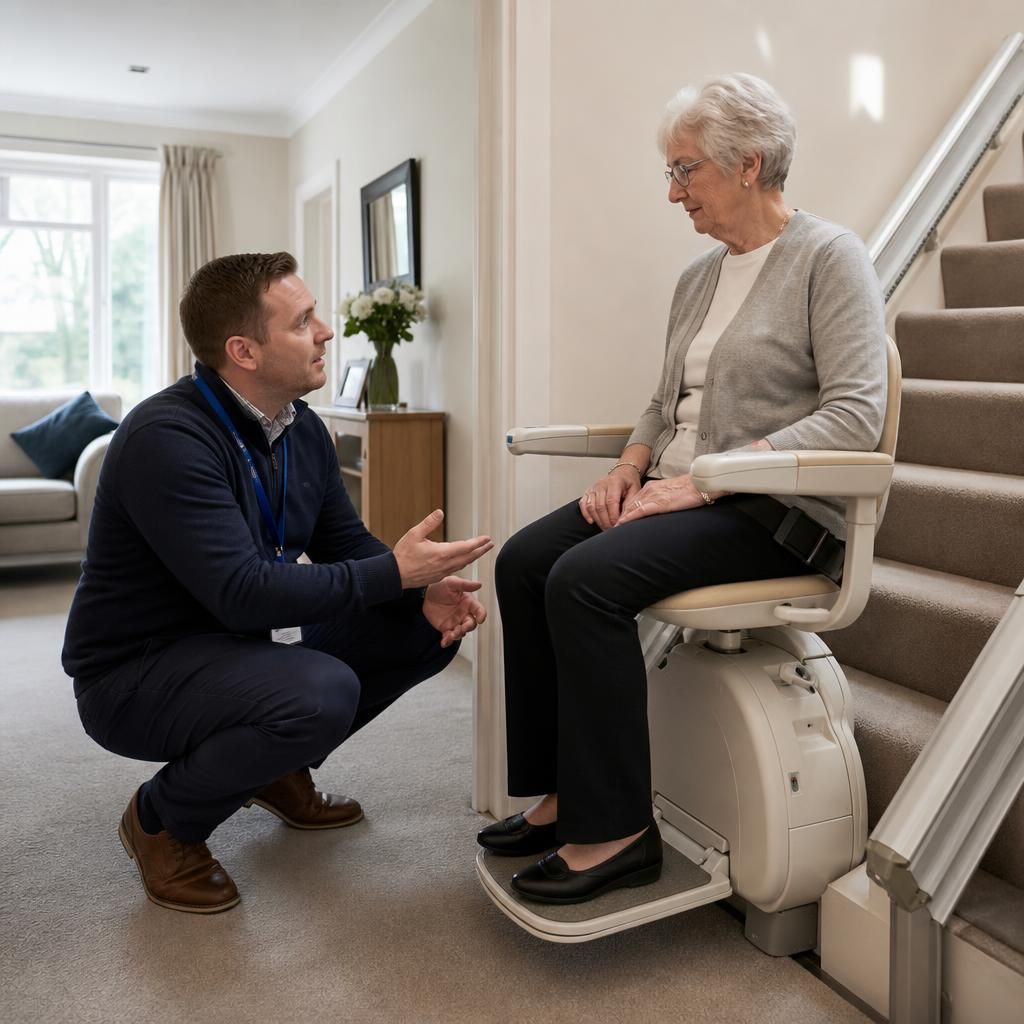
Arrange a Personalised Stairlift Assessment
Arrange a personalised stairlift assessment so we can evaluate your staircase, surrounding space and individual mobility needs. You will receive clear advice on suitable options, installation requirements and ongoing support.