
What measures can I take to maintain my stairlift between professional services?
Between professional services, keep your stairlift clean and dry, check the track and seat area for obstructions, and follow the manufacturer’s charging and operating guidance. Test the safety features during normal use and report unusual noises, movement, warning lights or reduced battery performance rather than attempting repairs yourself.
Between professional services, maintain your stairlift by keeping it clean and dry, checking the track and travel path, following the manufacturer’s charging guidance and watching for changes in its performance. These simple checks can help preserve reliable operation, but they do not replace professional servicing or authorise you to repair, dismantle or adjust the stairlift yourself.
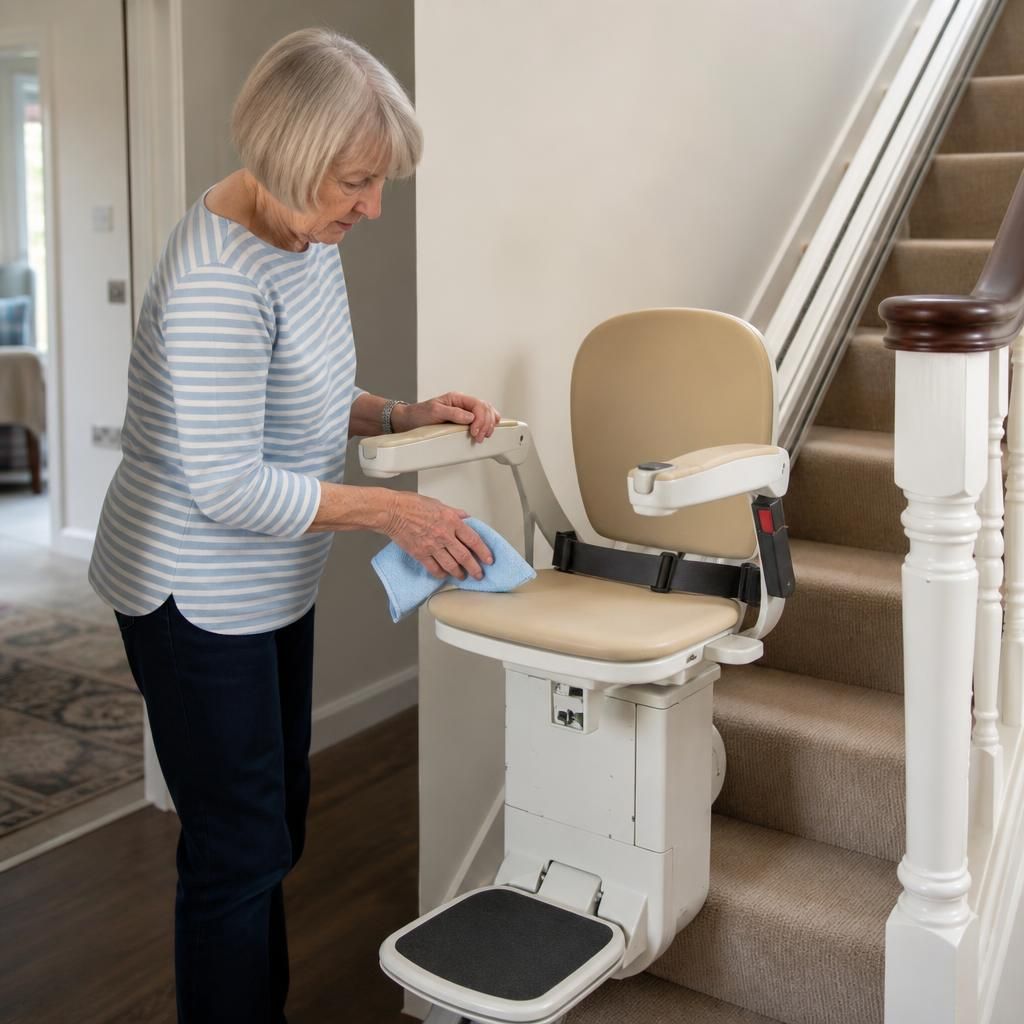
Keep the stairlift clean and dry
- Wipe the seat, armrests, footrest and controls with a soft, slightly damp cloth. Use only cleaning products recommended by the manufacturer, and do not spray liquid directly onto the controls, motor, charging points or other electrical parts.
- Remove dust, hair and loose debris from the footrest and around the seat. Take care not to push dirt into switches, sensors or moving joints.
- For an outdoor stairlift, remove water and accumulated dirt as appropriate and follow the manufacturer’s guidance for protecting it from prolonged exposure to rain, frost and extreme temperatures.
- Do not use a hose, pressure washer or excessive water on any part of the stairlift.
Keep the track and stairs clear
- Check that bags, clothing, toys, furniture, pets and other objects cannot obstruct the stairlift’s route.
- Look along the rail for visible dirt, foreign objects or anything that could interfere with the carriage or footrest.
- Do not place items on the stairs or track, even temporarily. An obstruction may activate the stairlift’s safety sensors or cause a sudden stop.
- Never apply oil, grease or other lubricant to the rail unless the manufacturer or a qualified stairlift engineer specifically instructs you to do so. The wrong product can attract dirt or affect the lift’s operation.
Use the charging system correctly
- Park the stairlift at its designated charging point whenever it is not in use, unless your manufacturer’s instructions state otherwise. This allows the batteries to remain charged and ready for use.
- Check that the charger is switched on where applicable and that the stairlift gives its normal charging indication.
- Keep charging points and the surrounding area clean and unobstructed. Do not use a damaged cable, plug or charger.
- If the stairlift repeatedly fails to charge, loses power quickly or operates more slowly than usual, contact us or a suitably qualified engineer. Do not attempt to replace batteries or electrical components without professional advice.
Carry out sensible safety checks during normal use
- Before travelling, make sure the seat is in its normal locked position, the armrests and footrest are clear, and the seat belt is available and functioning correctly.
- Use the controls as described in your operating instructions. Do not force the joystick, keyswitch, swivel mechanism or any manual release.
- Pay attention to whether the stairlift starts, stops and travels smoothly. A slight change in movement, repeated stopping or a control that feels stiff should be reported rather than ignored.
- Check that safety edges or sensors respond as expected during ordinary use, following the manufacturer’s instructions. Do not deliberately create a hazardous obstruction or put your hands, feet or clothing near moving parts to test them.
- Keep the remote controls dry and replace their batteries only as described in the user instructions. If a remote control is not responding, check its battery and contact an engineer if the problem remains.
Watch for signs that need attention
Contact us or your servicing provider if you notice unusual noises, juddering, uneven travel, unexpected movement, warning lights, repeated error tones, reduced battery performance, a loose seat or armrest, a damaged belt, a faulty swivel lock or difficulty using the controls. Stop using the stairlift if it becomes unsafe, emits a burning smell, shows visible electrical damage or cannot stop and start normally. Keep the stairs clear, switch off the stairlift only if your instructions tell you how to do so safely, and arrange professional assistance.
Do not remove covers, alter safety switches, bypass sensors, adjust the rail, disconnect wiring or investigate internal faults. Stairlifts contain electrical and mechanical parts that require the correct tools, replacement components and safety procedures. Attempting a repair can worsen the fault, create a risk of injury and affect future servicing or warranty arrangements.
Keep the user manual and service details accessible, and make a note of any fault codes, warning lights or circumstances in which a problem occurs. This information can help the engineer diagnose the issue efficiently. Continue with routine professional servicing even when the stairlift appears to be working normally, as servicing includes inspections that cannot be completed through everyday cleaning and visual checks.
Keeping the stairlift, rail and staircase clear is one of the most important maintenance measures between professional services. Before use, check that clothing, pets, furniture, bags and other objects cannot obstruct the carriage, footrest or safety sensors.
Wipe away visible dust and loose debris with a soft, dry or slightly damp cloth, following the manufacturer’s cleaning guidance. Do not use a hose, pressure washer or excessive water, and never apply oil or grease to the rail unless a qualified engineer specifically advises it. If the stairlift repeatedly stops, makes an unusual noise or appears to be affected by an obstruction, stop using it and arrange professional assistance rather than attempting to adjust or dismantle it.
Arrange Professional Stairlift Servicing
Arrange professional stairlift servicing with Independent Stairlifts to identify wear, faults and safety issues that routine cleaning and checks cannot detect. Contact us to book a service or discuss any concerns about your stairlift’s performance.