
What are the benefits of regular stairlift servicing compared to reactive repairs?
Regular stairlift servicing helps identify wear, safety issues and developing faults before they cause a breakdown, whereas reactive repairs only address problems after they occur. This can improve reliability and safety, reduce disruption and help control repair costs over the stairlift’s working life.
Regular stairlift servicing is generally safer, more reliable and easier to budget for than relying solely on reactive repairs. A planned service allows a qualified engineer to identify wear, contamination, loose connections and developing faults before they cause a breakdown. Reactive repair, by contrast, begins only after a fault has affected the stairlift, which can lead to unexpected disruption and more extensive work.
Improved day-to-day safety
A stairlift is a safety-critical mobility aid. During a routine service, the engineer can check the systems that help the lift start, travel, stop and park correctly. This may include the seat, swivel or folding mechanisms, armrests, footrest, seat belt, sensors, controls, batteries, charging points, track and safety edges. The engineer can also look for signs of wear or damage that may not be obvious during normal use.
Finding a developing issue does not necessarily mean that a component needs immediate replacement. It does, however, give you an opportunity to understand the condition of the stairlift and deal with a concern before it compromises safe operation. A service cannot remove every possible risk, and it does not replace sensible use or prompt reporting of faults, but it reduces the chance that preventable issues remain unnoticed.
Greater reliability and fewer unexpected breakdowns
Many stairlift faults develop gradually. Batteries may hold less charge, contacts can become dirty, fixings may loosen, and moving parts can become worn or stiff. The stairlift may continue to operate for a time, but with slower movement, intermittent stopping, warning sounds or reduced battery performance. Routine servicing provides a structured opportunity to investigate these changes.
Reactive repairs are important when a fault occurs, but they are necessarily focused on restoring operation after the problem has already affected the user. If a breakdown happens at an inconvenient time, the stairlift may be unavailable until an engineer can attend and the required part is available. Planned maintenance cannot guarantee that a breakdown will never happen, but it can help make faults less likely and identify some repairs before they become urgent.
Better control of repair costs
Regular servicing can help control costs by identifying minor defects or wear before they cause damage to related components. For example, addressing a problem with a charging connection or a worn moving part may be more straightforward than dealing with a complete loss of power or a secondary failure. Planned work can also make it easier to discuss the available options and approve necessary repairs without the pressure of an unexpected breakdown.
Servicing is not a promise that future repairs will be avoided, and it is not always the least expensive option in the short term. A stairlift that is used infrequently and appears to be working normally may not show an obvious fault during everyday use. Even so, the cost of a service should be considered alongside the potential inconvenience of being without the lift and the cost of urgent diagnosis, replacement parts or additional visits.
Less disruption for the user and household
A planned appointment can usually be arranged around the user’s routine and carried out before a minor issue becomes a complete loss of service. This is particularly relevant where the stairlift is the person’s main means of accessing different floors. An unexpected failure can restrict movement around the home, affect personal care arrangements and require family members or carers to make alternative plans.
During a service, the engineer can also check that the stairlift remains suitable for the way it is being used. Changes in the home, such as an obstruction near the track, new flooring or altered furniture, may affect safe operation. Raising these points during a planned visit can prevent avoidable problems.
More dependable battery performance
Batteries are wear items and their condition can change with age, usage and charging conditions. A stairlift may still travel normally while its batteries are losing capacity, until it begins to stop short of its destination or fails to operate when it has not been charged sufficiently. A service can include checks of the batteries, charging points and related connections, helping to identify reduced performance before it results in a breakdown.
Battery life is affected by the individual stairlift and its environment, so replacement should be based on condition and performance rather than an assumed timetable. Leaving the stairlift correctly parked on its charging point, where applicable, remains important between services.
A useful maintenance record
Professional servicing creates a record of inspections, identified defects and work completed. This helps build a clearer picture of how the stairlift is performing over time. It can also help an engineer distinguish a new fault from a recurring issue and decide whether adjustment, cleaning, repair or replacement is the appropriate response.
Keep the service information and report available, particularly if more than one person supports the stairlift user. The record may also be useful when discussing future repairs or assessing whether an older stairlift remains economical and suitable to maintain.
Why reactive repairs are still necessary
Routine servicing should complement, not replace, prompt repairs. Contact us if the stairlift stops unexpectedly, moves unevenly, repeatedly loses power, fails to charge, makes a new grinding or clicking noise, shows a warning indication, or has damaged safety equipment. Do not continue using a stairlift if the seat belt, swivel lock, footrest, sensors or other safety features are not working correctly. Follow the manufacturer’s instructions, switch the stairlift off if advised, and keep the staircase clear until it has been assessed.
Do not attempt to remove covers, adjust electrical parts or dismantle the mechanism yourself. Basic user checks, such as ensuring the power supply is on, the stairlift is properly parked for charging and the track is free from obvious obstructions, may be appropriate when described in the operating instructions. Anything beyond these checks should be left to a suitably qualified engineer.
Overall, regular servicing provides preventative oversight: it checks safety-related components, identifies wear, supports dependable operation and can reduce avoidable disruption. Reactive repairs remain the correct response to an unexpected fault, but relying on them alone means the first indication of a problem may be a breakdown. Combining planned servicing with prompt reporting of unusual behaviour offers the most practical way to keep a stairlift safe and available throughout its working life.
Regular stairlift servicing is a planned inspection that can identify developing safety and performance faults before they cause a breakdown. A qualified engineer checks key features such as the seat belt, swivel lock, footrest, sensors, controls, track, batteries and charging points, as well as looking for loose fixings, contamination or signs of wear.
This preventative approach is different from reactive repair, which starts after the stairlift has already stopped working or shown a fault. Finding an issue during a planned service gives you time to arrange appropriate maintenance and helps reduce the risk of unexpected loss of access between floors. Servicing cannot prevent every fault, so any unusual noise, uneven movement, warning indication or charging problem should still be reported promptly.
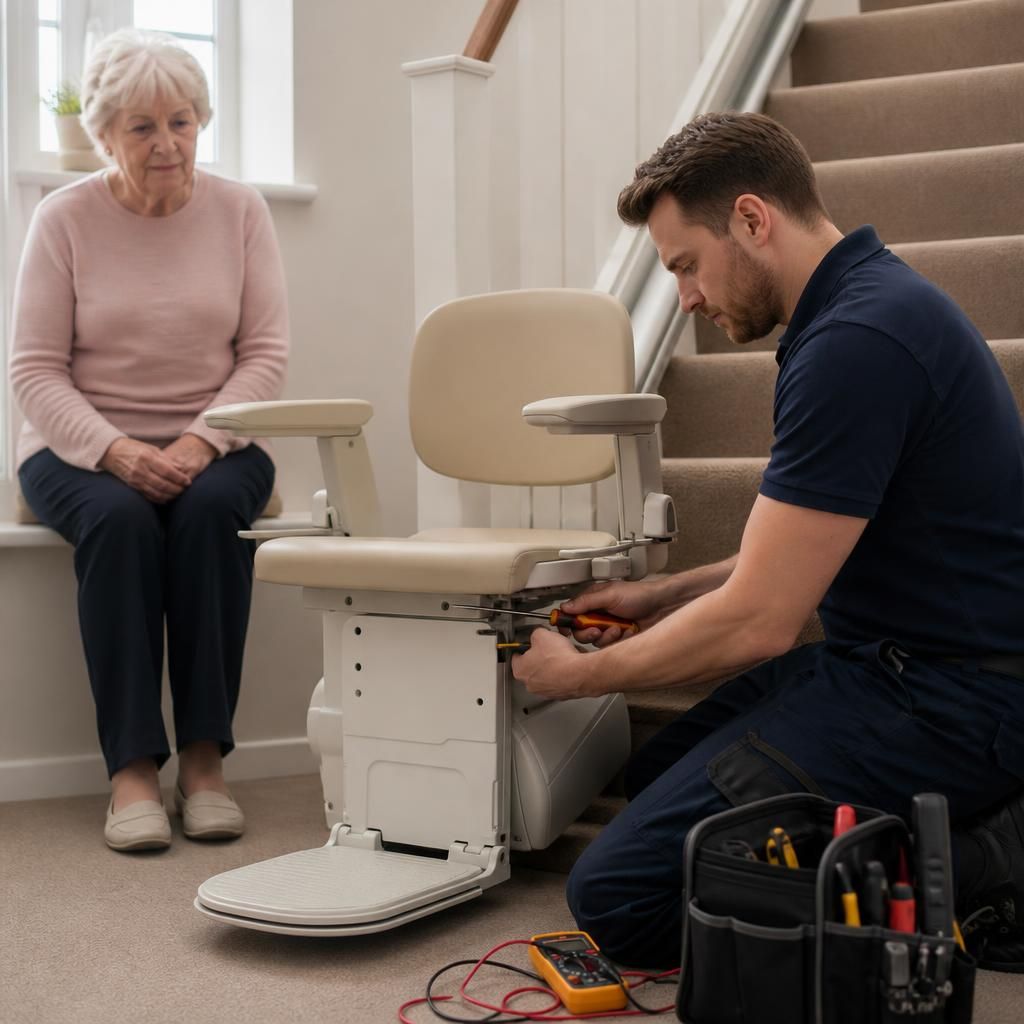
Book your professional stairlift service
Book your professional stairlift service to identify developing faults, check safety-critical components and support reliable day-to-day operation. Contact Independent Stairlifts to arrange a convenient appointment.