
What factors should be considered when choosing between purchasing and renting a stairlift?
Choosing between purchasing and renting a stairlift depends mainly on how long it will be needed, the total cost, the suitability of the model for your staircase, and the installation, servicing and removal arrangements. Renting can suit temporary or uncertain needs, while purchasing may offer better long-term value and more choice for ongoing use.
The choice between purchasing and renting a stairlift should be based on the expected length of use, the total cost over that period, the layout of your staircase, and the level of flexibility and support you need. Renting is often practical when access is required temporarily or the long-term need is uncertain. Purchasing may be more economical for ongoing use and can provide a wider choice of models and features.
Before deciding, consider the following factors.
How long the stairlift is likely to be needed
Expected duration is usually the most important consideration. A rental can avoid the larger initial payment associated with buying and may be suitable during recovery from an operation, while waiting for other adaptations, or when a stairlift is needed for a temporary change in mobility. It can also be useful when a person’s longer-term circumstances are not yet clear.
Buying is generally worth considering when the stairlift is likely to be used for an extended period. Although the initial cost is higher, there are no ongoing rental charges once the purchase has been completed, subject to any separately agreed servicing or repair costs. If the expected rental period becomes lengthy, the total rental cost may eventually exceed the cost of purchasing a suitable stairlift.
If the duration is uncertain, ask for a clear comparison of the likely rental cost against the purchase price. Check whether the rental agreement has a minimum term, how extensions are charged and what happens if the stairlift is no longer required earlier than expected.
Total cost rather than the initial price
Compare the complete cost of each option, not just the advertised starting price. For a rental, this may include the recurring rental charge, assessment or installation fees, delivery, removal, damage charges, deposits and any additional servicing terms. For a purchase, consider the stairlift itself, the survey and installation, warranty cover, servicing, repairs and eventual removal if it is no longer needed.
Ask whether installation and removal are included in the quoted rental price. A straight stairlift is often simpler to install and remove than a curved model, but the actual arrangement depends on the home and the agreement. For a purchase, clarify what is covered by the manufacturer’s warranty and which costs could arise after that cover ends.
Tax treatment can also affect the price. Some customers may qualify for VAT relief on certain mobility equipment and services, subject to the relevant eligibility requirements. This should be confirmed during the quotation process rather than assumed.
The shape and construction of the staircase
Your staircase determines which stairlift designs are suitable. Straight staircases may accommodate a standard straight stairlift, whereas stairs with a bend, landing, intermediate level or unusual geometry may require a bespoke curved rail. Outdoor stairs, narrow staircases and staircases with limited access at the top or bottom need separate assessment.
Rental availability can be more limited for highly customised installations because a curved rail is made to follow the individual staircase and may not be readily reusable elsewhere. Purchasing can therefore offer more flexibility where a bespoke solution is necessary. A home assessment should confirm whether the proposed stairlift leaves adequate room for other users, doors and walkways, and whether it can be folded or parked safely.
Your mobility and safety requirements
The stairlift must suit the person using it, not just the staircase. Consider transfers on and off the seat, balance, grip strength, flexibility, leg movement, vision and the ability to operate the controls. Seat height, seat width, armrests, swivel mechanisms, powered footrests, harnesses and control positions may all affect safe and comfortable use.
For a temporary need, a simpler rental model may be sufficient if it meets the user’s safety requirements. If the stairlift will be used frequently or for the foreseeable future, purchasing may make it easier to specify features that support changing needs. A professional assessment is particularly important if the user has a progressive condition, significant weakness or difficulty transferring.
Installation, removal and possible changes to the home
Most stairlifts are installed to the staircase rather than fixed to the wall, but fitting still requires careful measurement and a suitable electrical supply. Ask how the installation will affect the staircase, whether any preparation is needed and how quickly the lift can be removed when it is no longer required.
For a rental, removal should be agreed at the outset. Confirm whether the staircase will be left in its original condition and whether there are charges for removing the equipment. With a purchased stairlift, you retain responsibility for deciding when it should be removed and how that work will be arranged. If you are renting your property, obtain the landlord’s permission before installation and check who is responsible for reinstatement.
Maintenance, breakdown support and warranty
Reliable support is important with either option. A rental agreement may include servicing, breakdown assistance and replacement of faulty components, but the exact cover varies. Check the hours of support, response arrangements, exclusions and whether accidental damage or misuse is excluded.
When purchasing, establish the length and scope of the warranty, how repairs are requested and whether servicing is included or available under a separate plan. A low purchase price may not represent good value if essential support is excluded. Ask who will maintain the stairlift if it is reconditioned or previously used, and whether replacement parts remain available.
Whether a reconditioned stairlift is appropriate
A reconditioned stairlift may provide a cost-effective alternative to a new purchase, particularly for a straightforward staircase. It should be assessed and refurbished by a competent provider, with appropriate safety checks and clear information about its condition, warranty and support.
Reconditioned equipment may be less suitable where the staircase requires a new bespoke rail or where the user needs unusual seating or control adaptations. Ask whether the rail and other components are new, refurbished or being reused, and make sure the proposed model is suitable for the user’s weight, posture and mobility.
Flexibility if circumstances change
Renting can make it easier to end the arrangement when the stairlift is no longer required, but the agreement may include notice requirements or removal charges. Purchasing provides ownership but usually means arranging and paying for removal, resale or disposal later. A purchased stairlift may have limited resale value because curved rails are normally made for one staircase, while some components of a straight stairlift may be reusable subject to inspection and compatibility.
Consider likely changes in health, living arrangements and property ownership. If the user may move home, ask whether the stairlift can be adapted or transferred. A straight stairlift may sometimes be suitable for another staircase, but this cannot be assumed. Curved installations will usually need a new assessment and rail.
Rental agreement terms and ownership responsibilities
Read the agreement before committing. It should explain the rental period, renewal and cancellation terms, payment schedule, deposit arrangements, installation and removal responsibilities, maintenance cover and what happens if the equipment is damaged or unused for a period.
For a purchase, keep the quotation, installation details, warranty information and servicing records. Confirm who owns the equipment immediately after installation and whether any finance agreement has separate terms. If the stairlift is being arranged for someone else, make sure the user and the person responsible for payments both understand the arrangements.
A practical way to compare the options
- Arrange an assessment of the staircase and the user’s mobility needs.
- Confirm which stairlift types and features are genuinely suitable.
- Estimate how long the lift is likely to be needed, allowing for uncertainty.
- Request an itemised rental quotation, including installation, servicing, removal and any deposit or cancellation terms.
- Request an itemised purchase quotation, including warranty, servicing and likely removal arrangements.
- Compare the total expected cost over the intended period of use.
- Check the support available if the stairlift develops a fault or the user’s needs change.
In general, renting is most appropriate for a short-term, temporary or uncertain requirement where flexibility is more important than ownership. Purchasing is more likely to suit a continuing need, a user who requires specific features, or a staircase that needs a bespoke installation. The right decision is the option that remains safe, suitable and financially sensible for the expected period of use, with all installation, maintenance and removal terms understood in advance.
The most useful comparison between purchasing and renting a stairlift is the total cost over the expected period of use, rather than the initial payment or advertised rental charge alone. Rental costs may include installation, ongoing payments, servicing, removal, deposits and early-cancellation charges. A purchase quotation should be checked for installation, warranty cover, servicing, repairs and eventual removal.
Ask for both options to be itemised on the same basis. If the stairlift is likely to be needed for a prolonged period, purchasing may offer better overall value; if the need is temporary or uncertain, renting may avoid a larger upfront commitment. Confirm the rental minimum term, extension arrangements and notice period, and ask whether VAT relief applies to your circumstances before making a decision.
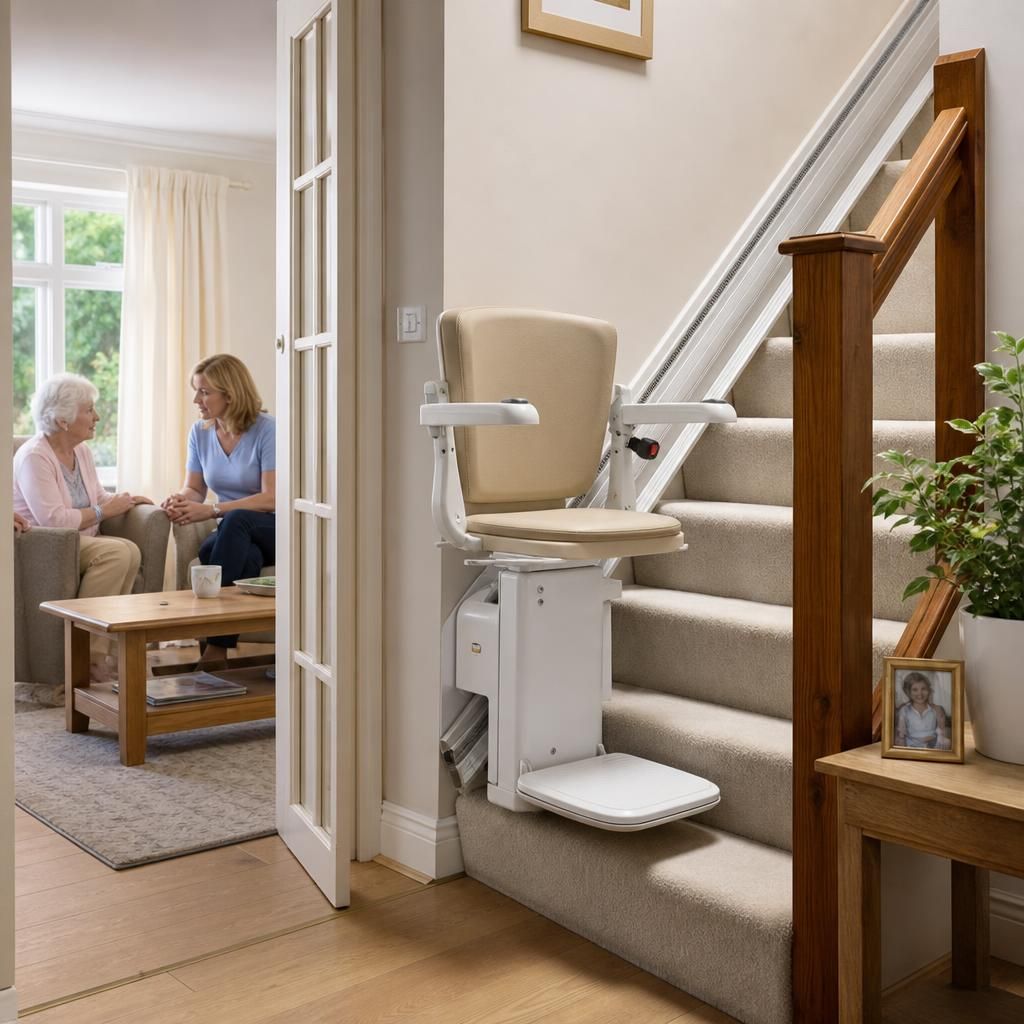
Get advice on buying or renting a stairlift
If you are unsure whether buying or renting is more suitable, contact Independent Stairlifts for advice based on your staircase, mobility needs and expected period of use. We can help you compare suitable options, including the installation, support and removal arrangements.