
What criteria determine the best type of stairlift for a temporary rental need?
The best stairlift for a temporary rental is determined by the staircase layout, expected hire period, user’s mobility and comfort needs, and whether the installation must be removable or easily adapted. A professional assessment can establish whether a straight, curved, outdoor, reconditioned, mobile or foldable model is the safest and most practical option for the property.
The best stairlift for a temporary rental is the model that safely fits the staircase, supports the user’s mobility needs and suits the expected hire period without creating unnecessary alteration or removal work. The main criteria are the shape and width of the stairs, the user’s physical requirements, the available installation options, the condition of the property and the level of flexibility needed if circumstances change.
Staircase layout is the starting point. A straight stairlift is generally appropriate where the stairs run in one uninterrupted direction between the floors. It is usually simpler to install and remove, which can make it practical for a short-term arrangement. A staircase with a bend, intermediate landing, multiple flights or a change of direction normally requires a curved stairlift with a rail made to follow the route. Curved equipment can sometimes be rented, although availability, assessment requirements and lead times may differ from those for straight models.
Outdoor stairs require a model designed for external conditions, particularly where the route is exposed to rain, damp, temperature changes or direct sunlight. An indoor stairlift should not be used outdoors unless it has been specifically designed and approved for that environment. The assessment should also consider the position of the entrance, the surface of the steps and whether the user needs to travel between different levels safely in poor weather.
The user’s mobility and transfer ability are equally important. The assessment should establish whether the user can transfer safely from a chair or standing position, remain seated throughout the journey and operate the controls. Relevant considerations include:
- Balance, strength and the ability to sit down and stand up safely
- Whether the user needs a standard, raised or more supportive seat position
- Hip, knee, back or joint restrictions that affect posture and comfort
- Whether the user can bend their knees sufficiently for the footrest and stair clearance
- Grip strength, vision and dexterity when using the control or remote
- The user’s height, weight and any need for a wider or more supportive seat
- Whether another person may need to assist with transfers or operation
A temporary rental should not be selected solely because it is available quickly. A model that is difficult to transfer into, uncomfortable to use or unsuitable for the user’s weight and posture may create avoidable safety risks. If the user’s condition is changing, this should be discussed during the assessment so that the equipment remains appropriate for the likely rental period.
The expected hire period affects the most suitable installation approach. For a short recovery period, a straightforward, removable installation may be preferable where the staircase and equipment allow it. A longer temporary requirement may justify prioritising seat comfort, charging convenience, additional support and the ability to adapt the arrangement if the user’s needs develop. The rental agreement should make clear how extensions, removal, servicing and changes to the equipment are handled.
Some rental stairlifts are installed using fittings attached to the stairs rather than the wall. This can avoid major structural work and may allow the equipment to be removed when it is no longer needed. However, “removable” does not mean that every model can be installed in every property without assessment. The stair construction, available clearance, landing space and fixing points all need to be checked. In a rented property, the landlord’s permission may also be required, particularly if any part of the installation affects the building.
Available space at the top and bottom of the stairs must be checked. The stairlift should allow the user to get on and off without obstructing a doorway, corridor or essential route. Where landing space is restricted, features such as a swivel seat, a powered swivel or a folding rail may help, but these options are not suitable for every staircase. A folding mechanism also needs enough clearance to operate safely and must not create a trip hazard when the lift is parked.
Measureable stair width alone does not determine suitability. The assessor should consider handrails, radiator positions, doors, architraves, low ceilings, adjacent walls and the location of electrical supplies. A narrow or awkward staircase may limit the choice of seat, rail or controls even where the lift technically fits. The user’s knees and feet must also have adequate clearance from the wall, steps and any obstruction while travelling.
Safety and ease of use should take priority over extra features. Useful features may include a seat belt, swivel seat, obstruction sensors, easy-to-reach controls, remote controls and a manual or powered folding mechanism. The right combination depends on the user and the layout. For example, remote controls can allow the stairlift to be called to another floor, while obstruction sensors can stop the lift if an object is detected in its path. These features support safe use but do not replace correct transfers, supervision where needed or regular servicing.
Battery condition is particularly relevant for a rented stairlift. A battery-powered model should charge reliably at its designated points and provide dependable operation during normal use. The customer should know how to park the lift for charging, what the indicators mean and whom to contact if the lift stops or shows a fault. Emergency lowering arrangements and the procedure for reporting a problem should be explained at installation.
The property and the rental arrangement also influence the choice. The assessment should confirm whether the stairlift can be delivered through the property, whether there is safe access for installers and whether other household members need to use the stairs at the same time. A foldable or compact design may be useful in a busy household, but it must still leave sufficient room for other users and comply with safe operating requirements.
For a temporary need, a reconditioned stairlift may be considered where it has been inspected, serviced and matched to the staircase and user. Reconditioned equipment can offer a practical rental option, but its suitability should be assessed in the same way as new equipment. The important points are its condition, compatibility, safety features, battery performance, warranty or support arrangements and whether replacement or removal can be provided if it is no longer suitable.
A professional home assessment brings these criteria together. Before recommending a model, the assessor should normally:
- Review the staircase shape, width, landings, clearances and fixing options
- Discuss the user’s mobility, transfer ability, posture, weight and likely changes in need
- Check the entrance and exit points, charging locations and access for other household members
- Explain suitable straight, curved, outdoor, mobile, foldable or reconditioned options where relevant
- Confirm installation, servicing, removal and extension arrangements for the proposed rental
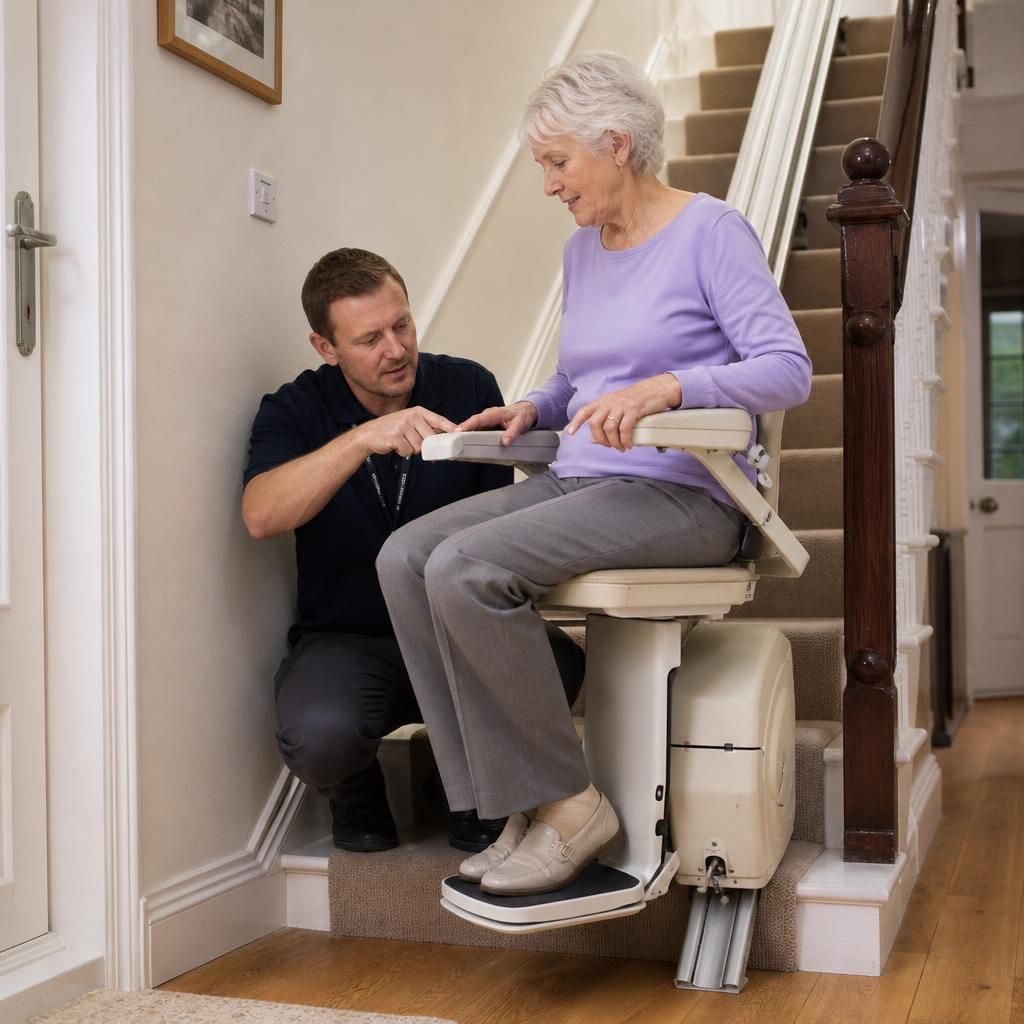
- Demonstrate the controls and identify any assistance or training required
When comparing temporary rental options, ask whether the quoted arrangement includes assessment, installation, delivery, removal, routine maintenance, fault call-outs and replacement equipment if a problem cannot be resolved promptly. Also confirm any conditions relating to cancellation, damage, early return and extending the hire period. These details can affect the practical suitability of a model just as much as its design.
In most cases, the decision is a balance between staircase compatibility, user safety, comfort, installation flexibility and the expected duration of use. A straight model with a removable fitting may suit a simple staircase and short recovery, while a curved or outdoor model may be necessary when the route demands it. The safest choice is the one confirmed by an assessment of the actual home and user, rather than a model selected from general descriptions alone.
A professional home assessment is the most reliable way to determine whether a temporary stairlift is suitable. The assessor checks the staircase shape, width, landings, obstructions and available clearance, then considers the user’s ability to transfer, sit comfortably, operate the controls and use the lift safely.
This assessment also confirms whether a straight, curved, outdoor, foldable, mobile or reconditioned model is appropriate. Installation, charging, removal, servicing and possible rental extensions should be discussed before hiring, so the chosen stairlift remains practical throughout the temporary period.
Arrange Your Temporary Stairlift Assessment
Arrange a professional temporary stairlift assessment to confirm which model suits your staircase, mobility needs and expected rental period. We can also explain installation, servicing, removal and extension arrangements before you hire.