
How does a mobile stairlift operate without installation?
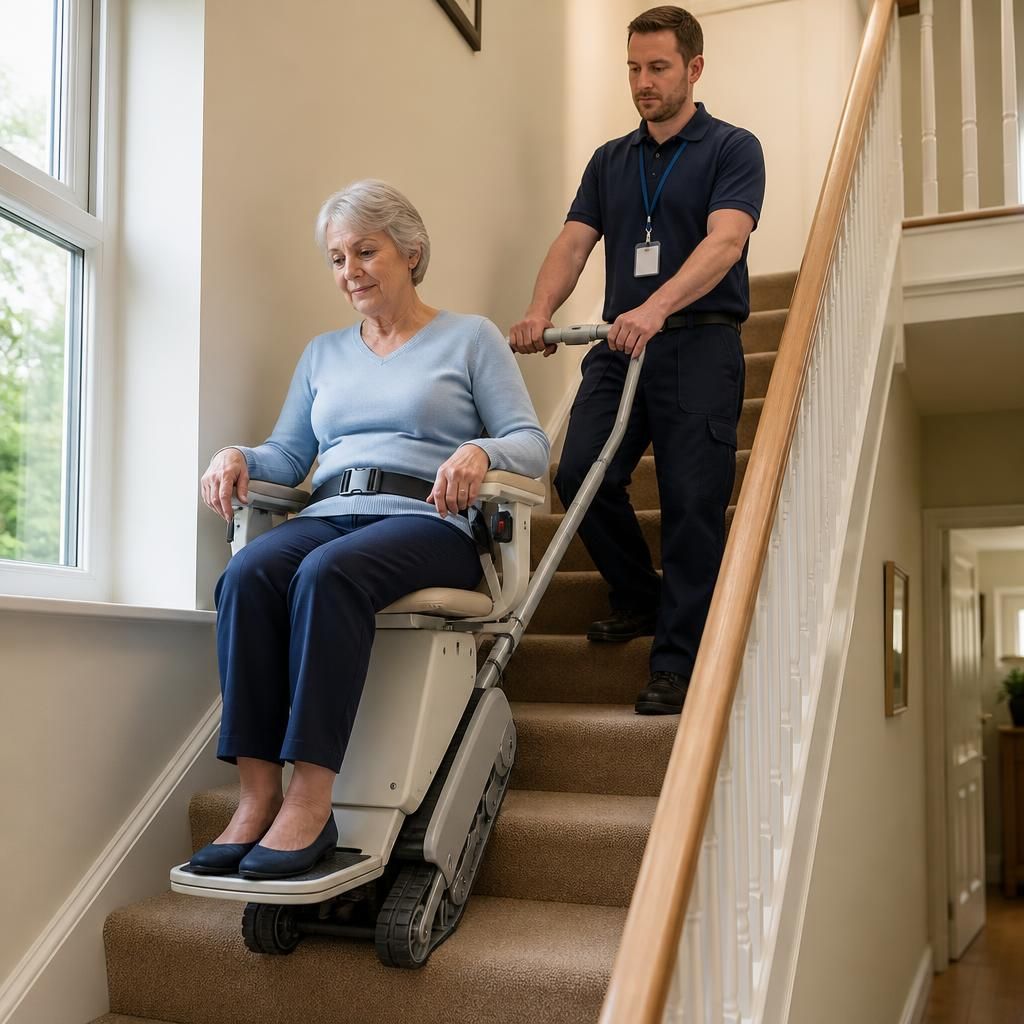
A mobile stairlift operates using a battery-powered motor and tracks or wheels that support and move the user up and down the stairs, without being permanently fixed to the staircase. It is secured in position using its built-in supports or clamps, then removed when no longer needed, with setup and safety checks carried out by a trained professional.
A mobile stairlift operates without permanent installation because it uses a self-contained battery-powered drive system, wheels or tracks, and built-in supports to move a seated user up or down the stairs. Instead of being attached to a rail fixed to the staircase, the unit is positioned on the steps and stabilised according to its design. A trained professional checks the equipment, the staircase and the user’s ability to operate it before it is used.
Most portable stairlift systems are designed as mobile stair climbers. They usually include a seat or support platform, a motor, rechargeable batteries, a control handset and wheels or continuous tracks. The tracks or wheels make contact with the stair treads while the support system keeps the device stable as it travels between levels. Some models are operated by the user, while others require an attendant to guide and control the stairlift throughout the journey.
Because the stairlift is not fixed to the wall or stairs, it can be brought into position when required and removed afterwards. This makes it suitable for temporary mobility needs, rented properties and situations where a permanent stairlift is not appropriate. It does not mean that the equipment can be used without preparation: correct positioning, safe transfers and appropriate supervision remain essential.
The usual process is as follows:
- Assessment: A trained adviser checks the staircase, including its width, gradient, surface, landings, turns and any obstructions. They also consider the user’s weight, balance, mobility and ability to sit safely during travel.
- Positioning: The mobile stairlift is placed at the bottom of the staircase. Its wheels, tracks, frame or stabilising supports are aligned with the steps in accordance with the manufacturer’s instructions.
- Safety checks: The operator confirms that the device is stable, the seat or support is correctly secured, the battery has sufficient charge and the controls, brakes and safety restraints are working properly.
- Transfer and operation: The user sits on the seat or uses the appropriate support, with the restraint fastened where provided. The motor then moves the unit steadily from step to step while the user or attendant operates the controls.
- Arrival: At the top or bottom landing, the device is brought to a complete stop before the user is helped to transfer. The stairlift is then moved out of the way or stored safely if the staircase needs to remain clear.
The motor is powered by rechargeable batteries, so the stairlift does not normally need a dedicated electrical connection while travelling. The battery must be charged using the supplied charger and kept in suitable condition. Charging requirements vary by model, so the equipment’s instructions should be followed rather than relying on an ordinary extension lead or an unsuitable charger.
Portable operation depends on the stairlift maintaining safe contact with each step. It is therefore different from a conventional stairlift, which runs along a permanently installed rail and is generally ready for use without being repositioned. A mobile model may need to be set up for each journey, and its movement can be affected by narrow treads, unusual step shapes, loose coverings, steep or uneven stairs and limited space at the landings.
A mobile stairlift is not automatically suitable for every staircase or every user. It may not be appropriate where the staircase has very narrow steps, sharp turns, inadequate landing space or surfaces that prevent the device from stabilising correctly. It may also be unsuitable if the user cannot transfer safely, remain seated and upright, follow instructions or tolerate the movement. A professional assessment is particularly important where another person will be assisting with operation.
Built-in safety measures commonly include a secure seat or support, a restraint, non-slip contact surfaces, controlled speed, automatic braking and controls that stop the unit when released. Exact features differ between models. These safeguards reduce risk but do not replace correct use. The stairway should be kept clear, the user should wear the restraint as instructed and nobody should attempt to move the equipment while a transfer is taking place.
For hired equipment, the installer or rental provider should explain how to charge, position, operate and store the stairlift. Report unusual noises, loss of power, damage, slipping, control problems or changes in the user’s mobility promptly, and stop using the equipment if it no longer feels stable. Do not attempt repairs or alter the supports yourself.
In short, a mobile stairlift avoids installation by carrying its own drive system and stabilising mechanism. It still requires a suitable staircase, careful positioning and proper safety checks. When those conditions are met, it can provide temporary access between floors without drilling into the stairs or fitting a permanent rail.
A mobile stairlift works without permanent installation because its motor, rechargeable battery and stabilising supports are built into the unit. Rather than travelling along a rail fixed to the staircase, it uses wheels or continuous tracks to maintain contact with the steps while moving the seated user between floors.
The stairlift is positioned and checked before use, with its supports or frame aligned according to the manufacturer’s instructions. A trained professional will confirm that the staircase and user are suitable, then demonstrate safe transfers, restraints and controls. Once the journey is complete, the unit can be moved aside or stored, making it practical for temporary access without drilling into the stairs or walls.
Need Help Choosing a Mobile Stairlift?
Speak to Independent Stairlifts for help choosing a mobile stairlift suited to your staircase, mobility needs and rental requirements. Our team can arrange a professional assessment and explain the available options.