
Are mobile stairlifts suitable for all types of staircases?
Mobile stairlifts are suitable for many straight staircases and some changes in level, but they are not suitable for every staircase. Compatibility depends on the stair width, angle, surface, landings, bends and available space, so a suitability assessment is needed; a fixed curved or straight stairlift may be safer where the mobile model cannot be used.
Mobile stairlifts are suitable for many straight staircases, but they are not suitable for every staircase. Compatibility depends on the equipment being used, the width and shape of the stairs, the condition of the steps, the landings and the amount of space available at the top and bottom. A suitability assessment is therefore needed before hire.
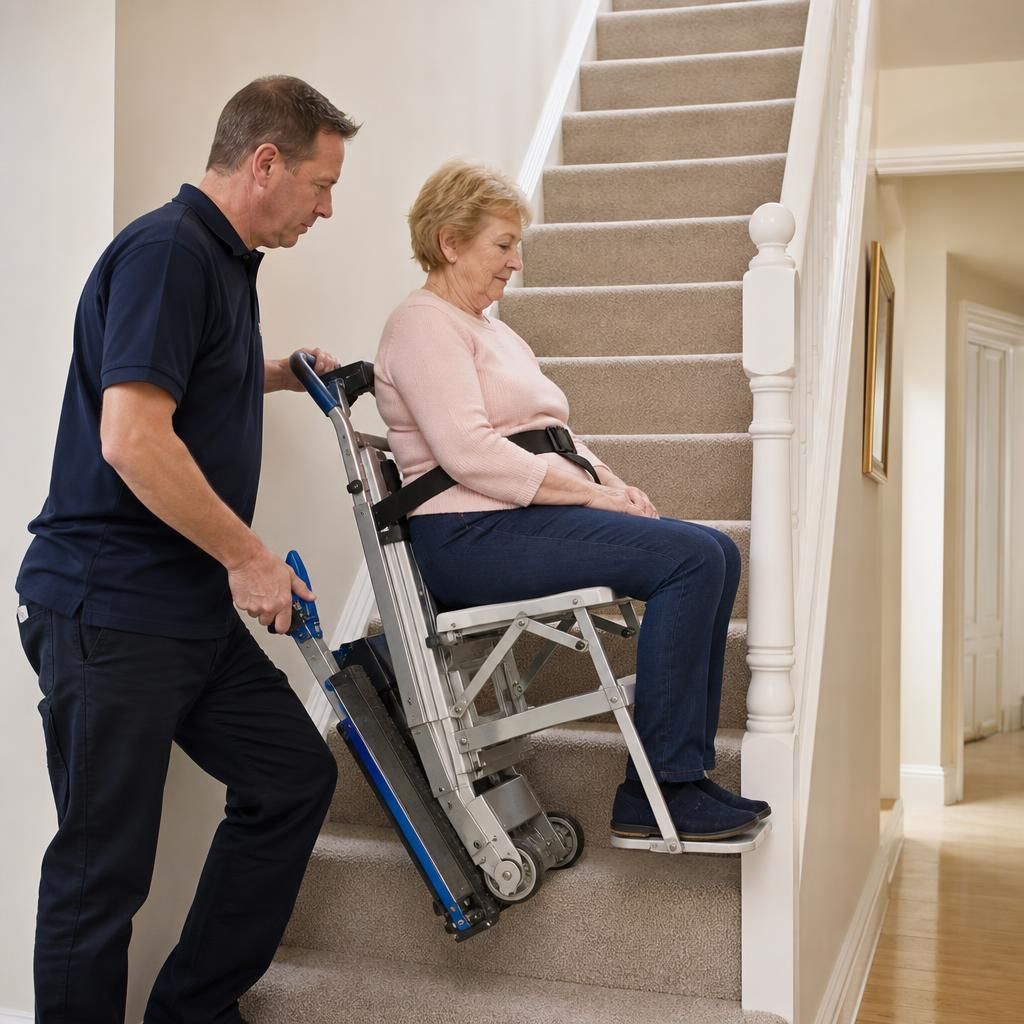
Unlike a fixed stairlift, a mobile model does not usually run on a permanently installed rail. Depending on the design, it may use a tracked mechanism or climbing wheels and can often be moved between different staircases. This makes it useful where a permanent installation is not wanted or where the stairlift is needed temporarily. However, its portability does not mean that it can safely negotiate every type of staircase.
Straight staircases are generally the most suitable. The stairs need to provide a consistent route, with enough width for the device and user, and a suitable surface for the model’s tracks or wheels. The stair treads must also be strong and even enough to support the equipment safely. Carpeting, deep nosings, loose coverings or damaged steps may affect operation and need to be assessed.
Staircases with a half-landing or change of direction may be possible with some mobile stair climbers, but the equipment may need to be stopped and repositioned on the landing. This requires adequate turning and transfer space, as well as a clear route between flights. A mobile stairlift will not normally travel continuously around a corner in the same way as a fixed curved stairlift.
Curved, winding and spiral staircases are often unsuitable for mobile stairlifts. Their changing angle, restricted width and tight turns can prevent the device from maintaining a stable position. Spiral stairs are particularly difficult because of their narrow inner edge, tapered treads and limited manoeuvring space. A bespoke curved stairlift may be more appropriate where the user needs to travel around bends or between several levels.
Very narrow or steep stairs can also present problems. There must be enough room for the user to sit or be supported safely without catching the walls, banister or other fixtures. The person operating the equipment, where an attendant is required, must also be able to stand in a safe position. The staircase must not be obstructed by doors, furniture, radiators or other items that restrict movement.
Suitability also depends on the user’s needs. Many mobile stairlifts require the user to transfer onto a seat or remain in a supported position while the device is operated. Some models require assistance from another person throughout the journey. They may not be suitable for someone who cannot sit upright, transfer safely, follow operating instructions or tolerate the movement involved. A fixed stairlift, through-floor lift or other access solution may provide safer and more independent use in these circumstances.
During an assessment, the important checks include:
- the width, gradient, tread depth and consistency of the stairs;
- the type and condition of the stair surface, including carpet, nosings and open risers;
- the shape of the staircase and whether it includes bends, landings or multiple levels;
- clearance from walls, handrails, doors and other obstructions;
- the space available to position and turn the equipment at the top and bottom;
- the user’s weight, posture, mobility and ability to transfer; and
- whether a responsible attendant is needed and can operate the equipment safely.
If the staircase is unsuitable for a mobile model, this does not necessarily mean that access between floors is impossible. A fixed straight stairlift may suit a simple flight, while a made-to-measure curved stairlift can follow bends and intermediate landings. In some homes, a platform lift or another accessibility adaptation may be considered instead.
Do not rely solely on photographs or general dimensions when deciding whether a mobile stairlift will work. Staircase construction and the user’s abilities both affect safe operation. An assessment by a trained adviser can confirm whether the available mobile model is appropriate, explain any assistance required and identify a safer alternative where necessary.
Mobile stairlifts are generally best suited to straight, consistently surfaced staircases with enough room for the user and equipment. They may not be suitable for curved, spiral, very narrow or steep stairs, where changing angles, tight turns or limited clearance can affect stability and safe operation.
A staircase assessment checks the width, gradient, tread condition, landings, obstructions and space at the top and bottom. It also considers whether the user can transfer and remain safely supported, and whether an attendant is required. Where a mobile model cannot safely follow the route, a fixed straight or bespoke curved stairlift may be a more suitable alternative.
Arrange a mobile stairlift suitability assessment
Arrange a mobile stairlift suitability assessment with Independent Stairlifts to check your staircase, available space and individual requirements. We can also explain whether a fixed stairlift or another access solution would be more appropriate.