
Are mobile stairlifts suitable for all types of staircases?
Mobile stairlifts are suitable for many straight staircases, but they are not suitable for every staircase. Suitability depends on the stairs’ shape, width, height, landing space, surface and any obstructions, so a professional assessment is needed before hire.
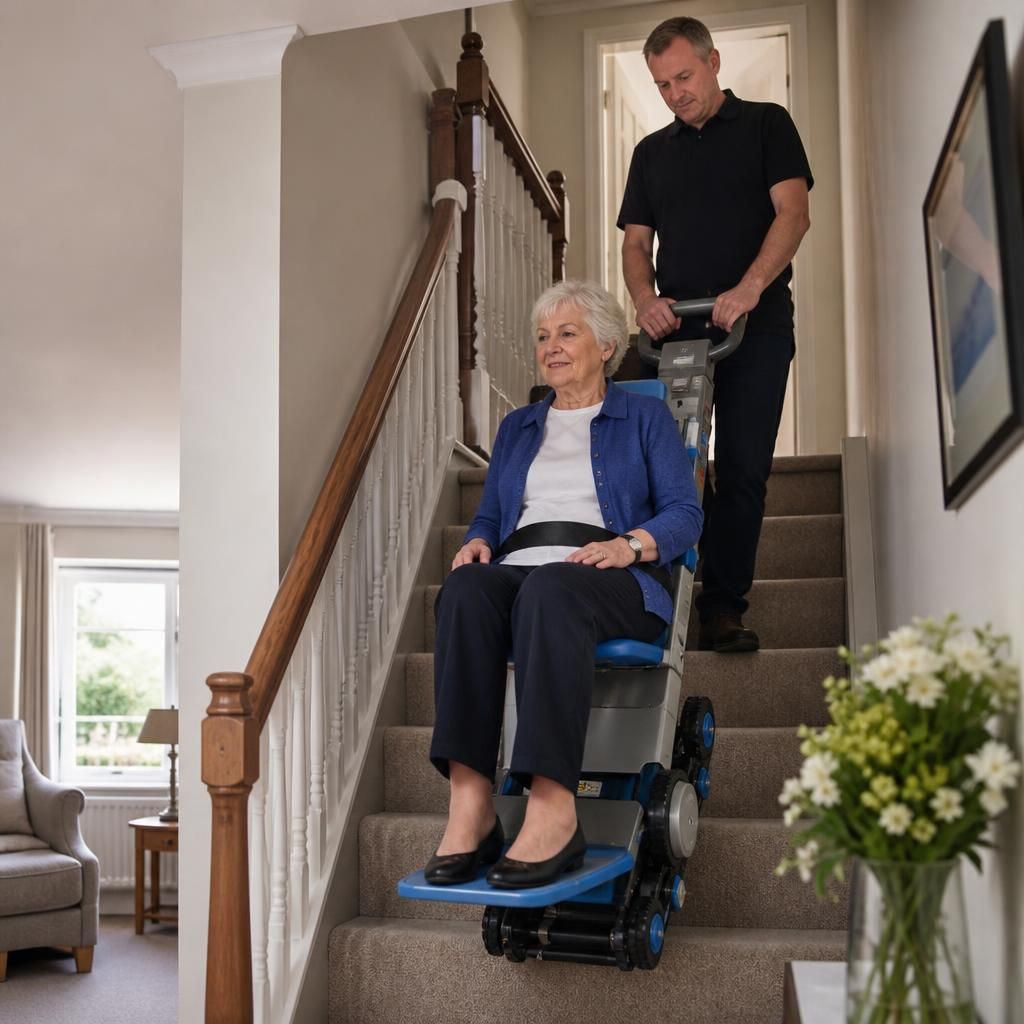
Mobile stairlifts are suitable for many straight staircases, but they are not suitable for every staircase. A portable stairlift or tracked stair climber normally rests on the steps rather than using a permanently fitted rail, so suitability depends on the staircase’s shape, width, height, surface, landing space, obstructions and the equipment being used. A professional assessment is needed before hire.
Staircases most likely to be suitable
Most mobile stairlifts are designed for straightforward, indoor flights of stairs with consistent, firm steps. They may be appropriate where:
- the staircase is straight or has a landing where the equipment can be safely repositioned;
- the steps have a solid, reasonably even surface;
- there is enough width for the stairlift and the person using it;
- there is adequate space at the top and bottom for safe boarding and getting off;
- the staircase and landings are free from furniture, loose coverings and other obstructions; and
- the user’s weight, posture and mobility are within the equipment’s operating limits.
Some portable stair climbers can be used on more than one flight, but the equipment may need to be stopped and repositioned at a landing. This is different from a conventional curved stairlift, which follows a permanently installed rail around bends and between flights.
Staircases that may not be suitable
A mobile stairlift may be unsuitable, or may require a particular model and additional assessment, where the stairs are:
- curved, spiral, helical or tightly turning;
- very narrow, unusually steep or irregular in shape;
- open-sided or lacking a secure edge for the equipment to track against;
- covered with loose, thick or highly uneven carpeting;
- damaged, slippery or unstable;
- interrupted by awkward turns, very small landings or changes in level; or
- blocked by doors, radiators, bannisters, furniture or other fixtures.
Even when a mobile stairlift can physically travel along the stairs, the top and bottom areas must still allow the user to transfer safely. A narrow landing, a door opening directly onto the stairs or insufficient room to turn may make the arrangement impractical.
Curved and spiral staircases
Mobile equipment is generally less suitable for curved and spiral staircases than a bespoke curved stairlift. A portable model usually travels in a relatively controlled line and may not follow a continuous bend. Some systems can be used on stairs with separate flights, but this depends on the landing and whether the equipment can be turned or repositioned safely.
For a staircase with a continuous curve, tight bend or spiral layout, a professionally measured curved stairlift is often the more appropriate option. If the need is temporary, alternative arrangements may include using a suitable room on one floor, a temporary ramp where appropriate, or another assessed mobility solution.
Outdoor and unusual stairs
Not all mobile stairlifts are designed for outdoor use. External steps may be exposed to rain, damp, dirt, uneven surfaces and temperature changes, and may have different dimensions from indoor stairs. A model must be specifically approved for the intended environment, and suitable storage and charging arrangements may also be required.
Stairs with stone, metal or other hard surfaces can sometimes be suitable, but their grip, condition and consistency must be checked. Wet or slippery steps can create additional risk. Portable equipment should not be used on a staircase simply because it fits physically; the surface and surrounding environment must support controlled operation.
The user is part of the assessment
Suitability is not determined by the staircase alone. The person using the mobile stairlift must be able to sit in the required position, maintain a safe posture and follow the operator’s instructions. Depending on the model, assistance may be needed when boarding, leaving the seat or moving the equipment between flights.
Most mobile stairlifts require a competent person to operate or guide them. This may be a family member, carer or trained user, rather than the passenger alone. If the person has limited trunk control, significant involuntary movement, difficulty transferring or a condition that affects their ability to follow instructions, a different stairlift or mobility solution may be safer.
What is checked before hire?
An assessment should consider the complete route, not just the first flight of stairs. This normally includes:
- the width, depth, height and condition of each step;
- the staircase angle and any changes in direction;
- the size and shape of landings;
- clearance from bannisters, walls, doors and other fixtures;
- boarding and exit space at both ends;
- the safest position for charging and storing the equipment;
- the passenger’s weight, mobility and transfer requirements; and
- whether an operator can use the equipment safely throughout the journey.
Measurements, photographs or a home visit may be needed, particularly where the staircase is narrow, turns at a landing or has unusual construction. The assessment also helps identify whether a portable stairlift is the right option compared with a fixed straight or curved stairlift, a reconditioned model or another accessibility aid.
Do not attempt to use a mobile stairlift on stairs that have not been assessed, or alter the equipment to make it fit. If your staircase is straight and clear, it may be a practical temporary solution. If it is curved, spiral, unusually narrow, uneven or obstructed, ask for a professional suitability check before arranging hire.
Mobile stairlifts are usually best suited to straight, firm and unobstructed staircases. They may not follow continuous curves, tight turns or spiral sections safely, and a landing must provide enough space to reposition the equipment when needed. Stair width, step condition, boarding space and the user’s ability to sit and transfer safely also affect suitability. A professional assessment should therefore be completed before hire, particularly for narrow, curved, outdoor or unusually shaped stairs.
Arrange a mobile stairlift suitability assessment
If you are unsure whether your staircase is suitable for a mobile stairlift, arrange a professional suitability assessment with Independent Stairlifts. We can review the stairs, landings and your mobility needs before you arrange hire.