
What steps are involved in refurbishing a stairlift to ensure safety and performance?
Refurbishing a stairlift involves inspecting, cleaning and servicing its mechanical and electrical components, replacing worn or unsuitable parts, and checking safety features. The lift is then installed correctly and thoroughly tested on the staircase to confirm safe, reliable performance before it is used.
Refurbishing a stairlift is a structured process of inspection, cleaning, servicing, part replacement, safety checking and operational testing. The aim is to confirm that the lift is suitable for the intended staircase, that its mechanical and electrical systems work correctly, and that it can be installed and used safely by the customer.
Initial assessment and identification
The process begins with identifying the stairlift model, its age, configuration and previous use. The engineer assesses the lift, rail, carriage, seat, controls and charging equipment for damage, wear or signs of unsuitable modification. For a curved stairlift, the rail and carriage are also checked against the staircase for compatibility, as curved systems are made to follow a particular layout and cannot always be transferred directly to another property.
The intended installation is considered at this stage. This includes the staircase shape, available landing space, power supply, parking position, access requirements and the user’s mobility needs. A stairlift should not be refurbished in isolation from its installation environment; a sound unit may still be unsuitable if its dimensions or controls do not meet the requirements of the staircase or user.
Removal, dismantling and cleaning
Where appropriate, the stairlift is dismantled so that key components can be examined properly. Dust, hair, grease and other debris are removed from the rail, drive system, wheels, switches and accessible internal areas. The seat, armrests, footrest and controls are cleaned using suitable products, while upholstery and other user-contact surfaces are checked for damage, staining and deterioration.
Cleaning is not simply cosmetic. Debris on the rail or around the drive mechanism can affect movement, while contamination around switches and controls can interfere with reliable operation. Components are cleaned without compromising electrical connections, sensors or protective covers.
Mechanical inspection and servicing
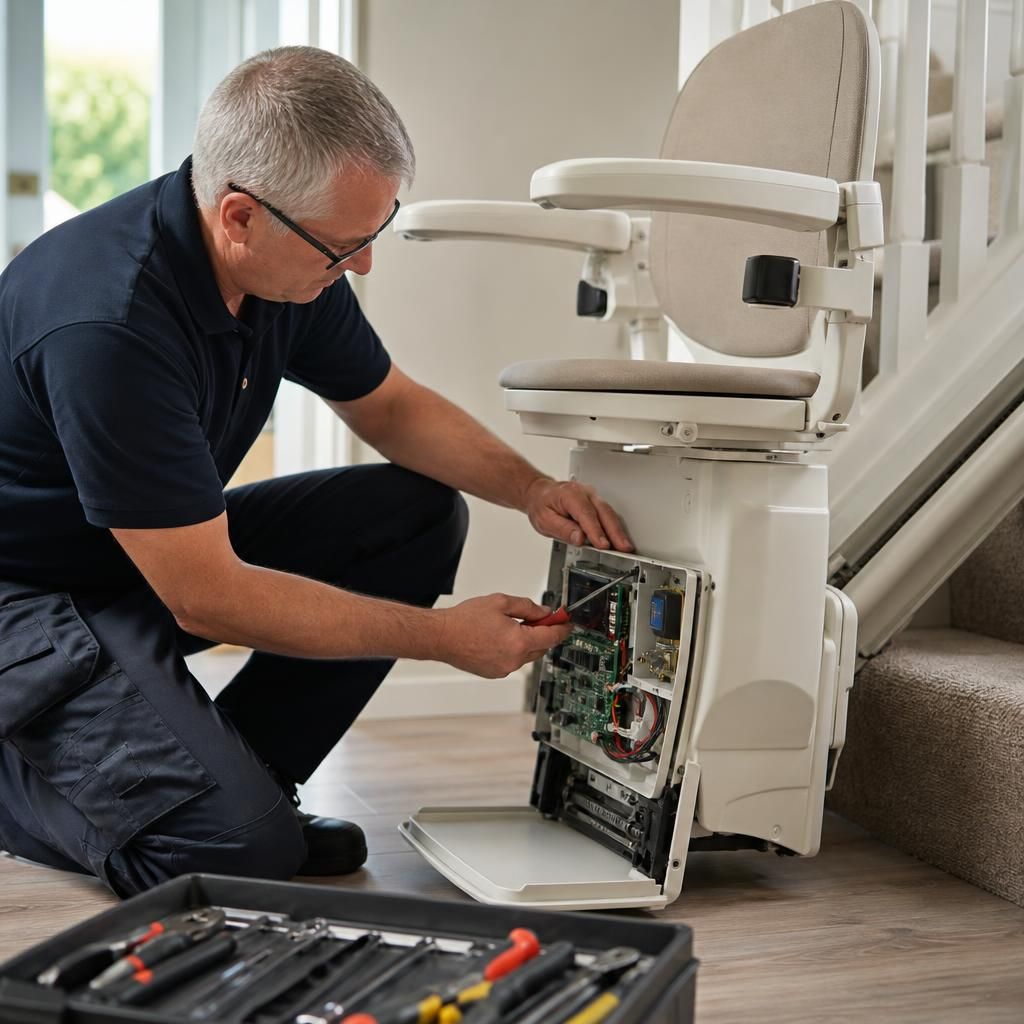
The engineer checks the parts that support and move the stairlift, including the drive mechanism, rollers, gears, bearings, rail, seat swivel, armrests, footrest and folding sections. Wear, looseness, unusual noise, corrosion and damage are assessed against the manufacturer’s requirements. Moving parts are serviced or lubricated where appropriate, using the correct method and materials for that model.
Parts that are worn, damaged, missing or unsuitable are replaced rather than left in service. This may include drive components, rollers, switches, covers, armrest controls, footrest parts or charging contacts. Replacing a part is only one stage of the work; the repair must also be checked to ensure that it operates correctly with the rest of the system.
Electrical checks and battery replacement
The electrical system is inspected for damaged wiring, loose connections, faulty switches and signs of overheating. The charger, charging points, batteries and control circuits are checked to make sure the stairlift can charge correctly and maintain dependable operation. Batteries are treated as service items because their condition can be affected by age, storage and previous use. If they do not meet the required performance standard, they are replaced with suitable compatible batteries.
Hand controls and remote controls are tested, including their response, labelling and, where applicable, the operation of call and send functions. Wiring and electrical covers are secured so that they do not create an avoidable snagging, contact or access hazard.
Safety feature checks
A refurbished stairlift must have its safety features checked as part of the process. Depending on the model, these may include obstruction sensors on the footrest or carriage, a seat swivel or locking mechanism, armrest and seat switches, a seat belt, overspeed protection, braking systems and emergency stop controls. The engineer verifies that the lift stops or responds as intended when a relevant safety control is activated.
The stairlift’s movement is also checked for smooth starting, stopping and travelling. Unusual juddering, hesitation, excessive movement or unexpected noise can indicate a mechanical, electrical or installation issue that needs resolving before the lift is put into use.
Replacement of consumable and user-facing components
Components that directly affect comfort, positioning or everyday use are reviewed as well as the main drive system. A worn seat belt, damaged armrest, deteriorated footrest surface or unreliable control can make a stairlift more difficult or unsafe to use, even if the motor and rail are functioning. Suitable replacement or repair is arranged where necessary, while optional features are confirmed to work with the refurbished unit.
Some cosmetic marks may remain on a used stairlift, but appearance should not be confused with condition. The important checks concern structural integrity, reliable operation, cleanliness, safety features and suitability for the new installation.
Preparation for installation
Before installation, the engineer confirms that the refurbished stairlift and its components match the agreed staircase layout. The rail is prepared for the correct parking position, and any required brackets, charging points or installation components are checked. For a straight stairlift, this includes confirming the rail length and the space needed at the top and bottom. For a curved stairlift, the rail’s shape, joins, clearances and landing positions require particular attention.
Installation is completed by a competent engineer following the relevant manufacturer’s instructions and the requirements of the individual property. The rail must be securely fixed, the carriage must run correctly along it, and the seat, footrest and controls must be positioned so the user can operate the lift without unnecessary reaching or twisting.
Testing after installation
Once installed, the stairlift is operated repeatedly through its available travel. Testing covers starting and stopping, charging, controls, remote operation where fitted, seat swivelling, the footrest, safety sensors, the seat belt and emergency functions. The engineer checks operation at relevant points on the staircase, including transitions, bends, landings and parking positions.
The installation is also assessed for clearances and possible obstructions. Doors, furniture, handrails and other features must not interfere with the stairlift or restrict safe access. Any issue found during testing is corrected and the lift is tested again rather than being handed over with an unresolved fault.
Final checks and handover
The completed work should be recorded, including the checks carried out, parts replaced and any relevant maintenance information. The customer is shown how to use the controls, seat belt, swivel mechanism, charging position and emergency stop. Safe-use guidance, cleaning advice and instructions for reporting a fault are also explained.
A reconditioned stairlift is ready for use only when it has passed its inspection, been correctly installed and completed its operational and safety tests. Ongoing reliability also depends on keeping the rail and charging points clear, using the stairlift as instructed and arranging servicing or assistance if its behaviour changes. If you notice unusual noise, interrupted travel, reduced battery performance or a safety control that does not respond correctly, stop using the lift and contact Independent Stairlifts for advice.
Post-installation testing confirms that a refurbished stairlift operates safely on the specific staircase where it will be used. The engineer runs the lift through its full travel and checks that it starts, stops, charges and parks correctly without obstruction or unusual movement.
Safety controls are tested individually, including the seat belt, swivel lock, armrest and footrest switches, obstruction sensors, emergency stop and remote controls where fitted. Clearances around doors, handrails and furniture are also checked. Any fault or adjustment identified during testing must be corrected and the stairlift tested again before handover.
Arrange a Stairlift Refurbishment Assessment
Arrange a stairlift refurbishment assessment with Independent Stairlifts to check the lift, its components and the intended staircase before work begins. We can advise whether refurbishment is suitable and identify any repairs, replacements or installation requirements.