
What factors should be considered when selecting between different models of reconditioned stairlifts?
When choosing between reconditioned stairlift models, compare their safety checks, suitability for your staircase, user comfort, essential features, remaining service life, warranty and total cost. A professional assessment should confirm that the model fits your home and mobility needs, including whether you require a straight or curved rail, powered options or a particular seat design.
The right reconditioned stairlift depends on more than its purchase price. Compare each model against the shape of your staircase, the user’s mobility and comfort needs, the lift’s refurbishment history, available safety features, warranty, ongoing support and total installed cost. A professional assessment should confirm that the selected stairlift is suitable for the staircase and can be operated safely by the intended user.
1. Staircase layout and rail compatibility
First establish whether you need a straight or curved stairlift. A straight stairlift is designed for a single, uninterrupted flight, while a curved stairlift uses a rail made to follow bends, landings, changes in direction or multiple flights. A model that works well on one staircase may not be suitable for another, even if the stairs appear similar.
Ask the installer to assess the available stair width, the position of doors and landings, the location of the charging points and how the stairlift will park. The rail should allow other household members to use the stairs where practical and should not obstruct essential access. Features such as a hinged rail, powered swivel seat or powered footrest may be useful where there is limited space at the top or bottom of the staircase.
2. Safety and quality of refurbishment
A reconditioned stairlift should be inspected, cleaned, serviced and tested before installation. Important checks include the drive system, batteries, charging equipment, safety sensors, seat belt, swivel mechanism, armrests, footrest, controls and rail. The condition of the carriage and electrical connections should also be assessed rather than relying solely on the age or appearance of the stairlift.
Ask what work has been completed and whether worn or unreliable parts have been replaced. Safety features commonly include sensors that stop the lift if an obstruction is detected, a secure seat belt, a swivel seat to support safer transfers and controls that can be used without excessive force. The installer should explain how these features work and demonstrate the stairlift after fitting.
3. The user’s mobility and comfort
The model must suit the person who will use it every day. Consider their height, weight, balance, leg strength, grip and ability to sit down and stand up. A seat that is comfortable for one person may be too narrow, low or difficult to swivel for another. The seat height, back support, armrest position, footrest size and belt arrangement all affect ease of use.
For someone with restricted knee or hip movement, a powered swivel seat or powered footrest may make transfers easier. A user with limited hand movement may need a simple, clearly positioned control or a remote control for calling the lift between floors. If more than one person will use the stairlift, choose controls and adjustments that are practical for everyone rather than focusing only on the primary user.
4. Essential features compared with optional features
Compare models by separating features that are necessary for safe use from those that are simply convenient. Essential features may include a suitable seat belt, obstruction sensors, reliable controls, appropriate charging and a stable seat and footrest. Optional features can include powered swivelling, powered folding components, adjustable seat height, a hinged rail, different upholstery or additional remote controls.
Optional equipment can increase the installed cost and may require additional maintenance. It is therefore worth considering whether a feature solves a specific problem in the home. For example, a hinged rail may be important where a doorway or walkway is close to the foot of the stairs, whereas it may provide little benefit on an open staircase with plenty of clearance.
5. Condition, age and service history
The age of a reconditioned stairlift is only one factor. A well-maintained lift that has been thoroughly refurbished may be a more suitable choice than an older or poorly documented model, but its condition and parts availability still need to be established. Ask whether the stairlift has been previously installed, how it has been maintained and which components have been replaced during refurbishment.
Check whether replacement batteries, chargers, hand controls and other service parts are expected to remain available. Batteries are particularly important because they are consumable components and can affect reliability if they are near the end of their useful life. A reputable assessment should identify any limitations and make clear what is included in the refurbishment.
6. Warranty and aftercare
Compare the warranty offered with each reconditioned model and check exactly what it covers. Clarify whether the warranty applies to parts, labour, call-outs and batteries, and whether there are exclusions for misuse, accidental damage or routine consumables. The length of cover matters, but the scope of support and the process for reporting a fault are equally important.
Ask what happens if the stairlift stops working, how technical support is arranged and whether servicing is available after the warranty period. It is also useful to confirm whether the installer provides user guidance, a handover demonstration and advice on routine care. These details can have a significant effect on the practical value of a lower-priced model.
7. Total cost rather than purchase price
When comparing prices, include the stairlift, survey, rail, installation, delivery, removal of an existing lift if required and any selected options. A curved model will normally involve a more bespoke rail and installation than a straight model, so the cost comparison should be made between suitable solutions rather than between unlike products.
Also consider potential future costs, including batteries, servicing, repairs and alterations if the user’s needs change. A model with fewer features may be the most cost-effective choice if it meets the user’s requirements, while paying more for a powered option may be justified if it makes transfers safer and more manageable.
8. Installation details and effect on the home
Confirm how the rail will be fixed, where the stairlift will park and whether the installation affects doors, radiators, bannisters or access to other rooms. Stairlifts are normally fitted to the stairs rather than the wall, but the survey should identify any unusual construction or access issue before a model is selected.
For shared staircases, consider whether the lift can be folded away when not in use and whether the user can reach the controls comfortably. A compact design may be preferable where the stairs are narrow, but it must still provide adequate seating and foot support for the user.
9. Making the final comparison
Before choosing, ask for a clear comparison of the suitable models, including:
- the staircase type and rail design;
- the user’s weight, posture, transfer ability and comfort requirements;
- the safety checks and replacement parts included in refurbishment;
- the controls and optional powered features;
- the condition, service history and likely availability of parts;
- the warranty, call-out arrangements and ongoing support; and
- the complete installed price and any likely future costs.
A demonstration is valuable where possible, particularly if the user has difficulty standing, sitting, gripping controls or turning at the top of the stairs. The preferred model should be the one that fits the staircase correctly, supports safe and comfortable daily use and comes with clear refurbishment, warranty and aftercare arrangements—not simply the one with the lowest initial price.
Staircase compatibility is one of the most important factors when selecting between reconditioned stairlift models. A straight model is suitable for a single uninterrupted flight, while a curved model may be required for bends, landings or changes in direction. The rail, parking position and available clearance must all be assessed before choosing a lift.
During the assessment, check whether the stairlift will affect doors, bannisters or access at the top and bottom of the stairs. A hinged rail, swivel seat or powered footrest may be worthwhile if space is restricted or transfers are difficult. The best model is the one that fits the staircase correctly and allows the user to travel, get on and off safely, without obstructing other household members.
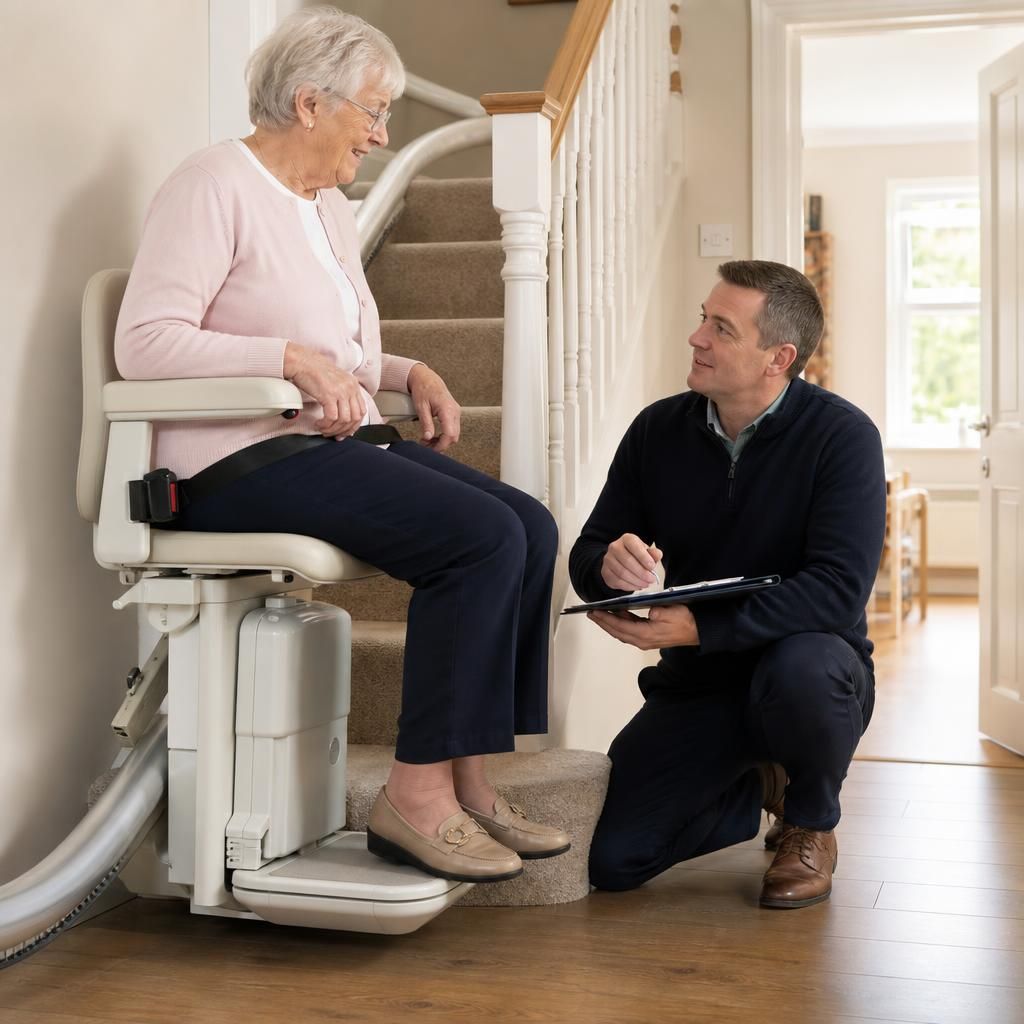
Arrange a professional assessment to compare suitable reconditioned stairlifts
Arrange a professional assessment to compare suitable reconditioned stairlifts for your staircase and mobility needs. We can explain the available models, features, refurbishment work, warranty and total installed cost before you decide.