
What factors should be considered when choosing between a new and a reconditioned stairlift?
Choosing between a new and reconditioned stairlift depends on your budget, staircase design, required features, expected usage and the warranty and aftercare provided. A reconditioned model may offer good value when it has been professionally inspected and refurbished, while a new stairlift may be preferable if you need the latest features, extensive customisation or a longer expected service life.
The choice between a new and a reconditioned stairlift should be based on the condition and layout of your staircase, how the lift will be used, the features required, the total cost, and the warranty and aftercare provided. A professionally reconditioned stairlift can be a practical, lower-cost option where a suitable model is available, while a new stairlift may be more appropriate when you need extensive customisation, the latest features or the widest choice of configurations.
Start with the staircase and installation requirements
The staircase is one of the most important factors. Straight staircases can often accommodate a range of stairlift models, whereas curved, split-level or unusually shaped staircases require equipment and rails designed for the specific route. Outdoor installations also need equipment suitable for changing weather conditions and exposure to moisture.
A new stairlift may provide more choice when the staircase has unusual dimensions or needs a highly tailored rail. However, a reconditioned stairlift can still be suitable if the available model and rail configuration match the property. An assessment should confirm the available stair width, the position of doors and landings, the location of charging points and whether the lift can be parked without obstructing access.
Compare the complete cost, not just the purchase price
Reconditioned stairlifts are generally considered because they can reduce the initial cost. The comparison should include assessment, delivery, installation, removal of an existing lift if necessary, batteries, servicing, warranty cover and any likely adaptations to the staircase or electrical supply. A lower advertised price is not necessarily better value if important services or support are excluded.
New equipment may cost more initially, but it could offer a wider choice of specification and a longer expected period before major components require attention. Reconditioned equipment may offer a sound financial choice where the installation is straightforward and the supplier provides clear refurbishment standards and dependable aftercare. Ask for an itemised quotation so the two options can be compared on the same basis.
Check how the reconditioned stairlift has been prepared
A used stairlift should not be judged solely by its age or appearance. Ask what inspection, cleaning, testing and replacement work has been completed. Important checks normally include the drive system, controls, safety sensors, seat and armrests, charging equipment, batteries, rail, braking system and emergency features. The installer should also confirm that the stairlift is suitable for the intended user and has been tested after installation.
It is reasonable to ask whether worn or damaged parts have been replaced, whether the batteries are included, and whether the model has ongoing parts and technical support. A professionally reconditioned stairlift should be supplied in a condition that is safe and reliable for its intended use, rather than simply being installed with minimal preparation.
Consider the user’s mobility and daily routine
The right stairlift must be comfortable and straightforward to operate. Consider whether the user can transfer safely on and off the seat, operate the controls, manage the armrests and use the swivel or folding mechanisms if fitted. Seat height, seat width, footrest design, weight capacity and control position can all affect day-to-day usability.
Think about how often the lift will be used and whether the user’s mobility is likely to change. Occasional use may make a suitable reconditioned model a sensible option. If the stairlift will be used frequently, by more than one person or as a long-term mobility solution, a new model may offer more choice in comfort features, controls and adjustment options. A professional assessment should take the user’s current abilities and foreseeable needs into account.
Identify the features that are genuinely needed
New stairlifts may offer a broader range of options, such as different seat styles, power-operated features, alternative controls, upgraded upholstery or additional safety functions. Some reconditioned models may include these features, but the choice depends on what is available and whether it can be adapted safely and economically.
Separate essential features from preferences. A powered swivel seat or powered footrest may be important if the user has difficulty turning or bending, while a particular finish may be less important than reliable controls and a comfortable seating position. Choosing a reconditioned model is more suitable when its existing specification already meets the user’s needs, rather than relying on extensive modifications.
Review the warranty and aftercare
Warranty terms can differ between new and reconditioned stairlifts, and they can also differ between suppliers. Check what is covered, how long cover lasts, whether parts and labour are included, and whether call-outs or batteries are treated separately. Confirm who to contact if the stairlift stops working and how urgent repair requests are handled.
Aftercare is particularly important for a stairlift that is relied upon every day. Ask whether servicing is available, whether replacement parts remain obtainable for the model, and whether support is provided throughout the warranty period and afterwards. The length of a warranty is only one consideration; its exclusions and the quality of the support behind it are equally important.
Consider expected service life and future flexibility
A new stairlift gives you a greater say over the model and specification from the outset. This can be useful when the installation is intended as a long-term solution or when the user has specific requirements. A reconditioned stairlift can also provide dependable service, but its remaining service life may depend on its previous use, maintenance history, model availability and the condition of key components.
Ask the installer to explain the likely maintenance requirements and whether the stairlift could be adapted if the user’s needs change. If the property may be sold, rented or altered, ask about removal, relocation and whether the rail or equipment can be reused. Curved stairlifts are usually more closely matched to an individual staircase, so relocation may be less straightforward than with some straight-stairlift installations.
Assess safety and ease of use in the home
Both new and reconditioned stairlifts should include appropriate safety equipment and be installed by a competent professional. The assessment should consider obstructions, lighting, the condition of the stairs, transfer areas at the top and bottom, and how the user will access the lift safely. The installer should explain the controls, charging routine, emergency lowering or stopping procedures and what to do if the lift displays a fault.
Do not choose a model solely because it fits the rail or appears inexpensive. A stairlift that is difficult to transfer into, uncomfortable to use or poorly positioned at the landing may not provide a suitable solution, even if the equipment itself is in good condition.
Questions to ask before deciding
- Has the stairlift been professionally inspected, refurbished and tested?
- Which components have been replaced, and are the batteries included?
- Does the model suit the staircase and the user’s weight, mobility and transfer needs?
- What is included in the quotation, including installation, removal and electrical work?
- What exactly does the warranty cover, and who provides repairs?
- Are parts and technical support available for the expected period of use?
- Can the stairlift be adjusted or upgraded if the user’s needs change?
In practical terms, a reconditioned stairlift is often suitable when the specification meets the user’s needs, the staircase is compatible and the equipment has been refurbished and supported by a reputable installer. A new stairlift is more likely to be the better choice when the installation is complex, the user requires specific features, or having the widest choice and a new equipment history is important. An individual assessment and a clear, comparable quotation will help establish which option offers the safest and most appropriate long-term solution.
The condition and preparation of a reconditioned stairlift are more important than its age alone. Before choosing it over a new model, confirm that it has been professionally inspected, cleaned, tested and refurbished for safe use in the intended home.
Ask which components have been checked or replaced, including the batteries, drive system, controls, safety sensors, charging equipment, seat and braking system. The lift should also be tested after installation, with the installer confirming that it suits the staircase, the user’s weight and their ability to transfer safely on and off the seat.
A reconditioned stairlift is most suitable when its existing specification meets the user’s needs and the supplier provides clear warranty terms, repair support and access to replacement parts. If extensive modifications or specialist features are required, a new stairlift may provide a wider choice.
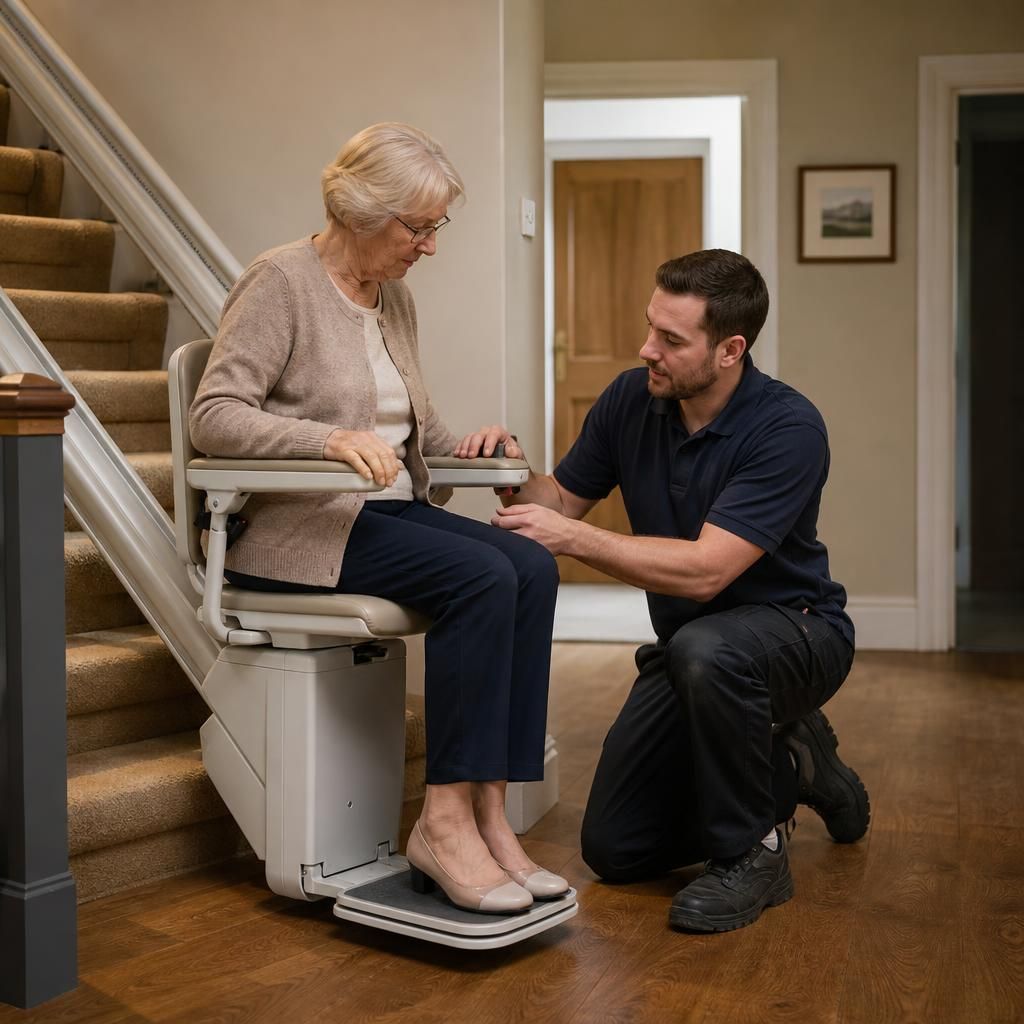
Arrange Your Stairlift Assessment
Arrange a stairlift assessment to compare new and reconditioned options against your staircase, mobility needs and budget. We can provide a clear recommendation and quotation for a suitable installation.