
What should I consider when choosing a reconditioned stairlift model?
When choosing a reconditioned stairlift model, consider its safety features, mechanical condition, compatibility with your staircase, user weight and comfort requirements, available warranty, and the quality of the inspection and installation service. A professional assessment will confirm whether the model is suitable for your home and explain any differences between the available options.
Choosing a reconditioned stairlift involves checking that the model is safe, mechanically sound, suitable for the staircase and comfortable for the person using it. You should also confirm what work has been carried out during reconditioning, who will install it, what warranty is included and whether servicing or replacement parts will remain available.
A reconditioned stairlift can be a practical option where a suitable model is available, but the right choice depends on the individual installation rather than the model name alone. A professional assessment should consider the staircase, the user’s mobility and posture, the lift’s condition and the support available after installation.
Check the model is suitable for the staircase
Start by establishing whether the stairlift is intended for a straight, curved or outdoor staircase. A straight stairlift normally travels along one continuous rail, while a curved stairlift is designed around bends, landings or changes in direction. Outdoor models require materials and controls that can withstand exposure to the weather.
Other points to check include:
- the width and shape of the staircase and the available headroom;
- the position of the top and bottom landings;
- whether the rail will affect access to doors, corridors or walkways;
- where the stairlift will park when it is not in use; and
- whether a hinged rail, swivel seat or other space-saving feature is needed.
For a curved staircase, the rail is usually made or selected to follow the specific layout. This means a reconditioned curved stairlift may not transfer directly from one home to another without the rail being adapted or replaced. The surveyor should explain what can be reused and what needs to be made or adjusted for your staircase.
Consider the user’s mobility and comfort
The person using the stairlift should be able to get on and off safely, operate the controls and remain stable throughout the journey. Consider whether they can bend their knees, sit upright, turn on the seat, transfer from a wheelchair or walking aid, and reach the controls without stretching.
Useful features may include a powered swivel seat, adjustable armrests, a retractable seat belt, a folding footrest, powered or manual footrest options and simple controls. These features are not necessary for every user, so the priority is choosing equipment that addresses the person’s actual needs without making the controls or transfers more complicated.
If more than one person will use the stairlift, check that the seat, armrests, footrest and controls are suitable for everyone. The maximum user weight must also be confirmed. Do not rely on appearance or a previous installation; the supplier should verify the lift’s specification and suitability for the intended user.
Ask what reconditioning includes
“Reconditioned” should mean more than a used stairlift that has been cleaned. Ask for a clear explanation of the inspection, testing and preparation process. This may include checking the motor, drive system, rail, charging points, safety sensors, seat mechanism, controls and batteries, as well as replacing worn or unsuitable components.
You should also ask whether the exact lift being offered has been assessed or whether the quotation is based on a similar model. A reputable provider should be able to explain the model’s condition, identify any refurbished or replacement parts and confirm that it will be tested after installation.
Look for evidence that the stairlift:
- starts, stops and travels smoothly;
- charges correctly at its parking points;
- responds to the handset and control switches;
- has working safety edges, sensors and seat-belt arrangements;
- locks securely when the seat is in its travelling position; and
- is appropriate for the user’s weight and the intended environment.
A visual inspection cannot confirm the condition of internal components or batteries. Those checks should be completed by a suitably trained installer as part of the assessment and installation process.
Compare safety features and ease of use
Safety features vary between models and may work differently. Ask the installer to demonstrate the controls, emergency stop function, seat belt, swivel mechanism and obstruction sensors. You should understand what happens if the stairlift encounters an object on the stairs or if the power supply is interrupted.
Controls should be clearly marked and easy to operate. If the user has reduced grip, limited vision, memory problems or difficulty using small switches, mention this during the assessment. A remote control may be useful when the lift is parked at the opposite end of the staircase, but it should not replace a proper assessment of the user’s ability to control the stairlift safely.
Check the warranty and aftercare
The warranty should be provided in writing before you agree to the purchase. Check its length and the parts, labour and call-outs it covers. It is also important to ask about exclusions, batteries, accidental damage, misuse and any requirement for servicing.
Find out who to contact if the stairlift stops working, how faults are reported and whether support is available in your area. Ask whether replacement parts and batteries can be sourced for the model in the future. A lower initial price may be less useful if the equipment is difficult to maintain or the aftercare arrangements are unclear.
Assess the installation service
The installation should be carried out by a competent stairlift installer after the staircase and the user’s requirements have been assessed. The installer should position the rail, charging points and seat so that the lift is safe to use while preserving access around the stairs as far as reasonably possible.
Before the installer leaves, the user or their carer should receive a practical demonstration. This should cover starting and stopping, parking, charging, using the controls, operating the seat belt and swivel seat, dealing with an obstruction and contacting the service team. Make sure the user can operate the stairlift confidently rather than simply watching the demonstration.
Think about future requirements
A model that is comfortable now should also be assessed against likely changes in mobility. For example, a user may later need more support when transferring, may use a different walking aid or may find a manual swivel more difficult to operate. Discuss these possibilities with the surveyor, while avoiding features that add unnecessary complexity.
It is sensible to compare the complete cost and support package rather than the purchase price alone. Consider installation, alterations to the staircase, warranty, servicing, batteries, removal and any future adjustments. Ask for the specification and terms in writing so that you can compare models on a like-for-like basis.
The most suitable reconditioned stairlift is therefore the one that fits the staircase, supports the user safely, has been properly inspected and comes with clear installation and aftercare arrangements. If any part of the model’s condition, compatibility or warranty is uncertain, raise it before installation so it can be checked during the home assessment.
Choosing a reconditioned stairlift means checking more than its appearance or model name. The lift should have been professionally inspected, tested and prepared for the intended user and staircase before installation.
Ask what the reconditioning process included, such as checks to the motor, batteries, charging points, controls, seat mechanism, safety sensors and drive system. Worn parts should be replaced where necessary, and the installed stairlift should travel smoothly, stop correctly and respond to its safety features.
The model must also suit the staircase and the user’s mobility. Confirm the maximum user weight, transfer space, seat and controls, as well as the warranty and aftercare arrangements. A home assessment provides the clearest way to establish whether the available reconditioned stairlift is a safe and practical fit.
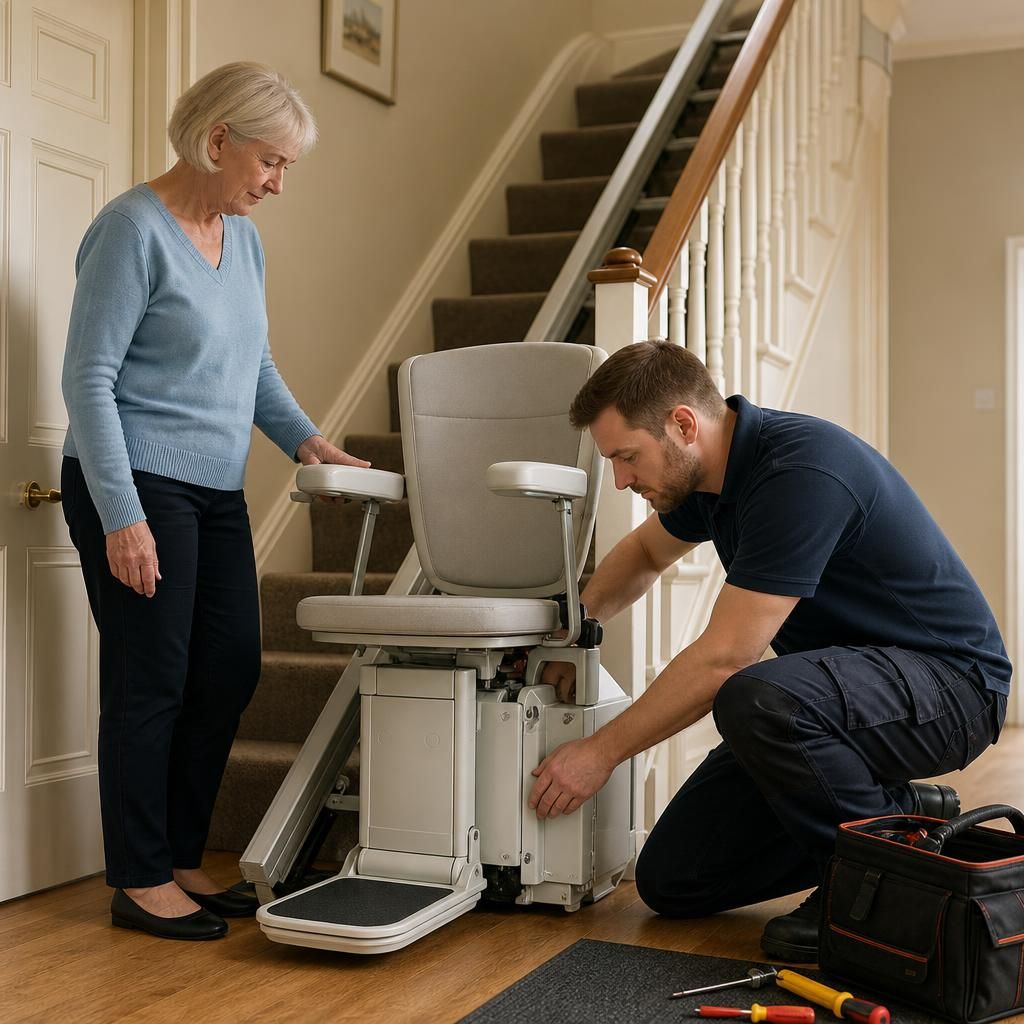
Arrange a home assessment to choose the right reconditioned stairlift
Arrange a home assessment so we can check the staircase, user’s requirements and available reconditioned stairlift models. We will explain the condition, installation requirements, warranty and aftercare before you decide.