
Can reconditioned stairlifts accommodate different types of staircases?
Yes, reconditioned stairlifts can accommodate many staircase types, including straight, curved, narrow and unusually shaped stairs, provided the rail and equipment are suitable for your home. A professional assessment will confirm whether an existing reconditioned model can be adapted safely or whether a bespoke curved solution is required.
Yes. Reconditioned stairlifts can accommodate many different staircase designs, including straight, curved, narrow, split-level and some unusually shaped stairs. The important point is that the lift unit and rail must be suitable for the staircase and the person using it. A professional home assessment is needed to establish whether a suitable reconditioned model is available, whether a rail can be adapted, or whether a bespoke rail is required.
Reconditioning normally applies to the stairlift equipment, such as the motor, seat, controls and batteries. The rail is a separate consideration. On a straight staircase, a reconditioned stairlift may be fitted using a compatible straight rail. On a curved or more complex staircase, the rail generally needs to follow the exact shape and measurements of the stairs, so it may need to be made or adapted specifically for the property. In some cases, a reconditioned lift unit can be paired with a suitable new or bespoke rail.
Different staircase layouts require different considerations:
- Straight stairs: These are usually the simplest to assess because the rail follows one uninterrupted flight. A reconditioned straight stairlift may be suitable where the stair width, landing space, user requirements and equipment specifications are compatible.
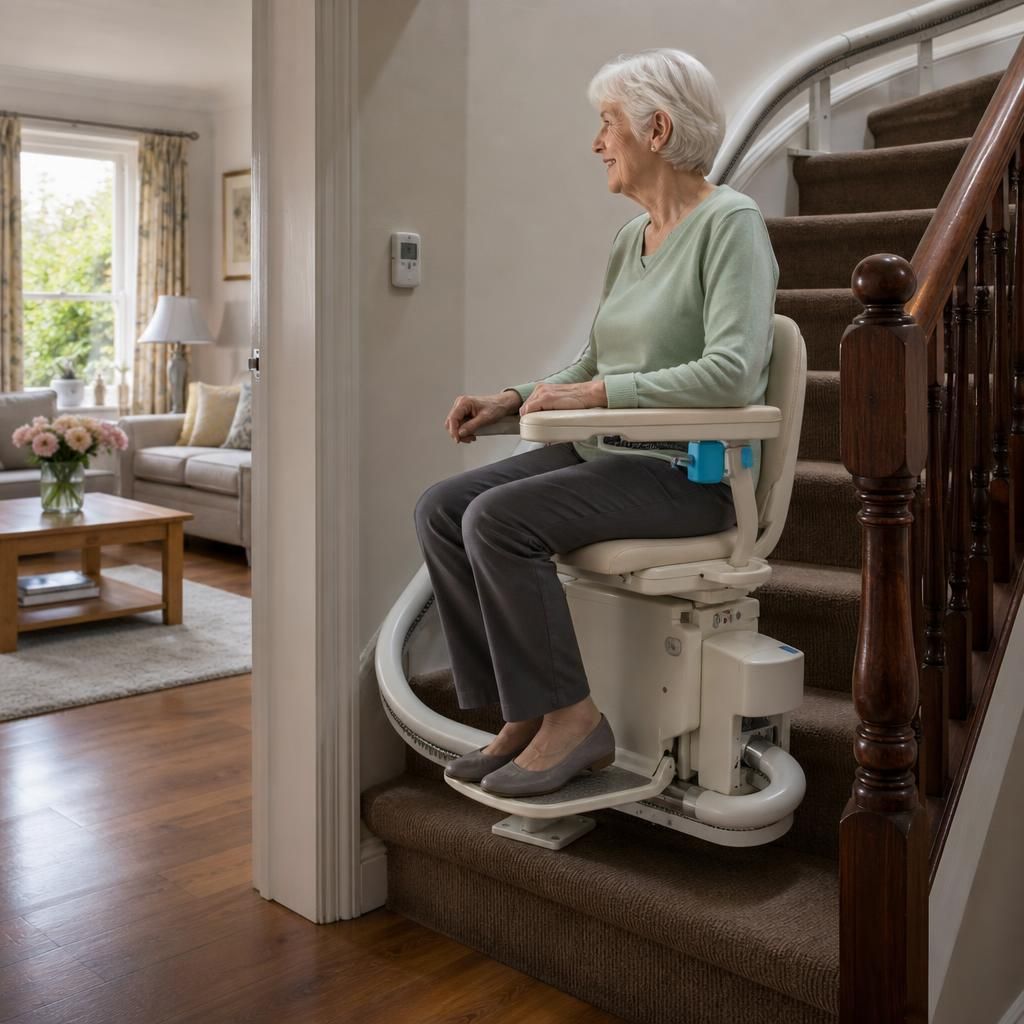
- Curved stairs: A curved stairlift follows bends, corners and changes in direction. The existing rail from another property will not usually match a different staircase exactly. A suitable reconditioned carriage may therefore be installed with a rail designed for the particular staircase.
- Stairs with a landing or multiple flights: A stairlift may be configured to follow the route, depending on the layout and the available space. The assessment will consider turning areas, stopping positions and whether the user can transfer safely between levels.
- Narrow staircases: Narrow stairs do not automatically rule out a stairlift. The assessor will check the remaining walking space, the width and position of the seat, the rail location and whether the stairlift can be used without obstructing access.
- Spiral, winding or unusually shaped stairs: These can be more technically demanding. A solution may still be possible, but the shape, gradient, available clearance and position of the top and bottom landings must be assessed carefully.
- Outdoor stairs: External staircases need equipment designed for outdoor conditions, with suitable protection from weather and an appropriate installation method. An indoor reconditioned model should not be assumed to be suitable outside.
The survey also covers factors that are not obvious from looking at the staircase. These include the stair width at different points, the height and depth of the steps, the position of handrails, doorways and radiators, the space at the top and bottom of the stairs, and any changes in floor level. The assessor will also discuss the user’s height, mobility, weight, ability to transfer on and off the seat, and whether the controls can be operated comfortably.
For a reconditioned stairlift, compatibility involves more than making the lift move along the rail. The carriage must be suitable for the rail system, the controls must work correctly, the charging points must be positioned appropriately and the safety features must be checked. These can include the seat belt, swivel or powered swivel function where fitted, safety sensors, obstruction detection, braking and battery performance. Equipment should be inspected, serviced and tested before it is installed.
There may be practical limitations. A particular reconditioned model may not be suitable for every user or staircase, and an older lift may not offer the seat style, weight capacity, powered features or control arrangement required. A staircase with limited landing space may also need a specific parking position or a different seat configuration. If a suitable reconditioned option cannot meet the requirements safely, a different model or a new bespoke solution may be more appropriate.
It is also important not to judge suitability by the appearance of a previously used rail or by measurements taken without professional equipment. Rails that look similar can have different profiles, fittings or operating requirements. Reusing a rail without confirming its compatibility can affect the stairlift’s operation and safety. The rail, carriage and installation should be treated as one complete system.
During the assessment, ask which parts are reconditioned, which parts are being supplied specifically for your staircase, and what testing and warranty apply to the completed installation. You should also receive clear advice about everyday use, charging, maintenance and what to do if the stairlift stops working.
In short, the fact that a stairlift is reconditioned does not restrict it to one standard staircase shape. Straight stairs may often suit a compatible reconditioned installation, while curved, narrow, split-level and unusual staircases require more detailed planning. The final recommendation should be based on a home survey and the needs of the user, rather than on the stairlift’s age or appearance alone.
A reconditioned stairlift can be suitable for a curved or unusual staircase, but the rail must match the exact shape of the stairs. In many cases, the reconditioned part is the lift unit, while the rail is made or adapted specifically for the property.
This means a previously used rail should not be reused simply because it looks similar. A professional assessment checks the bends, gradients, clearances, landing space and fixing points before confirming whether the complete stairlift system can be installed safely.
Arrange Your Reconditioned Stairlift Assessment
Arrange a professional assessment to confirm whether a reconditioned stairlift can be safely matched to your staircase and requirements. Independent Stairlifts can advise on suitable options for straight, curved, narrow or unusual stairs.