
Are reconditioned stairlifts suitable for all types of staircases?
Reconditioned stairlifts can be suitable for many straight and curved staircases, but not automatically for every layout. Suitability depends on the staircase shape, available space, rail design and whether a compatible reconditioned model is available, so an assessment is needed before installation.
Reconditioned stairlifts are suitable for many straight and curved staircases, but they are not automatically suitable for every layout. The deciding factors include the shape and width of the stairs, available space at the top and bottom, the position of doors and landings, the rail design, and whether a compatible reconditioned model is available. A professional home assessment is therefore essential before a stairlift is selected or installed.
Straight staircases
Straight staircases are usually the simplest application for a reconditioned stairlift. If the stairs run in one uninterrupted line without a bend, intermediate landing or change in angle, a suitable reconditioned unit may be available with a compatible straight rail. The rail must still be measured and fitted correctly for the staircase, as the available space beside the steps, skirting boards and obstructions can affect the installation.
The assessment will also check whether the stairlift can park safely without blocking a doorway, hallway or the top landing. Where space is limited, options such as a hinged rail, a different parking position or a powered swivel seat may need to be considered, depending on the model available.
Curved staircases
Reconditioned stairlifts can also be suitable for curved, winding or multi-flight staircases. These installations require a rail made to follow the particular shape of the stairs. A reconditioned curved stairlift may be appropriate where a compatible rail and carriage are available, but curved equipment is less interchangeable than standard straight-stair equipment. The rail may need to be adapted, refurbished or manufactured to match the staircase precisely.
For a staircase with a turn or intermediate landing, the assessment will consider whether the stairlift should travel continuously around the corner or stop at a suitable landing. It will also establish whether the user can get on and off safely at each end, and whether the seat, footrest and carriage have enough clearance from walls, banisters and adjacent stairs.
Narrow or unusually shaped staircases
A narrow staircase does not necessarily rule out a reconditioned stairlift. Some models have a relatively slim folded profile, and the rail can sometimes be positioned close to the steps to preserve access for other people. However, the stairlift must not create an unsafe obstruction or leave insufficient room for the user’s feet and body while travelling.
Staircases with tapered steps, tight turns, unusually high walls, low ceilings or restricted landings require careful checking. A model that fits a standard staircase may not be suitable where the steps change shape or where clearances vary along the route. In these cases, the available reconditioned equipment must be matched to the measurements rather than selected by appearance alone.
Split-level, spiral and external staircases
Split-level staircases can sometimes accommodate a reconditioned stairlift, although the arrangement may require more than one unit or a specially configured rail. The feasibility depends on the relationship between each flight, the landings and the available parking areas.
Spiral staircases are more challenging because their narrow, continuously curving shape can limit rail positioning, seating clearance and safe access. Some may be suitable for a specialist solution, while others may require an alternative mobility aid or a different access arrangement. An outdoor staircase also needs equipment designed for external conditions, with suitable weather protection and installation materials. An indoor reconditioned stairlift should not be used outside simply because its dimensions appear suitable.
What is checked during an assessment?
- The overall shape, length and angle of each flight.
- The width of the stairs and the clearance around the proposed rail.
- The position of doors, radiators, windows, handrails and other obstructions.
- The space available for boarding, alighting and parking at the top and bottom.
- Whether the user can operate the controls and transfer onto the seat safely.
- The condition of the staircase, walls and any fixing points needed for the rail.
- Whether the reconditioned lift, rail and components are compatible with the layout and suitable for the intended use.
The assessment should also consider the user’s mobility, posture and ability to bend their knees or transfer. A technically possible installation may still be unsuitable if the seat position, controls or access points do not provide safe and comfortable use.
Why the exact model matters
Reconditioned stairlifts are inspected, serviced and prepared for another installation, but each available model has its own dimensions, controls, seat options and rail arrangement. A suitable unit may be available for one staircase but not another, even where the two staircases look similar. Curved systems in particular depend on the compatibility of the carriage with the rail and the rail’s ability to follow the required route.
This is why it is not advisable to buy a reconditioned stairlift solely from a photograph, a general specification or a measurement taken without professional guidance. The installer needs to confirm the proposed equipment, installation position and safety arrangements in the actual property.
When a reconditioned stairlift may not be the best option
A reconditioned stairlift may not be suitable if there is no compatible equipment available, if the staircase requires a rail configuration that cannot be reused, or if the available model cannot provide adequate clearance or safe access. A new stairlift may offer more choice where the staircase is highly individual or where particular seating, control or parking features are essential.
If a reconditioned model is not suitable, this should be identified during the assessment rather than after installation. The practical alternatives may include a different stairlift configuration, a new bespoke system, more than one lift for separate flights, or another solution for accessing the relevant areas of the home.
In summary, reconditioned stairlifts can work well on many straight and curved staircases, including some narrow, multi-flight and outdoor layouts, but suitability is always specific to the staircase and the available equipment. An assessment by Independent Stairlifts can establish whether a compatible model can be installed safely and whether it will meet the user’s practical needs.
Reconditioned stairlifts can be suitable for both straight and curved staircases, but the equipment must match the exact layout of the stairs. Straight stairlifts are generally easier to reuse because the rail follows a simple, uninterrupted route. Curved stairlifts require a rail designed for the individual bends, landings and changes in angle, so compatibility must be confirmed before installation.
An assessment checks the staircase width, available clearance, obstructions and safe parking positions, as well as whether the user’s posture and transfers can be accommodated. A suitable reconditioned model should only be recommended when its rail, seat and safety features provide a safe fit for the home.
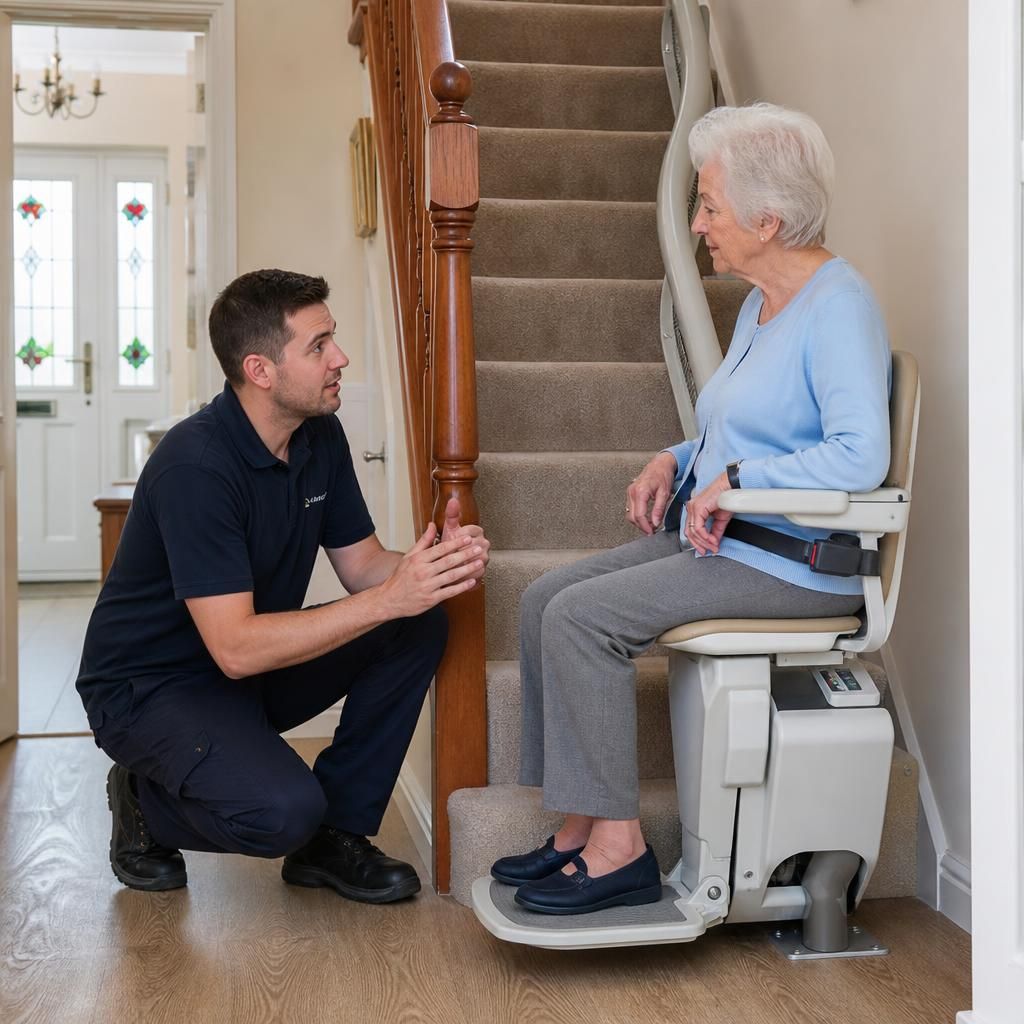
Arrange an assessment for your staircase
Arrange an assessment with Independent Stairlifts to check whether a compatible reconditioned stairlift can be installed safely on your staircase. We will review the layout, available space and your practical needs before recommending a suitable option.