
What should I consider when evaluating the condition of a used stairlift?
Evaluate a used stairlift by checking its overall condition, operation, safety features, batteries, charging system, track and installation history. A qualified stairlift assessment should also confirm that the model is suitable for your staircase and that replacement parts, servicing and warranty support are available.
When evaluating a used stairlift, look beyond its appearance and check its mechanical condition, safety systems, batteries, charging equipment, track, installation and service history. A stairlift that looks clean may still have worn components, while a properly reconditioned model should have been inspected, tested and prepared for safe use. The assessment should also confirm that the lift is suitable for your staircase and that parts and technical support remain available.
Start with a complete demonstration
Ask to see the stairlift operate through its full journey, rather than only moving a short distance. It should start and stop smoothly, travel at a consistent speed and avoid unusual vibration, hesitation, grinding or clicking noises. Test it from each charging position and, where appropriate, from both the top and bottom of the stairs.
- Check that the seat, footrest and armrests feel secure and do not move unexpectedly.
- Operate the controls and confirm that they respond promptly and consistently.
- Make sure the lift stops correctly at the upper and lower landing.
- Listen for changes in motor noise when the lift is carrying a user.
- Check that the stairlift does not move when the controls are released or when a safety system has been activated.
Inspect the seat and user-contact parts
Examine the seat covering, padding, armrests, footrest and seat swivel mechanism. Cosmetic wear is not necessarily a safety problem, but cracked plastic, loose fixings, damaged upholstery or a seat that does not lock firmly should be addressed before purchase. The seat should swivel and lock as intended, particularly at the top landing, so that the user can get on and off without twisting towards the stairs.
Check that the seat height and armrest arrangement are appropriate for the user. A stairlift can be mechanically sound but unsuitable if the user cannot sit comfortably, operate the controls or transfer safely at the landings.
Test every safety feature
Safety edges and sensors are designed to stop the stairlift if it encounters an obstruction. Ask for these to be demonstrated rather than assuming that they work. The seat belt should latch securely, adjust correctly and release without difficulty. Check the controls, key switch, isolation switch and any remote controls supplied with the lift.
Depending on the model, other features may include swivel-seat interlocks, folding-arm or footrest sensors, obstruction sensors and controls that prevent travel when the seat is not in the correct position. Do not try to defeat or bypass a safety device during testing. If a safety feature is not working, the stairlift should not be used until it has been inspected and repaired by a competent engineer.
Pay particular attention to the batteries and charger
Rechargeable batteries are among the components most likely to need replacement on a used stairlift. Ask how the batteries perform during a full demonstration and whether the lift remains reliable when travelling repeatedly. Warning lights, battery alarms, slow movement or failure to leave the charging point can indicate a battery, charger or electrical fault.
Inspect the charging points for damage, overheating or loose connections. Confirm that the stairlift charges at the intended parking positions and that the charger is the correct type for the model. Batteries may deteriorate even when a stairlift has had little use, so a statement that it was rarely operated does not, by itself, confirm that the batteries are in good condition.
Examine the rail, drive system and installation
The rail should be firmly fixed, correctly aligned and free from significant damage, corrosion or movement. Look for loose brackets, damaged covers, exposed wiring and signs that the rail or carriage has been modified. On a curved stairlift, the bends and joints require particular attention because the track is made to follow the staircase precisely.
Check the drive mechanism for excessive wear, oil or grease where it should not be present, and noises that suggest a problem with the motor, gearbox or drive components. The lift should not rock excessively on the rail. Installation quality matters as much as the condition of the stairlift itself: fixings must be secure, cables must be protected and the lift must not obstruct safe use of the stairs or nearby doors.
Confirm its age, model and repairability
Ask for the exact make, model and approximate installation date. These details help establish whether replacement batteries, remote controls, safety components and other parts are still available. An older model is not automatically unsuitable, but limited parts availability can make future repairs slower or more expensive.
Find out whether the stairlift is being sold as used, refurbished or reconditioned. These terms are not always used consistently. Ask what work has actually been completed, such as cleaning, electrical testing, battery replacement, replacement of worn drive parts, safety checks and a test installation. A reconditioned stairlift should have a documented preparation process rather than simply having been removed from another property and installed elsewhere.
Review service and installation records
Maintenance records can reveal how the stairlift has been used and whether recurring faults have been addressed. Ask for evidence of servicing, repairs, safety inspections and previous fault reports. If the lift has been removed from another home, confirm that it was dismantled and stored appropriately and that the installation will be assessed for the new staircase rather than treated as a simple transfer.
It is also important to establish who will install and test the stairlift. A competent installer should check the staircase, fixings, electrical supply, charging points and safety functions after installation. The final inspection should include a demonstration for the user and clear instructions on charging, controls and what to do if a fault occurs.
Look for these warning signs
- The seller will not allow a full operational demonstration.
- The stairlift stops unexpectedly, moves unevenly or makes persistent abnormal noises.
- There are battery warnings, unreliable charging or repeated fault codes.
- The rail, seat, footrest or fixings are loose, bent, cracked or visibly damaged.
- Safety edges, the seat belt or swivel mechanism cannot be tested.
- There is no clear model information, service history or explanation of previous repairs.
- Parts, servicing, installation support or warranty terms are unclear.
- The stairlift appears to have been altered without suitable technical documentation.
Arrange an expert condition assessment
A practical inspection by a qualified stairlift engineer is the most reliable way to assess a used model. The engineer can test the electrical and mechanical systems, identify wear that is not obvious during a short demonstration, check the installation and confirm whether the lift can be supported in the future. Ask for any faults or recommended work to be recorded in writing, including whether the price includes repairs, replacement batteries, installation and follow-up support.
Condition should be considered alongside suitability, warranty cover, maintenance costs and the availability of parts. A lower purchase price may not represent good value if the batteries need immediate replacement, the model is difficult to support or significant work is required after installation. A thorough assessment gives you a clearer basis for comparing a used stairlift with a reconditioned or new alternative.
A full operational demonstration is one of the most useful checks when evaluating a used stairlift. Ask the seller or installer to run it through the complete journey, checking that it starts and stops smoothly, travels at a steady speed and does not produce unusual grinding, clicking or vibration.
The demonstration should also include the safety functions and charging system. Check that the seat belt, swivel seat, footrest, controls and obstruction sensors work correctly, and confirm that the stairlift charges properly at its intended parking points. A short test can conceal problems with batteries, drive components or stopping mechanisms.
- Test the lift from each charging position where possible.
- Check that it stops when a safety edge encounters an obstruction.
- Listen for changes in motor noise during repeated journeys.
- Ask for any faults or recommended repairs to be recorded before purchase.
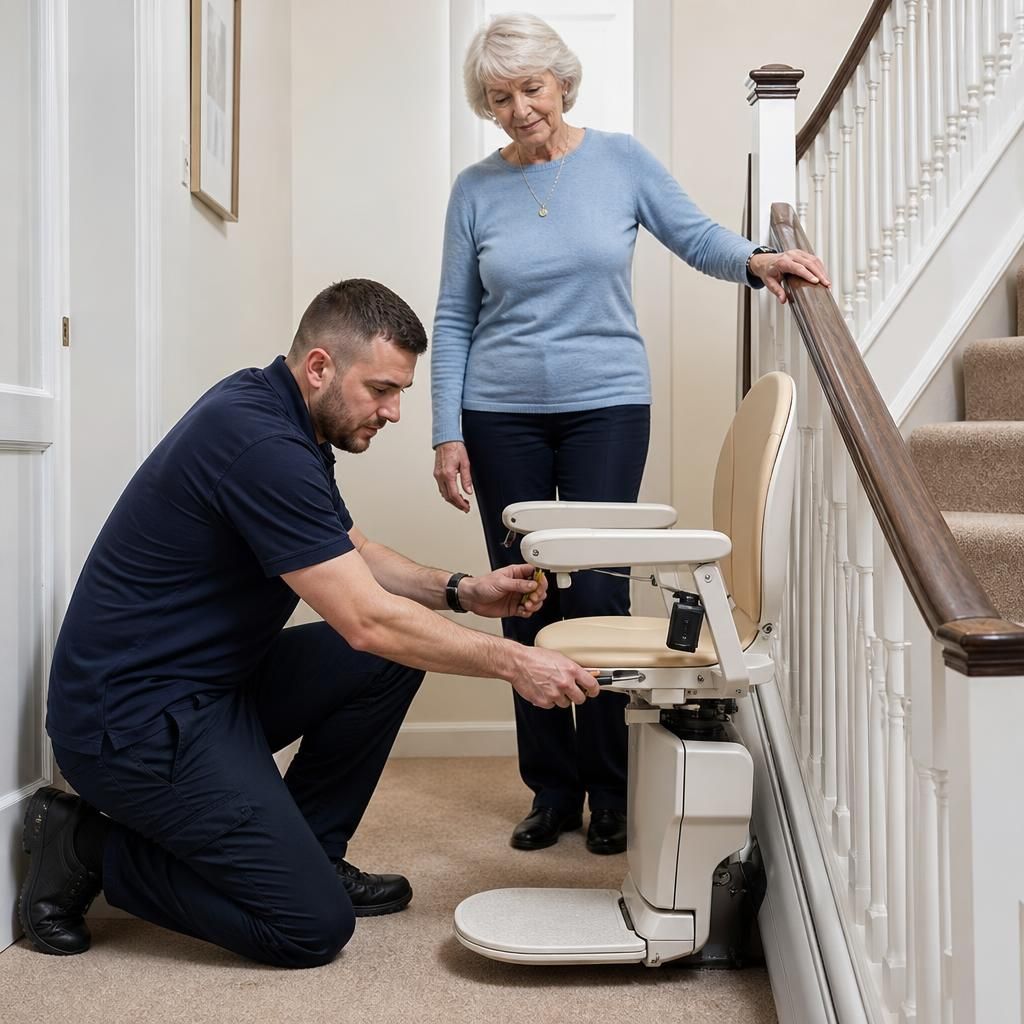
Arrange a used stairlift condition assessment
Arrange a used stairlift condition assessment with our team to check its operation, safety features, batteries, rail and installation. We can also confirm whether the model is suitable for your staircase and identify any repairs or replacement parts needed before purchase.